
Karbala
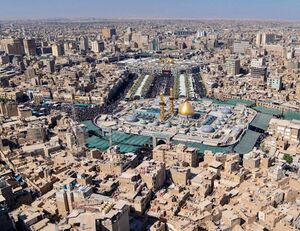 | |
| General Information | |
|---|---|
| Place | Iraq |
| Religious Aspect | |
| Religious Affiliation | Shai |
| History | |
| Events | The Wahhabi Invasion (1216 AH), The Wahhabi Invasion (1216 AH), The Attack of the Ba’ath Regime of Iraq (1412 AH / 1369 SH) |
Karbala is a city in Iraq, located beside the Euphrates River and 104 kilometers from Baghdad. As the capital of Karbala Province, the city has a hot and dry climate and a population of over 1.2 million people, most of whom are Shia and Arabic-speaking. Karbala was known before Islam by names such as “Kur Babel” (Temple of God), but its worldwide fame is due to the event of Ashura and the presence of the shrine of Imam Hussain(a) and the shrine of Hazrat Abbas(a). In addition to the holy shrines, the city has numerous pilgrimage sites such as the Tent Area (Khaymegah), the space between the two shrines (Bayn al-Haramayn), and the site of martyrdom (Qatl-gah), and during Arbaeen it hosts millions of pilgrims from around the world. Throughout history, Karbala has witnessed many ups and downs, including attacks by the Wahhabis, the Ottomans, and the Ba'ath regime of Iraq, yet it has always remained a symbol of resistance and love for the Ahl al-Bayt (AS).
Geography of Karbala
Karbala, the capital of Karbala Province, is located southwest of the Euphrates River and about 104 kilometers southwest of Baghdad, the capital of Iraq.The distance from Karbala to Najaf is 78 kilometers. [1] The city of Karbala is located at 44 degrees longitude and 33 degrees 31 minutes latitude.The area of Karbala is also approximately 52 square kilometers.[2]This city is located on a vast plain and has a hot and dry desert climate.The elevation of Karbala above sea level varies between 20 and 45 meters.The Euphrates River is the most important water source in the region.[3]. The city of Karbala is divided into two parts: the old section and the new section.[4]
Anthropology and Population
Most of the people of Karbala follow the Shia faith and primarily speak Arabic.With a population of over 1.2 million, this city is considered one of the most populous cities in Iraq. However, during occasions such as Arbaeen, Karbala hosts more than 20 million pilgrims who gradually enter the city and leave after visiting and making a relatively short stay.[5]
Name and Etymology
In religious narrations
According to some narrations, the land of Karbala has been known by this name since the time of Prophet Adam (AS).[6] And even before the creation of the Earth, it was known as "Karbala" in divine knowledge.[7]
Other Names
In the words of Imam Ali(a), it is known as Karb wa Bala.[8]. The names Ninawa, Ghadhriya, and Hayr (or Ha’ir) have also been used for this geographical area.[9]
Historical and Linguistic Perspectives
- Connection with Babylon:Some researchers have suggested that "Karbala" is derived from the term "Kur Babel"; during the Chaldean period (612–539 BCE), this area was also called "Kur Babel," meaning "Temple of God," because at that time, large temples and places of worship of Christians existed in this region.[10]
- Assyrian Origin: Another theory suggests that "Karbala" comes from the Assyrian words "Karb," meaning sanctuary, and "El," meaning God; therefore, Karbala would mean "Sanctuary of God."[11]
- Arabic Origin: Some have said that Karbala comes from "Karbala," meaning weakness or purity, because the land of this area was either soft or clean and free of stones and impurities.
Also, "Karbal" in Arabic refers to a particular type of grass, and it is possible that the name Karbala was given due to the abundance of this plant in that land.[12]
History of the City of Karbala
In the year 14 AH, the Karbala region was conquered by one of the commanders of Sa’d ibn Abi Waqqas.[13] In the year 36 AH, when Imam Ali(a) was heading toward the Battle of Siffin against Muawiya, he informed about the martyrdom of his son Hussain (AS) at this location and advised his son Hussain to be patient.[14]
The martyrdom of Imam Hussain(a) in the year 60 AH led to the burial of his body in Karbala.[15] And this city derives its fame from the presence of the shrine of Sayyid al-Shuhada (Imam Hussain, AS).[16]
Karbala flourished during the Abbasid Caliphate, but initially, its development was delayed due to opposition from some Abbasid caliphs. In the year 193 AH, Harun ordered the destruction of the sacred dome and the surrounding houses.[17] During his rule from 233 to 247 AH, Al-Mutawakkil, on four occasions including in 236 AH, ordered the destruction, plowing, and flooding of the grave of Imam Hussain (AS) and the demolition of the surrounding houses.[18] During the reign of Al-Muntasir Al-Abbasi (247–248 AH), the son of Al-Mutawakkil, the Shia inclination to settle in Karbala and develop it increased. Ibrahim Mujab, the grandson of the seventh Imam(a), is considered the first Alawi to settle in Karbala around the year 247 AH.After him, houses and markets emerged around his home and near the shrine of Aba Abdillah al-Hussain (a). When Adud al-Dawla Daylami of the Buyid dynasty visited Karbala in 370 AH, the population of Sayyids and Alawis in the city had reached 2,200 people.[19]
Some Historical Events
- Wahhabi Attack (1216 AH): On Eid al-Ghadir in the year 1216 AH, the Wahhabi army from Najd, numbering about 25,000, attacked Karbala.The city's governor at the time, Umar Agha, fled without resistance, leaving the city defenseless.
The Wahhabis, under the slogan "Kill the polytheists," massacred the people; in six hours, over five thousand were martyred.The shrine of Imam Hussain (AS) was destroyed, and the city's properties were looted.[20] Many scholars and seminary students of Karbala were also martyred in this tragedy.Sayyid Ali Tabatabai (author of Riyas) miraculously survived this attack.[21].
- The Najib Pasha Incident (1258 AH): Following a dispute between Iran and the Ottoman Empire and the rejection of Ottoman rule by the people of Karbala, Najib Pasha, the governor of Baghdad, attacked Karbala in 1258 AH.[22]
This attack resulted in the killing of approximately 10,000 people, including scholars and Sayyids, and became known as the "Incident of Ghadir al-Dam."[23]
- Attack by the Ba'ath Regime of Iraq (1412 AH / 1369 SH): During the Sha’baniyah Uprising in 1412 AH, Iraqi Ba'ath forces stormed the holy shrines of Najaf and Karbala.
In this assault, thousands of Iraqi citizens and pilgrims were killed or injured, and the shrine of Imam Hussain (AS) was damaged.The marks of bullets from this attack are still visible on the walls of the shrine.[24]
The Virtue of Karbala
In the narrations, the land of Karbala is compared in creation and virtue to the land of the Ka'ba.[25] And it has been described as a heavenly land.[26] In another set of narrations, the virtue of visiting Imam Hussain (AS) in Karbala is considered equal to or greater than performing the Hajj pilgrimage.[27]
The presence and supplications of the Divine Prophets, including Moses and Noah, have been reported on the land of Karbala.[28]
Visitation Days of Karbala
One of the most important days for visiting Karbala is the day of Arbaeen. In a narration from Imam Al-Askari(a), the Arbaeen pilgrimage is considered one of the five signs of a believer.[29] According to the Abbasid Shrine statistics, the number of pilgrims participating in the Arbaeen walk from 1395 to 1403 SH ranged between 11 and 22 million people.[30]
Pilgrimage Sites of Karbala
The Shrine and Zarih of Imam Hussain(a)
The tomb of Imam Hussain (AS) is a structure built over the burial site of the Imam.The two lower sides of the Zarih of Imam Hussain(a) are dedicated to Hazrat Ali Akbar and the martyrs of Banu Hashim.[31] A dome covered with gold has been built over the Zarih.[32]
Within the shrine complex, there are other places and sections:
- The Zarih of the Martyrs of Karbala: They are buried a few meters away from the foot of the Imam.
Their grave is inside a room with a silver window, above which the names of the martyrs are inscribed on a plaque.[33]
- The Zarih of Habib ibn Muzahir: Habib ibn Muzahir was one of the companions of Imam Ali (AS), Imam Hasan (AS), and Imam Hussain (AS).[34]
He was the standard-bearer on the left flank of the Imam's army.[35] His grave is now in a silver-colored Zarih in the southern corridor facing the Qibla.
- Qatligah: The Qatl-gah is the place where the head of Imam Hussain (AS) was severed from his body.
This site is located in a special chamber in the southern part of the courtyard (Golden Iwan).[36]
Other sections within the shrine include: Template:Cb
- The tomb of Ibrahim Mujab
- The Four Porticos
- Abd Minaret
- The Maqam of Maryam’s Palm Tree (Karbala)
- The gates of the Holy Shrine of Imam Hussain(a)
- The museum and library of the shrine.[37]

Other Pilgrimage Sites
There are numerous pilgrimage sites around the shrine of Imam Hussain (AS), which are as follows: Template:Column-start
- The Shrine of Hazrat Abbas (a)
- Khaymegah(Husseini Tent Area)
- Bayn al-Haramayn (the area between the two shrines)
- Tal Zainabiya
- The tomb of Hur ibn Yazid Riyahi
- The tomb of Awn ibn Abdullah
- The tomb of the Children of Muslim
- The tomb of Ibn Fahd Hilli
- The tomb of Sayyid Ahmad Abu Hashim, a descendant of Imam Kazim (a)
- The grave of Sayyid Abu Ahmad Mousavi, a descendant of Imam Kazim (a)
- Wadi Ayman Cemetery (Karbala)
- The tomb of Ibn Hamza, a descendant of Hazrat Abbas(a)
- The shrine of Noah ibn Darraj
- The tomb of Imamzada Ahmad ibn Musa(a)
- The tomb of Imamzada Akhrs ibn Musa(a)
- The tomb of Imamzada Ismail ibn Musa(a)
- The tomb of Imamzada Abdullah ibn Musa (Karbala)
- The tomb of Sayyid Ismail and Umm Kulthum
- The Maqam of Imam Ali (Karbala)
- The Maqam of the meeting between Imam Hussain(a) and Umar ibn Sa’ad
- The tomb of Muhammad ibn Nabi ibn Kazim(a).[38]
Historical Sites of Karbala
- Ukhaydir Castle: This castle and fortress is located in an area of the same name, 20 kilometers west of the city of Karbala.Inside the castle, there is a small mosque, and the surrounding walls are built in the form of towers.[39]
- Hendi Castle: This castle, located 4 kilometers from the city of Karbala, was built by Agha Mohammad Khan Qajar to secure Karbala, but it remained unfinished after his death.
Since the funding for its completion came from India and Asaf al-Dawla Hendi added rooms for accommodating pilgrims at the beginning of the 13th century AH, the castle became known as Hendi Castle.[40]
- Atshan Palace: Atshan Palace dates back to the Abbasid era and is located 30 kilometers southwest of Karbala, with some of its walls and arches still remaining today.[41]
- Maqam of Imam Zain al-Abidin(a): Abu Talib Khan, the famous traveler, in the early 13th century AH (1217 AH), referred to the Maqam of Imam Zain al-Abidin (AS) or the Khaymegah, on which Asaf al-Dawla's wife had constructed a building.
This Maqam was apparently next to the present-day Imam Hussain Hospital, and some consider it to be at the original site of the Khaymegah.[42]
Notes
- ↑ Qaʾidān,"ʿAtabāt ʿĀliyāt-i ʿIrāq",p. 95. ,,, Hamsafar, Rah-Tūsheh-yi Zāʾirān, p. 175.
- ↑ Hamsafar, Rah-Tūsheh-yi Zāʾirān, p. 175.
- ↑ Klīddār Āl Ṭuʿmah, "Baghīyat al-Nubalāʾ fī Tārīkh Karbalā" ,p. 95-115.
- ↑ Hamsafar, Rah-Tūsheh-yi Zāʾirān, p. 175.
- ↑ Āshenāʾī bā Tārīkh-i Tamaddon-i Islāmī",p. 146.
- ↑ Khalīlī, "Mawsūʿah al-ʿAtabāt al-Muqaddasa",vol. 8,p. 179.
- ↑ Ibn Qulawayhو" Kāmil al-Ziyārāt",p. 450/451.
- ↑ Shaykh Ṭūsī, " Amālī", p. 598.
- ↑ Khalīlī, "Mawsūʿah al-ʿAtabāt al-Muqaddasa",vol. 8,p. 179.
- ↑ Shamīm Yār. Vīzheh Zāʾirān-i ʿAtabāt ʿĀliyāt.,p. 29.
- ↑ Khalīlī, "Mawsūʿah al-ʿAtabāt al-Muqaddasa",vol. 8,p. 179.
- ↑ Yāqūt al-Ḥamawī,"Muʿjam al-Buldān",vol. 4,p. 445.
- ↑ Klīddār Āl Ṭuʿmah, "Baghīyat al-Nubalāʾ fī Tārīkh Karbalā" ,p.18/19.
- ↑ Ibn Qutaybah al-Dīnawarī, "Al-Akhbār al-Ṭiwāl", p. 252/253.
- ↑ Abū Mukhnaf , "Waqʿat al-Ṭuf ", p. 250-258.
- ↑ Bīnish., " Āshenāʾī bā Tārīkh-i Tamaddon-i Islāmī",p. 146.
- ↑ ʿKlīddār, "Tārīkh Karbalā wa Ḥāʾir Ḥusaynī ", p. 44.
- ↑ ʿKlīddār, "Tārīkh Karbalā wa Ḥāʾir Ḥusaynī ", p. 260-270.
- ↑ Klīddār Āl Ṭuʿmah, "Baghīyat al-Nubalāʾ fī Tārīkh Karbalā" ,p. 29/30.
- ↑ Ṭālebī al-Isfahānī ," Masīr Ṭālebī",vol. 3,p. 408/409.
- ↑ Khwānsārī, " Rawḍāt al-Jinān fī Aḥwāl al-ʿUlamāʾ wa al-Sādāt ",vol. 4,p. 405
- ↑ Ḥabīb Ābādī, "Makārim al-Āthār fī Aḥwāl Rijāl Dawr-i Qājār",vol. 5, p. 1582/1583.
- ↑ Khalīlī, "Mawsūʿah al-ʿAtabāt al-Muqaddasa",vol. 8,p. 126.
- ↑ Hasht Behesht: Vīzheh-Nāmah Zāʾirān-i Dāneshgāhī ʿAtabāt", p. 160.
- ↑ Ibn Qulawayhو" Kāmil al-Ziyārāt",p. 449/450, ʿUddah min al-Muḥaddithīn al-Qarn al-Thānī. Al-Uṣūl al-Sittah ʿAshar", p. 16.
- ↑ Ibn Qulawayhو" Kāmil al-Ziyārāt",p. 451,ʿUddah min al-Muḥaddithīn al-Qarn al-Thānī. Al-Uṣūl al-Sittah ʿAshar" ,p. 17.
- ↑ Ibn Qulawayh," Kāmil al-Ziyārāt",p. 449.
- ↑ Ibn Qulawayhو" Kāmil al-Ziyārāt",p. 452-455.
- ↑ Shaykh Ṭūsī, "Tahdhīb al-Aḥkām", vol. 6, p. 52.
- ↑ https://alkafeel.net/news/index?id=27092&lang=en
- ↑ Shamīm Yār. Vīzheh Zāʾirān-i ʿAtabāt ʿĀliyāt.,p. 33/34.
- ↑ Khalīlī, "Mawsūʿah al-ʿAtabāt al-Muqaddasa",vol. 8,p. 181.
- ↑ Shamīm Yār. Vīzheh Zāʾirān-i ʿAtabāt ʿĀliyāt.,p. 33.
- ↑ Tafreshī, "Naqd al-Rijāl",vol. 1,p. 339.
- ↑ al-Ṭabarī , "Tārīkh al-Ṭabarī" ,vol. 5,p. 422.
- ↑ Hasht Behesht: Vīzheh-Nāmah Zāʾirān-i Dāneshgāhī ʿAtabāt", p. 161; Shamīm Yār. Vīzheh Zāʾirān-i ʿAtabāt ʿĀliyāt.,p. 33.
- ↑ Amīn ʿĀmilī, "Aʿyān al-Shīʿah",vol. 2, p. 224/230; Ḥabīb Ābādī, "Makārim al-Āthār fī Aḥwāl Rijāl Dawr-i Qājār",vol. 2, p. 610; Āl Ṭuʿmah., "Al-Mawāqiʿ al-Athariyya wa al-Siyāḥiyya fī Karbalā", p. 60-64; Shaykh Ṭūsī, "Tahdhīb al-Aḥkām", vol. 6, p. 73; Ḥurr ʿĀmilī, " Wasāʾil al-Shīʿah",vol. 14, p. 517; ʿAzd al-Mulk , "Safarnāmah ʿAzd al-Mulk ilā al-ʿAtabāt", p. 161.
- ↑ Zamānī , "Sīrī dar Sarzamīn-i Khāṭirah-hā (Safarnāmah Karbalā)" ,p. 116; Qaʾidān,"ʿAtabāt ʿĀliyāt-i ʿIrāq",p. 135; Hasht Behesht: Vīzheh-Nāmah Zāʾirān-i Dāneshgāhī ʿAtabāt", p. 165/166; Farhang-i Ziyārat. Quarterly Journal, Markaz-i Taḥqīqāt-i Ḥajj, vol. 4, p. 107.
- ↑ Qaʾidān,"ʿAtabāt ʿĀliyāt-i ʿIrāq",p. 157.
- ↑ Qaʾidān,"ʿAtabāt ʿĀliyāt-i ʿIrāq",p. 157. ,,, Āl Ṭuʿmah., "Al-Mawāqiʿ al-Athariyya wa al-Siyāḥiyya fī Karbalā", p. 29-31.
- ↑ Qaʾidān,"ʿAtabāt ʿĀliyāt-i ʿIrāq",p. 157.
- ↑ Qaʾidān,"ʿAtabāt ʿĀliyāt-i ʿIrāq",p. 158.
References
- Ibn Qutaybah al-Dīnawarī. Al-Akhbār al-Ṭiwāl. Edited by ʿAbd al-Munʿim ʿĀmir. Cairo: Dār al-Kutub al-ʿArabiyya, 1960 CE.
- ʿUddah min al-Muḥaddithīn al-Qarn al-Thānī. Al-Uṣūl al-Sittah ʿAshar. Qom: Dār al-Shubastrī, 1405 AH.
- Amīn ʿĀmilī, Sayyid Muḥsin. Aʿyān al-Shīʿah. Edited by Ḥasan Amīn. Beirut: Dār al-Taʿāruf, 1403 AH.
- ʿAbd al-Ḥusayn Bīnish. Āshenāʾī bā Tārīkh-i Tamaddon-i Islāmī. Tehran: Edārah-yi ʿAqdīyat-i Sīyāsī-yi Sepāh, 1387 SH.
- Shaykh Ṭūsī. Amālī (Persian). Tehran: Ketābchī, 1376 SH.
- ʿAbd al-Ḥusayn Klīddār Āl Ṭuʿmah. Baghīyat al-Nubalāʾ fī Tārīkh Karbalā. Edited by ʿĀdel Klīddār Āl Ṭuʿmah. Karbala: Markaz al-Dirāsāt wa al-Buḥūth, 1435 AH.
- Muḥammad b. Jarīr al-Ṭabarī. Tārīkh al-Ṭabarī. Edited by Muḥammad Abū al-Faḍl Ibrāhīm. Beirut: Dār al-Turāth, 1967.
- ʿAbd al-Jawwād Klīddār. Tārīkh Karbalā wa Ḥāʾir Ḥusaynī. Edited by Muslim Ṣāḥibī. Tehran: Nashr Mashʿar, 1389 SH.
- Abū ʿAlī al-Masʿkūwī al-Rāzī. Tajārib al-Umam. Edited by Abū al-Qāsim Imāmī. Tehran: Soroush, 1379 SH.
- Shaykh Ṭūsī. Tahdhīb al-Aḥkām. Edited by Sayyid Ḥasan Mūsawī Khursān. Tehran: Dār al-Kutub al-Islāmiyya, 1365 SH.
- Abū Ṭāleb Ṭālebī al-Isfahānī. Masīr Ṭālebī. Edited by Khodīyu Jam. Tehran: Sherkat Intishārāt ʿIlmī Farhangī, 1383 SH.
- Yāqūt al-Ḥamawī. Muʿjam al-Buldān. Beirut: Dār Ṣādir, 1995 CE.
- Ibn Qulawayh Jaʿfar b. Muḥammad. Kāmil al-Ziyārāt. Edited by Jawād Qayūmī. Qom: Muʾassasah Nashr al-Fiqhah, 1417 AH.
- Jaʿfar Khalīlī. Mawsūʿah al-ʿAtabāt al-Muqaddasa. Beirut: Muʾassasah al-Aʿlamī, 1407 AH.
- Aḥmad Zamānī. Sīrī dar Sarzamīn-i Khāṭirah-hā (Safarnāmah Karbalā). Tehran: Mashʿar, 1388 SH.
- Shamīm Yār. Vīzheh Zāʾirān-i ʿAtabāt ʿĀliyāt. Office of Cultural Affairs, Hawzah Representation of the Supreme Leader in Hajj and Pilgrimage.
- Qaʾidān, Aṣghar. ʿAtabāt ʿĀliyāt-i ʿIrāq. Tehran: Mashʿar, 1383 SH.
- Ibn Baṭūṭah, Muḥammad b. ʿAbdallāh. Safarnāmah Ibn Baṭūṭah. Translated by Muḥammad ʿAlī Mowḥadd. Tehran: Nashr Āgeh, 1376 SH.
- ʿAzd al-Mulk ʿAlīrzā b. Mūsā Īlkhānī. Safarnāmah ʿAzd al-Mulk ilā al-ʿAtabāt. Edited by Ḥasan Mursalūnah. Tehran: Muʾassasah Pazhūhish wa Mutālaʿāt Farhangī, 1370 SH.
- Khwānsārī, Muḥammad Bāqir b. Zayn al-ʿĀbidīn. Rawḍāt al-Jinān fī Aḥwāl al-ʿUlamāʾ wa al-Sādāt. Edited by Asad Allāh Ismāʿīlīān. Qom: Nashr Dahāqānī (Ismāʿīlīān), 1390 AH.
- Ḥabīb Ābādī, Muḥammad ʿAlī. Makārim al-Āthār fī Aḥwāl Rijāl Dawr-i Qājār. Isfahan: Nashr Kamāl, 1362 SH.
- Salmān Hādī Āl Ṭuʿmah. Al-Mawāqiʿ al-Athariyya wa al-Siyāḥiyya fī Karbalā. Tehran: Nashr Mashhar, 1389 SH.
- Mūsawī Ḥusaynī, ʿAbbās b. ʿAlī. Nuzhat al-Jalīs wa Munyat al-Adīb al-Anīs. Edited by Muḥammad Mahdī Khursān. Qom: Al-Maktabah al-Ḥaydariyya, 1375 SH.
- Tafreshī. Naqd al-Rijāl. Qom: Muʾassasah Āl al-Bayt, 1418 AH.
- Farhang-i Ziyārat. Quarterly Journal, Markaz-i Taḥqīqāt-i Ḥajj, Tehran: Nashr Mashʿar, 1388 SH.
- Hamsafar, Rah-Tūsheh-yi Zāʾirān. Tehran: Nashr Mashʿar, 1394 SH.
- Hasht Behesht: Vīzheh-Nāmah Zāʾirān-i Dāneshgāhī ʿAtabāt. By Muḥammad Ḥusayn-Pūr Āmīnī.
- Abū Mukhnaf Lūt b. Yaḥyā. Waqʿat al-Ṭuf. Edited by Muḥammad Hādī Yūsufī Gharawī. Qom: Muʾassasah Nashr Islāmī, 1417 AH.
- Ḥurr ʿĀmilī. Wasāʾil al-Shīʿah. Qom: Muʾassasah Āl al-Bayt, 1414 AH.