
Abu Bakr Mosque (Medina)
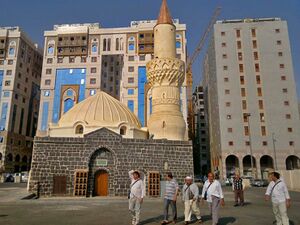 | |
| General Information | |
|---|---|
| Place | Manakha, west of al-Masjid al-Nabawi in Medina. |
| Usage | Mosque |
| History | |
| Reconstructors | Malik fahad, Sultan Mahmud Uthmani the second |
Abu Bakr Mosque (Medina) is one of the musalla mosques located in the Manakhah area of Medina, west of al-Masjid al-Nabawī. Muṣallā mosques were built in open spaces where the Prophet (s) performed Eid prayers. It is said that the Prophet (s) performed the funeral prayer for al-Najashi in this place. Abu Bakr performed Eid prayers here during his caliphate after the Prophet (s).
Location of the Mosque
The Abu Bakr Mosque is one of the mosques in the Manakha area of Medina and close to Masjid al-Nabawi.[1] Manakha was an open area that served as Medina's market.[2] Some researchers believe that this mosque was built on the site of Kathir b. al-Salt's house, where, according to narrations, the Prophet (s) once performed Eid prayers.[3]
The Abu Bakr Mosque is the second of the three mosques (Ghamamah Mosque, Imam Ali Mosque (a), and Abu Bakr Mosque) located in the Musalla al-Aʿyad square (the place for Eid prayers).[4] The distance from Abu Bakr Mosque to Masjid al-Nabi is 335 meters.[5] This mosque was formerly located in a wide alley. Currently, after the removal of the surrounding buildings, it overlooks the courtyard of al-Masjid al-Nabawi.[6]
Older sources mention the existence of this mosque in the middle of a garden called ʿAyn al-Arzaq.[7] It is also said that this mosque was located near the house of Muḥammad b. ʿAbd Allah b. Kathir b. al-salt.[8]
Prophet's Prayer
It is narrated in sources that when the Prophet(s) learned of the death of Najashi, the ruler of Abyssinia, he informed the people and, along with his companions, performed the funeral prayer for al-Najashi in this place.[9] It is said that Abu Bakr, after the Prophet (s), performed Eid prayers in this place during his caliphate, and for this reason, this place was named Abu Bakr Mosque.[10]
History of the Building
Some believe that mosques were first built in the places where the Prophet (s) prayed in this area during the time of Umar b. Abd al-Aziz (governor of Medina in 87-93 AH).[11][12]
The mosque was destroyed during the time of al-Samhudi (d. 911 AH), the historian of Medina. According to al-Samhūdī, this mosque was located in the middle of a garden near a spring, and the local residents would lead their livestock through the mosque's area. Al-Samhudi stated that livestock entered through the northern door of the mosque, and over time, the residents kept their livestock there, turning it into a dump. Al-Samhudi requested the Shaykh al-Haram, Ashraf Inal, to address the situation of this mosque, and he assigned the jurist Shihab al-Din Ahmad al-Nusi to this task.[13] Consequently, a wall was placed on the northern side of the mihrab, which was roofed, to prevent the entry of livestock. A path was also allocated on the northern side for the passage of livestock.[14] There is no report on subsequent constructions of the mosque.
Current Building
The current building of the mosque dates back to the time of Sultan Mahmud of the Ottoman Empire, who built it in 1254 AH/1838 CE.[15] An embossed inscription above its entrance reads: "This is the mosque of our master Abu Bakr." Above this line, there is also the signature of Sultan Mahmud within a circle, along with the date 1254 Hijri/1838 CE.[16]
According to the sign next to the mosque's entrance, this mosque was renovated in 1411 AH during the reign of King Fahd b. Abd al-Aziz.[17] Other repairs and renovations were carried out in this mosque from 1429 to 1430 (2007-2008).[18]
Features of the Mosque Building
The Abu Bakr Mosque in Medina consists of two sections: the western part, which is roofed with a dome, and its entrance is on the eastern side. A minaret is located in its northeastern corner. The eastern part of the mosque is open. The length of the mosque reaches 19.5 meters. Its width is 15 meters. Its area is 292.5 square meters.[19] The walls are high and made of stone. The entrance is in the eastern wall, and two columns are placed on either side of the entrance. The mosque's entrance is square, measuring ten meters, with a dome over it.[20]
Notes
- ↑ Masājid al-Atharīyah, p. 223.
- ↑ Maʿālim al-Madīnah al-Munawwarah bayn al-ʿImārah wa l-Tārīkh, part 4, p. 402
- ↑ Maʿālim al-Madīnah al-Munawwarah bayn al-ʿImārah wa l-Tārīkh, part 4, volume 1, pp. 403-404
- ↑ Masājid al-Atharīyah, p. 223.
- ↑ Maʿālim al-Madīnah al-Munawwarah bayn al-ʿImarah wa l-Tārīkh, part 4, volume 1
- ↑ Masājid al-Atharīyah, p. 237
- ↑ al-Taʿrīf, p. 146; al-Maʿālim, p. 406.
- ↑ al-Maʿālim, p. 403.
- ↑ Maʿālim al-Madīnah, p. 402.
- ↑ al-Taʿrīf, p. 146; al-Taʿrīf, p. 147.
- ↑ Wafāʾ al-Wafāʾ, vol. 3, p. 122
- ↑ al-Madīnah al-Munawwarah, p. 145
- ↑ Wafāʾ al-Wafāʾ, vol. 3, p. 122
- ↑ Wafāʾ al-Wafāʾ, vol. 3, p. 123
- ↑ al-Madīnah al-Munawwarah, p. 147
- ↑ Masājid al-Atharīyah, p. 239
- ↑ Masājid al-Atharīyah, p. 239
- ↑ Maʿālim al-Madīnah al-Munawwarah bayn al-ʿImārah wa l-Tārīkh, part 4, volume 1, p. 409
- ↑ Masājid al-Atharīyah, p. 237
- ↑ al-Madīnah al-Munawwarah, p. 146
References
- Āthār-i Islāmī-yi Makkah wa Madīnah: Rasūl Jaʿfarīyān, Tehran, Nashr-i Mashʿar, 1390 Sh.
- al-Taʿrīf bi-mā Ansat al-Hijrah min Maʿālim Dār al-Hijrah, Jamāl al-Dīn Muḥammad b. Aḥmad Maṭarī, Dirāsah wa al-Taḥqīq, A.D. Sulaymān al-Ruḥaylī, al-Riyāḍ, 1426 AH.
- al-Masājid al-Atharīyah fī al-Madīnah al-Nabawīyah, Muḥammad Ilyās ʿAbd al-Ghanī, al-Madīnah al-Munawwarah, Fahrasat Maktabat al-Malik Fahd al-Waṭanīyah Athnāʾ al-Nashr, al-Ṭabʿah al-Thāniyah, 1419 AH/1999 CE.
- al-Maʿālim al-Madīnah al-Munawwarah bayn al-ʿImārah wa l-Tārīkh, ʿAbd al-ʿAzīz ʿAbd al-Raḥmān Ibrāhīm Kaʿkī, volume one, Beirut, Muʾassasat al-Tārīkh al-ʿArabī li-l-Ṭibāʿah wa l-Nashr wa l-Tijārah, al-Ṭabʿah al-Ūlá 1432 AH/2011 CE.
- Wafāʾ al-Wafāʾ bi-Akhbār Dār al-Muṣṭafá, ʿAlī b. ʿAbd Allāh al-Samhūdī, Taḥqīq wa Taqdīm al-Duktūr Qāsim al-Sāmarrāʾī, al-Juzʾ al-Thālith, Muʾassasat al-Furqān li-l-Turāth al-Islāmīyah, al-Ṭabʿah al-Ūlá 1422 AH/2004 CE.