
User:Pourghorbani: Difference between revisions
Pourghorbani (talk | contribs) No edit summary |
Pourghorbani (talk | contribs) No edit summary |
||
| Line 52: | Line 52: | ||
| map description = | | map description = | ||
}} | }} | ||
'''Masjid al-Ghamama''' also known as the Musalla Mosque, is a mosque located west of the [[Prophet's Mosque]] in the city of [[Medina]]. Along with two other mosques (the [[Imam Ali Mosque (Manakha)]] and the [[Abu Bakr Mosque (Manakha)]], collectively referred to as the [[mosques of musalla]], Masjid al-Ghamama was built in an open area known as [[Manakha]], where the Prophet performed Eid al-Adha and Eid al-Fitr prayers. | '''Masjid al-Ghamama''' also known as the Musalla Mosque, is a mosque located west of the [[Prophet's Mosque]] in the city of [[Medina]]. Along with two other mosques (the [[Imam Ali Mosque (Manakha)]] and the [[Abu Bakr Mosque (Manakha)]], collectively referred to as the [[mosques of musalla]], Masjid al-Ghamama was built in an open area known as [[Al-Manakha]], where the Prophet performed Eid al-Adha and Eid al-Fitr prayers. | ||
The current structure of Masjid al-Ghamama dates back to the time of Sultan Abdulmejid I of the Ottoman Empire (r. 1255–1277 AH / 1839–1861 CE) and has only been restored since then. | The current structure of Masjid al-Ghamama dates back to the time of Sultan Abdulmejid I of the Ottoman Empire (r. 1255–1277 AH / 1839–1861 CE) and has only been restored since then. | ||
| Line 59: | Line 59: | ||
Masjid al-Ghamama, or the Musalla Mosque, is located southwest of the [[Prophet's Mosque]] in an area known as the Musalla Square. This area, called [[Al-Manakha]], was a desert where the Medina market was also held. The Prophet used this open space for Eid prayers (Eid al-Adha and Eid al-Fitr) and the prayer for rain (Istisqa).<ref>[https://wikihaj.com/index.php?title=File:Wafa_al-Wafa_Samhudi_Vol3.pdf&page=122 Wafāʾ al-Wafāʾ, vol. 3, p. 122]; [https://wikihaj.com/index.php?title=File:Masajid_al-Athariya.pdf&page=223 Masājid al-Athariya, p. 223]</ref> | Masjid al-Ghamama, or the Musalla Mosque, is located southwest of the [[Prophet's Mosque]] in an area known as the Musalla Square. This area, called [[Al-Manakha]], was a desert where the Medina market was also held. The Prophet used this open space for Eid prayers (Eid al-Adha and Eid al-Fitr) and the prayer for rain (Istisqa).<ref>[https://wikihaj.com/index.php?title=File:Wafa_al-Wafa_Samhudi_Vol3.pdf&page=122 Wafāʾ al-Wafāʾ, vol. 3, p. 122]; [https://wikihaj.com/index.php?title=File:Masajid_al-Athariya.pdf&page=223 Masājid al-Athariya, p. 223]</ref> | ||
[[Prophet Muhammad ( | [[Prophet Muhammad(s)]] performed Eid prayers in various locations within Manakha. Later, mosques were built on some of these sites, collectively known as the **Prayer Ground Mosques**. The other two mosques are the [[Imam Ali Mosque (Manakha)]] and the [[Abu Bakr Mosque (Manakha)|Abu Bakr Mosque]].<ref>[https://wikihaj.com/index.php?title=File:Masajid_al-Athariya.pdf&page=223 Masājid al-Athariya, p. 223]</ref> | ||
==Naming== | ==Naming== | ||
Revision as of 14:37, 18 March 2025
 | |
| General Information | |
|---|---|
| Place | Manakha district, west of the Prophet's Mosque in Medina |
| Usage | mosque |
| Religious Aspect | |
| Religious Affiliation | Islam |
| History | |
| Historical Features | The place of Eid prayers by the Prophet |
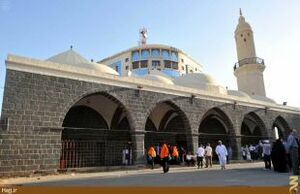
Masjid al-Ghamama also known as the Musalla Mosque, is a mosque located west of the Prophet's Mosque in the city of Medina. Along with two other mosques (the Imam Ali Mosque (Manakha) and the Abu Bakr Mosque (Manakha), collectively referred to as the mosques of musalla, Masjid al-Ghamama was built in an open area known as Al-Manakha, where the Prophet performed Eid al-Adha and Eid al-Fitr prayers.
The current structure of Masjid al-Ghamama dates back to the time of Sultan Abdulmejid I of the Ottoman Empire (r. 1255–1277 AH / 1839–1861 CE) and has only been restored since then.
Location
Masjid al-Ghamama, or the Musalla Mosque, is located southwest of the Prophet's Mosque in an area known as the Musalla Square. This area, called Al-Manakha, was a desert where the Medina market was also held. The Prophet used this open space for Eid prayers (Eid al-Adha and Eid al-Fitr) and the prayer for rain (Istisqa).[1]
Prophet Muhammad(s) performed Eid prayers in various locations within Manakha. Later, mosques were built on some of these sites, collectively known as the **Prayer Ground Mosques**. The other two mosques are the Imam Ali Mosque (Manakha) and the Abu Bakr Mosque.[2]
Naming
The name **Ghamama** means "cloud." It is said that once, while the Prophet was performing the prayer for rain (Istisqa), a cloud shaded him, and then rain fell.[3]
Masjid al-Ghamama is also called the Musalla Mosque because it is believed to be the site where the Prophet performed Eid prayers in the final years of his life.[4]
History
The site of Masjid al-Ghamama was the last prayer ground used by the Prophet. It was the final place where he performed Eid prayers, and after his passing, Eid and rain prayers continued to be held there. During the time of Ibn Zabala (d. 200 AH) and Ibn Shabba (d. 262 AH), historians of Medina, this site was recognized as the prayer ground.[5]
It is said that this site was near the house of Kathir ibn Salt, a companion of the Prophet, and located to its south.[6]

9th Century and Beyond
Masjid al-Ghamama is mentioned in the reports of Medina historians from the 8th century.[7] According to Samhudi (d. 911 AH), it was likely first built during the time of Umar ibn Abd al-Aziz.[8] Samhudi reports that the mosque existed during his time, though it was in a state of disrepair. An inscription on the mosque's door stated that it was reconstructed by the order of Izz al-Din, the Sheikh of the Haram in Mecca (d. 761 AH).[9] The mosque was reconstructed in 861 AH by Amir Bardbak, who was an architect.[10]
It is said that Al-Ayyashi mentioned this mosque in his travelogue in 1073 AH, referring to it as the **Musalla al-Eid Mosque**.[11]
Ottoman Era Reconstruction
Masjid al-Ghamama was reconstructed during the reign of Sultan Abdulmejid I of the Ottoman Empire (r. 1255–1277 AH / 1839–1861 CE), and the same structure remains to this day.[12] During the reign of Sultan Abdul Hamid II (1293–1327 AH / 1876–1909 CE), further renovations were carried out.[13] In the Saudi era, the mosque was restored based on the same structure, with an inscription dating the restoration to 1411 AH during the reign of King Fahd.[14]
Description of the Mosque
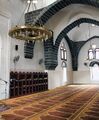
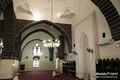
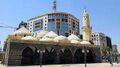
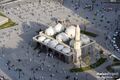
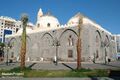
Masjid al-Ghamama is 26 meters long, approximately 13 meters wide, and covers a total area of 338 square meters. The mosque has six circular domes, the largest of which is above the mihrab. Salih Lam'i Mustafa, in his book Al-Madīna al-Munawwara: Tatawwuruhā al-ʿUmrānī, provides a detailed description and analysis of the mosque's architecture.[15]
The Minbar of the Musalla Mosque
In recent times, the mosque housed a minbar with nine steps, bearing an inscription from Sultan Suleiman the Magnificent. It is said that this minbar was likely a gift from him to the Prophet's Mosque, transferred to the Musalla Mosque in 998 AH / 1590 CE.[16] Some authors, including Abd al-Aziz Ka'ki in his book **Maʿālim al-Madīna al-Munawwara bayn al-ʿImāra wa al-Tārīkh**, published in 2011, have published images of the minbar.[17] However, the minbar is not visible in recent images of Masjid al-Ghamama.Template:Citation needed
Gallery
-
-
-
-
-
-
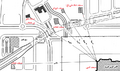 The image above shows the distance between the Prayer Ground Mosques and one of the corners of the current Prophet's Mosque building.


Related Topics
Notes
- ↑ Wafāʾ al-Wafāʾ, vol. 3, p. 122; Masājid al-Athariya, p. 223
- ↑ Masājid al-Athariya, p. 223
- ↑ Madīna Shināsī, vol. 1, p. 153
- ↑ Wafāʾ al-Wafāʾ, vol. 3, p. 117
- ↑ Wafāʾ al-Wafāʾ, vol. 3, p. 115
- ↑ Wafāʾ al-Wafāʾ, vol. 3, p. 118
- ↑ bi-mā Anasat al-Hijra.pdf&page=146 Al-Taʿrīf bi-mā Anasat al-Hijra, p. 146
- ↑ Wafāʾ al-Wafāʾ, vol. 3, p. 122
- ↑ Wafāʾ al-Wafāʾ, vol. 3, p. 123
- ↑ Wafāʾ al-Wafāʾ, vol. 3, p. 146
- ↑ Al-Masājid al-Athariya, p. 235
- ↑ Maʿālim al-Madīna bayn al-ʿImāra wa al-Tārīkh, Juzʾ 4, Mujallad 1, p. 348
- ↑ Masājid al-Athariya, p. 232
- ↑ Masājid al-Athariya, p. 234
- ↑ See: Al-Madīna al-Munawwara: Tatawwuruhā al-ʿUmrānī, pp. 138–145.
- ↑ Al-Madīna al-Munawwara: Tatawwuruhā al-ʿUmrānī, p. 142; Maʿālim al-Madīna al-Munawwara bayn al-ʿImāra wa al-Tārīkh, Juzʾ 4, Mujallad 1, p. 366
- ↑ Maʿālim al-Madīna al-Munawwara, Juzʾ 4, Mujallad 1, p. 364
References
- Al-Taʿrīf bi-mā Anasat al-Hijra, Muḥammad ibn Aḥmad al-Muṭarrī (d. 741 AH). Edited by Sulaymān al-Rāḥilī. Riyadh: Dārat al-Malik ʿAbd al-ʿAzīz, 1426 AH.
- Al-Madīna al-Munawwara: Tatawwuruhā al-ʿUmrānī wa Turāthuhā al-Miʿmārī, Ṣāliḥ Lamʿī Muṣṭafā. Beirut: Dār al-Nahḍa al-ʿArabiyya, 1981 CE.
- Al-Masājid al-Athariya fī al-Madīna al-Munawwara, Muḥammad Ilyās ʿAbd al-Ghanī. Medina: Self-published, 1998 CE.
- Al-Masājid al-Athariya fī al-Madīna al-Munawwara, Muḥammad Ilyās ʿAbd al-Ghanī. Medina: Self-published, 2000 CE.
- Tārīkh al-Madīna al-Munawwara, Abū Zayd ʿUmar ibn Shabba. Qom: Dār al-Fikr, 1368 SH.
- Maʿālim al-Madīna al-Munawwara bayn al-ʿImāra wa al-Tārīkh, Part 4, ʿAbd al-ʿAzīz Kaʿkī. Beirut: 2011 CE.
- Wafāʾ al-Wafāʾ bi-Akhbār Dār al-Muṣṭafā, Nūr al-Dīn ʿAlī al-Samhūdī. Beirut: Dār Iḥyāʾ al-Turāth al-ʿArabī, 1995 CE.