
Mosque of Fatima al-Zahra
 | |
| General Information | |
|---|---|
| Other Names | Mosque of Sa'd b. Mu'adh |
| Place | Saudi Arabia, Medina, beside the Mosque of 'Ali at the Trench and on the slopes of Mount Sela' |
| Usage | Mosque |
| Religious Aspect | |
| Religious Affiliation | Islam |
| History | |
| Events |
|
| Current State | |
| Length | 7 m |
| Width | 3 m |
| Status | Existing |
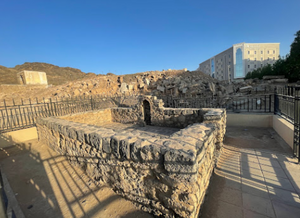
The Mosque of Fatima al-Zahra (Arabic: مسجد فاطمة الزهراء) is one of the historic mosques of Medina, built after the 14th/20th century in the southernmost area of the al-Fath Mosques, located near the western side of the Mosque of 'Ali. This site is reported to have served as one of the command positions of the Prophet Muhammad (s) during the Battle of the Trench, as well as a place of prayer for him and his Companions. The mosque consists of a roofless rectangular structure with walls about one meter high, enclosed by an iron fence. Another name attributed to this mosque is the "Mosque of Sa'd b. Mu'adh".

Location
The Mosque of Fatima al-Zahra is situated in the southernmost part of the al-Fath Mosques, to the west of the Mosque of 'Ali (a). It lies within the old quarter of Medina, on an elevated area of Mount Sela'.[1]
Names
According to a 1947 report, the name of Sa'd b. Mu'adh was applied to the Mosque of Fatima al-Zahra.[1] It has been noted, however, that neither of these names appear in early sources.[2]
Architectural History
None of the historical sources prior to the 14th/20th century mention the existence of a mosque named after Fatima al-Zahra or Sa'd b. Mu'adh in this area.[3] For example, 'Ali b. Musa, in his 1303/1885 travelogue, made no reference to this mosque.[4] It is only in newer maps of Medina (dated 1325/1947) that a mosque under the name of Sa'd b. Mu'adh is recorded.[5]
Modern Renovations
In 1399/1979, the Saudi authorities undertook repairs on the mosque.[6] By 1418/1997-98, the mosque was a rectangular plot measuring 21 m², roofless, with walls about two meters high. Its length exceeded six meters and its width exceeded three meters.[7] In 1419/1998-99, the entrance was sealed with concrete blocks, and worshippers prayed outside the mosque.[2]
Present Structure
According to aerial maps[8] and user-contributed images,[9] by 1442/2021 the mosque had become a roofless rectangular structure with low stone walls, today enclosed by a metal fence.
Gallery


Notes
- ↑ 1.0 1.1 Maʿālim al-Madīnah al-Munawwarah bayna al-ʿimārah wa-l-tārīkh, vol. 4, p.180.
- ↑ 2.0 2.1 Āthār Islāmī Makkah wa-Madīnah, Jaʿfarīyān, p.303.
- ↑ Al-Masājid al-Atharīyya, ʿAbd al-Ghanī, p.149.
- ↑ Waṣf al-Madīnah al-Munawwarah, p.17.
- ↑ al-Madīnah al-Munawwarah: Tatawwuruhā al-ʿImrānī, p.198 / Al-Al-Masājid al-Atharīyya, ʿAbd al-Ghanī, p.149.
- ↑ Maʿālim al-Madīnah al-Munawwarah bayna al-ʿimārah wa-l-tārīkh, vol.4, p.183.
- ↑ Al-Masājid al-Atharīyya, ʿAbd al-Ghanī, p.150.
- ↑ Google Maps, map
- ↑ photos
References
- Maʿālim al-Madīna al-Munawwara bayn al-ʿimārah wa-l-tārīkh, ʿAbd al-ʿAzīz b. ʿAbd al-Raḥmān al-Kaʿkī, Beirut: 2011.
- Āthār-i Islāmī-yi Makka wa Madīna, Rasul Jaʿfarīyān, Tehran: Nashr Mashʿar, 1390Sh.
- Al-Masājid al-atharīyya, Muḥammad Ilyās ʿAbd al-Ghanī, Medina: Maṭābiʿ al-Rashīd bi-l-Madīna al-Munawwara, second edition, 1419AH.
- Al-Madīna al-munawwara: taṭawwuruhā l-ʿumrānī, Ṣāliḥ Lumaʿī Muṣṭafā, Beirut: Dār al-Nihḍat al-ʿArabīyya, 1981.