
Imam Ali Mosque (Manakha): Difference between revisions
Pourghorbani (talk | contribs) Created page with "{{Building | title = Imam Ali Mosque | image =مسجد امام علی.jpg | image size = | image link = | image description = | other names = | place =Manakha district, west of the Prophet's Mosque in Medina | usage = mosque | religious affiliation = Islam | beliefs = | rituals = | rulings = | pilgrims = | visitors = | time of construction = | founder = | events = | reconstructions = | reconstructors = | missing parts = | historical fe..." |
Pourghorbani (talk | contribs) |
||
| Line 56: | Line 56: | ||
==Location== | ==Location== | ||
The Mosque of Ali ibn Abi Talib (AS), the [[Musalla Mosque]], and the [[Abu Bakr Mosque (Medina)|Abu Bakr Mosque]] are three mosques known as the Prophet's Prayer Ground Mosques in the Manakha district. These mosques are located close to each other, west of the Prophet's Mosque.<ref>[https://wikihaj.com/index.php?title=File:Masajid_al-Athariya.pdf&page=223 Masājid al-Athariya, p. 223]</ref> The Imam Ali Mosque is located north of the Musalla Mosque and the Abu Bakr Mosque, with a distance of 122 meters from the Musalla Mosque, 80 meters from the Abu Bakr Mosque, and 290 meters from the Prophet's Mosque.<ref>[https://wikihaj.com/index.php?title=File:Masajid_al-Athariya.pdf&page=242 Masājid al-Athariya, p. 242]; Maʿālim al-Madīna al-Munawwara bayn al-ʿImāra wa al-Tārīkh, vol. 1, p. 486.</ref> | The Mosque of Ali ibn Abi Talib (AS), the [[Musalla Mosque]], and the [[Abu Bakr Mosque (Medina)|Abu Bakr Mosque]] are three mosques known as the Prophet's Prayer Ground Mosques in the Manakha district. These mosques are located close to each other, west of the Prophet's Mosque.<ref>[https://wikihaj.com/index.php?title=File:Masajid_al-Athariya.pdf&page=223 Masājid al-Athariya, p. 223]</ref> The Imam Ali Mosque is located north of the Musalla Mosque and the Abu Bakr Mosque, with a distance of 122 meters from the Musalla Mosque, 80 meters from the [[Abu Bakr Mosque]], and 290 meters from the [[Prophet's Mosque]].<ref>[https://wikihaj.com/index.php?title=File:Masajid_al-Athariya.pdf&page=242 Masājid al-Athariya, p. 242]; Maʿālim al-Madīna al-Munawwara bayn al-ʿImāra wa al-Tārīkh, vol. 1, p. 486.</ref> | ||
According to Samhudi (d. 911 AH), a historian of Medina, these mosques were built on the sites where the Prophet performed Eid prayers. These locations were initially not mosques but open spaces or deserts that were later converted into mosques.<ref>[https://wikihaj.com/index.php?title=File:Wafa_al-Wafa_Samhudi_Vol3.pdf&page=122 Wafāʾ al-Wafāʾ, vol. 3, p. 122]</ref> | According to Samhudi (d. 911 AH), a historian of Medina, these mosques were built on the sites where the Prophet performed Eid prayers. These locations were initially not mosques but open spaces or deserts that were later converted into mosques.<ref>[https://wikihaj.com/index.php?title=File:Wafa_al-Wafa_Samhudi_Vol3.pdf&page=122 Wafāʾ al-Wafāʾ, vol. 3, p. 122]</ref> | ||
==Naming== | ==Naming== | ||
Revision as of 13:31, 18 March 2025
 | |
| General Information | |
|---|---|
| Place | Manakha district, west of the Prophet's Mosque in Medina |
| Usage | mosque |
| Religious Aspect | |
| Religious Affiliation | Islam |
| History | |
| Historical Features | The place of Eid prayers by the Prophet and Imam Ali |
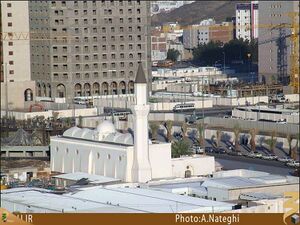
Imam Ali Mosque(a) is one of the historical mosques in Medina, built on the site of the Musalla of the Prophet(s). The prayer ground was an open area where the Prophet and the people of Medina performed Eid al-Adha and Eid al-Fitr prayers. This mosque is located in the Manakha district, west of the Prophet's Mosque. According to reports, Imam Ali (a) led Eid prayers at this site when Uthman was under siege by his opponents.
Location
The Mosque of Ali ibn Abi Talib (AS), the Musalla Mosque, and the Abu Bakr Mosque are three mosques known as the Prophet's Prayer Ground Mosques in the Manakha district. These mosques are located close to each other, west of the Prophet's Mosque.[1] The Imam Ali Mosque is located north of the Musalla Mosque and the Abu Bakr Mosque, with a distance of 122 meters from the Musalla Mosque, 80 meters from the Abu Bakr Mosque, and 290 meters from the Prophet's Mosque.[2]
According to Samhudi (d. 911 AH), a historian of Medina, these mosques were built on the sites where the Prophet performed Eid prayers. These locations were initially not mosques but open spaces or deserts that were later converted into mosques.[3]
Naming
According to narrations, when Uthman was under siege in his house by his opponents, Imam Ali (AS) performed Eid prayers at this site. Some historians of Medina believe this event is the reason for the mosque's name.[4] They emphasize that Imam Ali (AS) and the caliphs only performed Eid prayers at the Prophet's prayer grounds; thus, the Mosque of Ali ibn Abi Talib is one of the Prophet's prayer grounds.[5]
History of the Mosque's Construction
According to Samhudi, the mosque was first built during the time of Umar ibn Abd al-Aziz (r. 87–93 AH). However, it was later abandoned, and the site became a burial ground for pilgrims who passed away during the Hajj season. In 881 AH, Zayn al-Din Digham al-Mansuri, the governor of Medina, reconstructed it.[6]
Ali ibn Musa, in 1303 AH (1885 CE), described the mosque as having a single minaret.[7] Ibrahim Rif'at Pasha also mentioned the mosque during his travels in 1318 AH.[8]
Reconstruction in the 13th Century AH
An inscription, reportedly present on the mosque's wall until the early 20th century, contained verses indicating that the mosque was reconstructed in 1269 AH (1852 CE) during the reign of Sultan Abdulmejid I of the Ottoman Empire.[9] The building, before its reconstruction in 1411 AH (1991 CE), looked like this:

Reconstruction in 1991 CE
The Imam Ali Mosque in Manakha was completely demolished and reconstructed in 1411 AH (1991 CE) due to its deterioration. It was rebuilt in its original architectural style,[10] with the addition of a women's prayer area and restrooms.[11] Further renovations were carried out in 1429 AH (2009 CE).[11]
Architectural Features
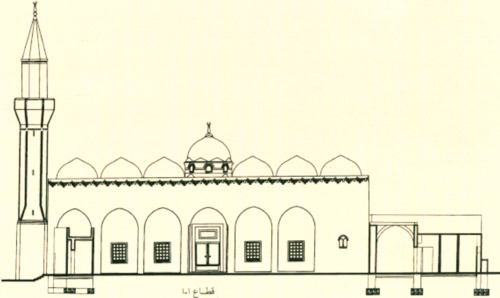
The Imam Ali Mosque (AS) has a rectangular structure. To the north is an open courtyard, and to the south is a covered arcade with seven domes, the largest of which is above the mihrab. The arcade is 30 meters long and 6 meters wide, with doors opening to the mosque's courtyard. The mosque also has a minaret located in the southeastern corner.[12]
Gallery
.jpg)
2.jpg)


The image below shows the distance between the Prayer Ground Mosques and one of the corners of the current Prophet's Mosque building.

Related Topics
Notes
- ↑ Masājid al-Athariya, p. 223
- ↑ Masājid al-Athariya, p. 242; Maʿālim al-Madīna al-Munawwara bayn al-ʿImāra wa al-Tārīkh, vol. 1, p. 486.
- ↑ Wafāʾ al-Wafāʾ, vol. 3, p. 122
- ↑ Wafāʾ al-Wafāʾ, vol. 3, p. 121
- ↑ bi-mā Anasat al-Hijra.pdf&page=147 Al-Taʿrīf bi-mā Anasat al-Hijra, p. 147
- ↑ Wafāʾ al-Wafāʾ, vol. 3, p. 123
- ↑ Wasf al-Madīna al-Munawwara, p. 17
- ↑ Mirʾāt al-Haramayn, vol. 1, p. 422
- ↑ Al-Madīna al-Munawwara, p. 158; Maʿālim al-Madīna al-Munawwara, Juzʾ 4, Mujallad 1, p. 489
- ↑ Masājid al-Athariya, p. 243; Maʿālim al-Madīna al-Munawwara, Juzʾ 4, Mujallad 1, p. 490
- ↑ 11.0 11.1 Maʿālim al-Madīna al-Munawwara, Juzʾ 4, Mujallad 1, p. 490
- ↑ Maʿālim al-Madīna al-Munawwara bayn al-ʿImāra wa al-Tārīkh, vol. 1, p. 490
References
- Maʿālim al-Madīna al-Munawwara bayn al-ʿImāra wa al-Tārīkh**, ʿAbd al-ʿAzīz Kaʿkī, Beirut: Dār Maktabat al-Hilāl, 2007.
- Wafāʾ al-Wafāʾ bi-Akhbār Dār al-Muṣṭafā**, ʿAlī ibn ʿAbd Allāh al-Samhūdī, edited by Qāsim al-Sāmarrāʾī, London: Al-Furqān, 2001 CE.
- Al-Taʿrīf bi-mā Anasat al-Hijra**, Jamāl al-Dīn Muḥammad ibn Aḥmad al-Muṭarrī, edited by Sulaymān al-Rāḥilī, Riyadh: Idārat al-Malik ʿAbd al-ʿAzīz, 1426 AH.
- Masājid al-Athariya fī al-Madīna al-Nabawiyya**, Muḥammad Ilyās ʿAbd al-Ghanī, Medina: Self-published.
- Wasf al-Madīna al-Munawwara**
- Al-Madīna al-Munawwara Tatawwuruhā al-ʿUmrānī wa Turāthuhā al-Miʿmārī**, Ṣāliḥ Lamʿī Muṣṭafā, Beirut: Dār al-Nahḍa al-ʿArabiyya, 1981.
- Mirʾāt al-Haramayn**, Ibrāhīm Rifʿat Pāshā.