
Al-Tahajjud Pillar: Difference between revisions
Pourghorbani (talk | contribs) |
Pourghorbani (talk | contribs) |
||
| Line 58: | Line 58: | ||
Currently, it is located inside the Prophet’s shrine and on the marble stone they have placed there, they have written: “هذا متهجد النبی: This is the place where the Prophet spent the night(means keeping vigil at night for performing night prayer).” | Currently, it is located inside the Prophet’s shrine and on the marble stone they have placed there, they have written: “هذا متهجد النبی: This is the place where the Prophet spent the night(means keeping vigil at night for performing night prayer).” | ||
== | ==Reason for naming== | ||
The reason why this pillar is named Tahajjud is because when the mosque was empty of worshipers, the Prophet would spread a mat next to this pillar, which was located after the door of the house of Imam Ali, and would stand on it to perform prayer.<ref>Shurrāb, ''Al- maʿālim al-ʾathīra'', p. 43.</ref> [[Imam Ali]](a) also prays the night prayer here.<ref> Najjār, ''Al-Durra al-thamīna'', p. 125; Yamānī, ''Mawsūʿa makka al-mukarrama'', vol. 2, p. 420.</ref> | The reason why this pillar is named Tahajjud is because when the mosque was empty of worshipers, the Prophet would spread a mat next to this pillar, which was located after the door of the house of Imam Ali, and would stand on it to perform prayer.<ref>Shurrāb, ''Al- maʿālim al-ʾathīra'', p. 43.</ref> [[Imam Ali]](a) also prays the night prayer here.<ref> Najjār, ''Al-Durra al-thamīna'', p. 125; Yamānī, ''Mawsūʿa makka al-mukarrama'', vol. 2, p. 420.</ref> | ||
Following the imitation of some Muslims from the prophet, he removed the mat and in response to those who asked the reason for this, he said: I was afraid that the night prayer would become obligatory on you and you would not be able to do it.<ref>Samhūdī, ''Wafāʾ al-wafā'', vol. 2, p. 187.</ref> Ibn Najjar and Matari from This place has been referred to as “مصلّی النّبی صلّی الله علیه و آله باللّیل: the night prayer place of the Prophet”. In the following centuries, an altar was built in that place.<ref>Samhūdī, ''Wafāʾ al-wafā'', vol. 2, p. 189; Shurrāb, ''Al- maʿālim al-ʾathīra'', p. 43.</ref> | Following the imitation of some Muslims from the prophet, he removed the mat and in response to those who asked the reason for this, he said: I was afraid that the night prayer would become obligatory on you and you would not be able to do it.<ref>Samhūdī, ''Wafāʾ al-wafā'', vol. 2, p. 187.</ref> Ibn Najjar and Matari from This place has been referred to as “مصلّی النّبی صلّی الله علیه و آله باللّیل: the night prayer place of the Prophet”. In the following centuries, an altar was built in that place.<ref>Samhūdī, ''Wafāʾ al-wafā'', vol. 2, p. 189; Shurrāb, ''Al- maʿālim al-ʾathīra'', p. 43.</ref> | ||
==Notes== | ==Notes== | ||
{{Notes}} | {{Notes}} | ||
Revision as of 09:35, 2 December 2023
 | |
| General Information | |
|---|---|
| Place | Medina, Masjid al-Nabi |
| History | |
| Events | The place of the Prophet's night prayer |
| Current State | |
| Status | This column was located behind Fatima's house and on its north side. Today it is out of the reach of pilgrims. |
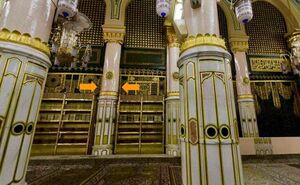
Tahajjud pillar,(Arabic: تَهَجُّد) is one of the pillars of Masjid al-Nabi, which was the place of the Prophet’s night prayers. When the mosque was empty of worshipers, the Prophet pray at night next to this pillar Therefore, that pillar is called Tahajjud (literaly means night life). Later, next to this pillar, a mihrab was built, which was named Mihrab al-Tahajjud . It is recommended to pray next to this pillar.
location
This pillar was located behind Fatima’s house and on its north side. Now there is a small mihrab[1]which when someone stands in front of it, the pillar is placed on his left, facing the Bab Jibraʾīl(the gate of Gabriel) .[2] This pillar was next to the main place of Bab Jibrīl before the development of Masjid al-Nabi, which is now a little behind the first place. is located.[3] Currently, it is located inside the Prophet’s shrine and on the marble stone they have placed there, they have written: “هذا متهجد النبی: This is the place where the Prophet spent the night(means keeping vigil at night for performing night prayer).”
Reason for naming
The reason why this pillar is named Tahajjud is because when the mosque was empty of worshipers, the Prophet would spread a mat next to this pillar, which was located after the door of the house of Imam Ali, and would stand on it to perform prayer.[4] Imam Ali(a) also prays the night prayer here.[5] Following the imitation of some Muslims from the prophet, he removed the mat and in response to those who asked the reason for this, he said: I was afraid that the night prayer would become obligatory on you and you would not be able to do it.[6] Ibn Najjar and Matari from This place has been referred to as “مصلّی النّبی صلّی الله علیه و آله باللّیل: the night prayer place of the Prophet”. In the following centuries, an altar was built in that place.[7]
Notes
- ↑ Shurrāb, Al- maʿālim al-ʾathīra, p. 42.
- ↑ Najjār, Al-Durra al-thamīna fī akhbār al-madina, p. 257; Yamānī, Mawsūʿa makka al-mukarrama wa al-madina al-munawwara, vol. 2, p. 420.
- ↑ Qāʾidān, Tārīkh wa āthār-i Islāmi Makka wa Madīna, p.195.
- ↑ Shurrāb, Al- maʿālim al-ʾathīra, p. 43.
- ↑ Najjār, Al-Durra al-thamīna, p. 125; Yamānī, Mawsūʿa makka al-mukarrama, vol. 2, p. 420.
- ↑ Samhūdī, Wafāʾ al-wafā, vol. 2, p. 187.
- ↑ Samhūdī, Wafāʾ al-wafā, vol. 2, p. 189; Shurrāb, Al- maʿālim al-ʾathīra, p. 43.
References
- Najjār, Muḥammad b. Maḥmūd al- .Al-Durra al-thamīna fī akhbār al-madina. Medina: Markaz Buḥūth wa Darāsāt al-Madina al-Munawwara, 1427 AH.
- Qāʾidān, Aṣghar. Tārīkh wa āthār-i Islāmi Makka wa Madīna. 4th edition. Qom: Nashr-i Mashʿar, 1381 Sh.
- Samhūdī, ʿAlī b. ʿAbd Allāh. Wafāʾ al-wafā bi akhbār dar al-Muṣṭafā. Edited by Muḥammad Muḥyi al-Dīn ʿAbd al-Ḥamīd. Beirut: 1984.
- Shurrāb, Muḥammad Muḥammad b. Ḥasan. Al- maʿālim al-ʾathīra fī al-sunna wa al-sīra. Beirut: Dār al-kutub al-ʿarabī, 1387AH.
- Yamānī, Aḥmad Zakkī. Mawsūʿa makka al-mukarrama wa al-madina al-munawwara. London: Muʾssisa al-furqān, 1429 AH.