
Mount Uhud: Difference between revisions
Pourghorbani (talk | contribs) No edit summary |
Pourghorbani (talk | contribs) |
||
| (19 intermediate revisions by the same user not shown) | |||
| Line 52: | Line 52: | ||
| map description = | | map description = | ||
}} | }} | ||
'''Mount Uhud''' is a mountain | '''Mount Uhud''' is a mountain north of [[Medina]] and the site of [[the Battle of Uhud]]. Today, following the expansion of Medina, the mountain lies within the city. Its distance from [[Al-Masjid al-Nabawi|Al-Masjid an-Nabawi]] is five and a half kilometers. Mount Uhud is also known as Dhu Aynayn. Uhud is a mountain range consisting of numerous peaks. <br />In 3 AH, the Battle of Uhud took place on this mountain between Muslims and polytheists from [[Mecca]], and many Muslims were [[martyred]] in it. On the [[Prophet Muhammad (s)|Prophet Muhammad (s)]]'s orders, some of the fallen in this battle, including [[Hamza ibn Abd al-Muttalib|Hamza]], the Prophet's uncle, were buried at the foot of Mount Uhud. | ||
==Geographical Location== | ==Geographical Location== | ||
Uhud is | Uhud is a mountain range northeast of [[Medina]]<ref>Mu'jam al-Buldan, vol. 1, p. 109; Wafa al-Wafa, vol. 3, p. 108.</ref> located five and a half kilometers from [[Al-Masjid al-Nabawi|Al-Masjid an-Nabawi]].<ref>Islamic Monuments of Mecca and Medina, p. 354.</ref> Before Islam, it was known as Unqud (cluster).<ref>Tarikh al-Madinah, vol. 1, p. 85.</ref> The name Uhud, meaning "one" or "alone," has been attributed either to its separation from the surrounding mountains or to the people of Medina's adherence to [[tawhid]] (monotheism)..<ref>Fath al-Bari, vol. 7, pp. 289-290; Wafa al-Wafa, vol. 3, p. 108; Sharh Usul al-Kafi, vol. 12, p. 447.</ref> Mount Uhud is also known as Dhu Aynayn (possessor of two springs).<ref>Umdat al-Qari, vol. 17, p. 138; Al-Mawahib al-Ladunniyah, vol. 1, p. 240.</ref> At the foot of the mountain, near the entrance to the Uhud valley, lies the small mountain of [[Aynayn]].It was on this mountain that the Prophet stationed the archers during the [[Battle of Uhud]].<ref>Al-Tabaqat, vol. 2, p. 30.</ref> | ||
The Uhud | The Uhud range is six<ref>Athar al-Madinah, p. 193; Tarikh Ma'alim al-Madinah, p. 317.</ref> to seven<ref>Tarikh wa Athar Islami Makkah, p. 307.</ref> kilometers long and one to three kilometers wide, stretches from east to west and covers an area of 19 square kilometers.<ref>Tarikh wa Athar Islami Makkah, p. 307.</ref> It rises 300 meters above the surrounding terrain and reaches an elevation of 1,000 meters above sea level.<ref>Tarikh wa Athar Islami Makkah, p. 307.</ref> The range consists of massive rock formations and numerous peaks of varying sizes.<ref>Athar al-Madinah, p. 193.</ref>Its peaks are separated from one another like a cluster of grapes, giving the appearance of distinct mountains.<ref>Athar al-Madinah, p. 193.</ref> Most of the rocks on the mountain are reddish in color..<ref>Mu'jam al-Buldan, vol. 1, p. 109; Tarikh Ma'alim al-Madinah, p. 317.</ref> Rocks of other colors are also seen there.<ref>Athar al-Madinah, p. 193.</ref> | ||
Today, this mountain is located within the city. One can now reach Mount Uhud and the [[Martyrs of Uhud Cemetery|martyrs' shrine]] from the Prophet's Mosque via King Fahd bin Abdulaziz Highway. There is also a route from Sayyid al-Shuhada Street.<ref>Islamic Monuments of Mecca and Medina, p. 354.</ref> | Today, this mountain is located within the city. One can now reach Mount Uhud and the [[Martyrs of Uhud Cemetery|martyrs' shrine]] from the Prophet's Mosque via King Fahd bin Abdulaziz Highway. There is also a route from Sayyid al-Shuhada Street.<ref>Islamic Monuments of Mecca and Medina, p. 354.</ref> | ||
==Military Importance== | ==Military Importance== | ||
[[File:کوه احد. موقعیت.jpg|thumb|Geographical location of Mount Uhud in [[Medina]]]] | [[File:کوه احد. موقعیت.jpg|thumb|Geographical location of Mount Uhud in [[Medina]]]] | ||
[[Medina]] is surrounded by low, scattered hills and mountains, cultivated lands, and palm groves and is surrounded by natural barriers on three sides. The eastern Harrah and western Harrah are to its east and west, and the palm groves are to its south.<ref>See: Tarikh Ma'alim al-Madinah, pp. 315-338; Atlas Tarikh Islam, p. 9.</ref> As a result, an invading army could approach the city only from the north, passing by the northwestern side of Mount Uhud and then along its southern flank.<ref>Tarikh Ma'alim al-Madinah, pp. 315-338; Atlas Tarikh Islam, pp. 9-13.</ref> | |||
During | During [[the Battle of the Trench]], the [[Quraysh]] army, advancing from [[Mecca]] toward Medina, had to pass through this area in order to approach the city. [[Prophet Muhammad (s)|The Prophet of Islam (s)]] positioned his forces on the southern slope of Uhud, with the mountain behind them and [[Medina]] in front of them, so that any enemy advancing toward the city would have the Muslim forces behind it.<ref>See: Islamic Monuments of Mecca and Medina, pp. 361-362.</ref> | ||
==Virtue== | ==Virtue== | ||
Islamic sources contain numerous reports concerning the virtues and significance of Mount Uhud. According to [[Ibn Shabba]] (died 262 AH) in [[Tarikh al-Madinah (Ibn Shabba)|Tarikh al-Madinah]], when the Prophet (s) was returning to [[Medina]] from the [[Battle of Khaybar]], upon seeing Mount Uhud, he said: Uhud loves us, and we love it.<ref>Tarikh al-Madinah, vol. 1, p. 81.</ref> In another narration from him, it is stated: Uhud is at one of the gates of Paradise.<ref>Tarikh al-Madinah, vol. 1, pp. 82-84.</ref> Whenever you pass by it, eat from its plants and trees.<ref>Tarikh al-Madinah, vol. 1, p. 83.</ref> | |||
==Literary Usage== | ==Literary Usage== | ||
The Prophet ( | The Prophet (s) designated Medina as a [[Haram]] (sacred precinct).<ref>Sahih al-Bukhari, vol. 2, p. 221; vol. 8, p. 10; Sahih Muslim, vol. 4, pp. 115-116, 217.</ref> The Haram extends 12 miles, equivalent to four farsakhs, in every direction, and Mount Uhud is located within this boundary.<ref>Al-Musannaf, vol. 9, pp. 260-261; Fath al-Bari, vol. 4, pp. 72-73; Awn al-Ma'bud, vol. 6, p. 16.</ref> In Persian literature, the expression "having one's back to Mount Uhud" is used idiomatically to mean "having strong support". In narrations, Mount Uhud is used as a symbol for greatness and abundance; for example, "Whoever worships for two-thirds of the night will have a reward equivalent to the grains of sand in the desert, the least of which is a good deed ten times heavier than Mount Uhud."<ref>Amali, p. 368.</ref> | ||
==Martyrs of Uhud Cemetery== | ==Martyrs of Uhud Cemetery== | ||
[[File:مقبره شهدای غزوه احد.jpg|thumb|Martyrs of the [[Battle of Uhud]] cemetery at the foot of Mount Uhud]] | [[File:مقبره شهدای غزوه احد.jpg|thumb|Martyrs of the [[Battle of Uhud]] cemetery at the foot of Mount Uhud]] | ||
{{Main|Martyrs of Uhud Cemetery}} | {{Main|Martyrs of Uhud Cemetery}} | ||
In the | In the 3 AH, a fierce battle was fought on the southern slope of the mountain between Muslims and the polytheists of [[Quraysh]], which was named the [[Battle of Uhud]]. In this battle, a number of Muslims were killed, and by the command of Prophet(s), they were buried at the places where they had been martyred on the slopes of the mountain,<ref>Al-Sirah al-Nabawiyyah, vol. 2, pp. 60, 98; Tarikh al-Tabari, vol. 2, p. 499.</ref> and the site remains a place of pilgrimage for Muslims. According to some reports, before the Prophet's command, the bodies of some martyrs were buried in other locations, and it was not possible to return them to Uhud.<ref>Al-Maghazi, vol. 1, p. 312.</ref> The body of [[Hamza ibn Abd al-Muttalib|Hamza]], the Prophet's uncle, was buried on the slope of this mountain, in the place where his shrine is now located.<ref>Tarikh al-Madinah, vol. 1, p. 125.</ref> | ||
[[File:مهراس - احد.png|thumb|Mihras basin in Mount Uhud]] | [[File:مهراس - احد.png|thumb|Mihras basin in Mount Uhud]] | ||
==Mihras== | ==Mihras== | ||
Mihras is a stone basin on the ridge of Mount Uhud | Mihras is a stone basin located on the ridge of Mount Uhud. According to reports, after the Battle of Uhud, [[Imam Ali (a)]] filled his shield with water from it and brought the water to the Prophet (s), so that he could wash his bloodied face.<ref>Tarikh al-Tabari, vol. 2, p. 519; Wafa al-Wafa, vol. 4, p. 152.</ref> | ||
== See also == | == See also == | ||
| Line 87: | Line 87: | ||
* [[Martyrs of Uhud Cemetery]] | * [[Martyrs of Uhud Cemetery]] | ||
== | ==Notes== | ||
{{ | {{Notes}} | ||
==References== | ==References== | ||
{{References}}{{Encyclopedia | {{References}}{{Encyclopedia | ||
Latest revision as of 22:25, 27 August 2026
 | |
| General Information | |
|---|---|
| Other Names | Dhu Aynayn |
| Place | Medina |
| Religious Aspect | |
| Religious Affiliation | Islam |
| History | |
| Events | The Battle of Uhud |
| Current State | |
| Length | 6 to 7 kilometers |
| Width | 1 to 3 kilometers |
| Height | 1000 meters above sea level |
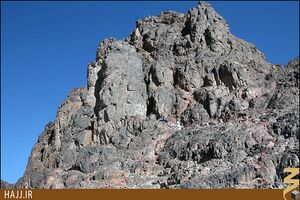
Mount Uhud is a mountain north of Medina and the site of the Battle of Uhud. Today, following the expansion of Medina, the mountain lies within the city. Its distance from Al-Masjid an-Nabawi is five and a half kilometers. Mount Uhud is also known as Dhu Aynayn. Uhud is a mountain range consisting of numerous peaks.
In 3 AH, the Battle of Uhud took place on this mountain between Muslims and polytheists from Mecca, and many Muslims were martyred in it. On the Prophet Muhammad (s)'s orders, some of the fallen in this battle, including Hamza, the Prophet's uncle, were buried at the foot of Mount Uhud.
Geographical Location
Uhud is a mountain range northeast of Medina[1] located five and a half kilometers from Al-Masjid an-Nabawi.[2] Before Islam, it was known as Unqud (cluster).[3] The name Uhud, meaning "one" or "alone," has been attributed either to its separation from the surrounding mountains or to the people of Medina's adherence to tawhid (monotheism)..[4] Mount Uhud is also known as Dhu Aynayn (possessor of two springs).[5] At the foot of the mountain, near the entrance to the Uhud valley, lies the small mountain of Aynayn.It was on this mountain that the Prophet stationed the archers during the Battle of Uhud.[6]
The Uhud range is six[7] to seven[8] kilometers long and one to three kilometers wide, stretches from east to west and covers an area of 19 square kilometers.[9] It rises 300 meters above the surrounding terrain and reaches an elevation of 1,000 meters above sea level.[10] The range consists of massive rock formations and numerous peaks of varying sizes.[11]Its peaks are separated from one another like a cluster of grapes, giving the appearance of distinct mountains.[12] Most of the rocks on the mountain are reddish in color..[13] Rocks of other colors are also seen there.[14]
Today, this mountain is located within the city. One can now reach Mount Uhud and the martyrs' shrine from the Prophet's Mosque via King Fahd bin Abdulaziz Highway. There is also a route from Sayyid al-Shuhada Street.[15]
Military Importance

Medina is surrounded by low, scattered hills and mountains, cultivated lands, and palm groves and is surrounded by natural barriers on three sides. The eastern Harrah and western Harrah are to its east and west, and the palm groves are to its south.[16] As a result, an invading army could approach the city only from the north, passing by the northwestern side of Mount Uhud and then along its southern flank.[17]
During the Battle of the Trench, the Quraysh army, advancing from Mecca toward Medina, had to pass through this area in order to approach the city. The Prophet of Islam (s) positioned his forces on the southern slope of Uhud, with the mountain behind them and Medina in front of them, so that any enemy advancing toward the city would have the Muslim forces behind it.[18]
Virtue
Islamic sources contain numerous reports concerning the virtues and significance of Mount Uhud. According to Ibn Shabba (died 262 AH) in Tarikh al-Madinah, when the Prophet (s) was returning to Medina from the Battle of Khaybar, upon seeing Mount Uhud, he said: Uhud loves us, and we love it.[19] In another narration from him, it is stated: Uhud is at one of the gates of Paradise.[20] Whenever you pass by it, eat from its plants and trees.[21]
Literary Usage
The Prophet (s) designated Medina as a Haram (sacred precinct).[22] The Haram extends 12 miles, equivalent to four farsakhs, in every direction, and Mount Uhud is located within this boundary.[23] In Persian literature, the expression "having one's back to Mount Uhud" is used idiomatically to mean "having strong support". In narrations, Mount Uhud is used as a symbol for greatness and abundance; for example, "Whoever worships for two-thirds of the night will have a reward equivalent to the grains of sand in the desert, the least of which is a good deed ten times heavier than Mount Uhud."[24]
Martyrs of Uhud Cemetery

In the 3 AH, a fierce battle was fought on the southern slope of the mountain between Muslims and the polytheists of Quraysh, which was named the Battle of Uhud. In this battle, a number of Muslims were killed, and by the command of Prophet(s), they were buried at the places where they had been martyred on the slopes of the mountain,[25] and the site remains a place of pilgrimage for Muslims. According to some reports, before the Prophet's command, the bodies of some martyrs were buried in other locations, and it was not possible to return them to Uhud.[26] The body of Hamza, the Prophet's uncle, was buried on the slope of this mountain, in the place where his shrine is now located.[27]

Mihras
Mihras is a stone basin located on the ridge of Mount Uhud. According to reports, after the Battle of Uhud, Imam Ali (a) filled his shield with water from it and brought the water to the Prophet (s), so that he could wash his bloodied face.[28]
See also
Notes
- ↑ Mu'jam al-Buldan, vol. 1, p. 109; Wafa al-Wafa, vol. 3, p. 108.
- ↑ Islamic Monuments of Mecca and Medina, p. 354.
- ↑ Tarikh al-Madinah, vol. 1, p. 85.
- ↑ Fath al-Bari, vol. 7, pp. 289-290; Wafa al-Wafa, vol. 3, p. 108; Sharh Usul al-Kafi, vol. 12, p. 447.
- ↑ Umdat al-Qari, vol. 17, p. 138; Al-Mawahib al-Ladunniyah, vol. 1, p. 240.
- ↑ Al-Tabaqat, vol. 2, p. 30.
- ↑ Athar al-Madinah, p. 193; Tarikh Ma'alim al-Madinah, p. 317.
- ↑ Tarikh wa Athar Islami Makkah, p. 307.
- ↑ Tarikh wa Athar Islami Makkah, p. 307.
- ↑ Tarikh wa Athar Islami Makkah, p. 307.
- ↑ Athar al-Madinah, p. 193.
- ↑ Athar al-Madinah, p. 193.
- ↑ Mu'jam al-Buldan, vol. 1, p. 109; Tarikh Ma'alim al-Madinah, p. 317.
- ↑ Athar al-Madinah, p. 193.
- ↑ Islamic Monuments of Mecca and Medina, p. 354.
- ↑ See: Tarikh Ma'alim al-Madinah, pp. 315-338; Atlas Tarikh Islam, p. 9.
- ↑ Tarikh Ma'alim al-Madinah, pp. 315-338; Atlas Tarikh Islam, pp. 9-13.
- ↑ See: Islamic Monuments of Mecca and Medina, pp. 361-362.
- ↑ Tarikh al-Madinah, vol. 1, p. 81.
- ↑ Tarikh al-Madinah, vol. 1, pp. 82-84.
- ↑ Tarikh al-Madinah, vol. 1, p. 83.
- ↑ Sahih al-Bukhari, vol. 2, p. 221; vol. 8, p. 10; Sahih Muslim, vol. 4, pp. 115-116, 217.
- ↑ Al-Musannaf, vol. 9, pp. 260-261; Fath al-Bari, vol. 4, pp. 72-73; Awn al-Ma'bud, vol. 6, p. 16.
- ↑ Amali, p. 368.
- ↑ Al-Sirah al-Nabawiyyah, vol. 2, pp. 60, 98; Tarikh al-Tabari, vol. 2, p. 499.
- ↑ Al-Maghazi, vol. 1, p. 312.
- ↑ Tarikh al-Madinah, vol. 1, p. 125.
- ↑ Tarikh al-Tabari, vol. 2, p. 519; Wafa al-Wafa, vol. 4, p. 152.
References
 The main source: Encyclopedia of Hajj and the Two Holy Mosques entery: [{{{link}}} Mount Uhud].
- Islamic Monuments of Mecca and Medina: Rasoul Ja'farian, Qom, Mash'ar, 1386 SH.
- Athar al-Madinah al-Munawwarah: Abdul Quddus al-Ansari, Jeddah, Kitab al-Manhal, 1420 AH.
- Al-Amali: Al-Saduq (d. 381 AH), Qom, Al-Ba'thah, 1417 AH.
- Atlas of Islamic History: Sadegh Ayyinehvand, Madrasah, 1382 SH.
- Imta' al-Asma: Al-Maqrizi (d. 845 AH), edited by Muhammad Abd al-Hamid, Beirut, Dar al-Kutub al-Ilmiyyah, 1420 AH.
- Ansab al-Ashraf: Al-Baladhuri (d. 279 AH), edited by Zakkar, Beirut, Dar al-Fikr, 1417 AH.
- Al-Bidaya wa al-Nihaya: Ibn Kathir (d. 774 AH), edited by Ali Shiri, Beirut, Dar Ihya al-Turath al-Arabi, 1408 AH.
- Tarikh al-Islam wa Wafayat al-Mashahir: Al-Dhahabi (d. 748 AH), edited by Omar Abd al-Salam, Beirut, Dar al-Kitab al-Arabi, 1410 AH.
- Tarikh al-Tabari (Tarikh al-Umam wa al-Muluk): Al-Tabari (d. 310 AH), edited by Muhammad Abu al-Fadl, Beirut, Dar Ihya al-Turath al-Arabi.
- Tarikh al-Madinah al-Munawwarah: Ibn Shabbah al-Numayri (d. 262 AH), edited by Shaltut, Qom, Dar al-Fikr, 1410 AH.
- Tarikh Ma'alim al-Madinah al-Munawwarah: Ahmad Yasin al-Khiyari, Riyadh, Maktabat al-Malik Fahd, 1419 AH.
- Tarikh wa Athar Islami Makkah al-Mukarramah wa Madinah al-Munawwarah: Asghar Qa'idan, Tehran, Mash'ar, 1386 SH.
- Tafsir al-Tha'labi (Al-Kashf wa al-Bayan): Al-Tha'labi (d. 427 AH), edited by Ibn Ashur, Beirut, Dar Ihya al-Turath al-Arabi, 1422 AH.
- Al-Tafsir al-Kabir: Al-Fakhr al-Razi (d. 606 AH), Qom, Daftar Tablighat, 1413 AH.
- Al-Tamhid: Ibn Abd al-Barr (d. 463 AH), edited by Mustafa and Muhammad Abd al-Kabir, Ministry of Endowments and Islamic Affairs, 1387 AH.
- Tahdhib al-Ahkam: Al-Tusi (d. 460 AH), edited by Musawi and Akhundi, Tehran, Dar al-Kutub al-Islamiyyah, 1365 SH.
- Thawab al-A'mal: Al-Saduq (d. 381 AH), Qom, Al-Radhi, 1368 SH.
- Al-Rawd al-Unuf: Al-Suhayli (d. 581 AH), edited by Abd al-Rahman, Beirut, Dar Ihya al-Turath al-Arabi, 1412 AH.
- Al-Sirah al-Halabiyyah: Al-Halabi (d. 1044 AH), Beirut, Dar al-Ma'rifah, 1400 AH.
- Al-Sirah al-Nabawiyyah: Ibn Hisham (d. 213-8 AH), edited by Al-Saqqa and others, Beirut, Al-Maktabah al-Ilmiyyah.
- Sharh Usul al-Kafi: Muhammad Salih Mazandarani (d. 1081 AH), edited by Sayyid Ali Ashour, Beirut, Dar Ihya al-Turath al-Arabi, 1421 AH.
- Sahih al-Bukhari: Al-Bukhari (d. 256 AH), Beirut, Dar al-Fikr, 1401 AH.
- Sahih Muslim: Muslim (d. 261 AH), Beirut, Dar al-Fikr.
- Al-Tabaqat al-Kubra: Ibn Sa'd (d. 230 AH), edited by Muhammad Abd al-Qadir, Beirut, Dar al-Kutub al-Ilmiyyah, 1418 AH.
- Umdat al-Qari: Al-Ayni (d. 855 AH), Beirut, Dar Ihya al-Turath al-Arabi.
- Awn al-Ma'bud: Al-Azim Abadi (d. 1329 AH), Beirut, Dar al-Kutub al-Ilmiyyah, 1415 AH.
- Fath al-Bari: Ibn Hajar al-Asqalani (d. 852 AH), Beirut, Dar al-Ma'rifah.
- Al-Kafi: Al-Kulayni (d. 329 AH), edited by Ghaffari, Tehran, Dar al-Kutub al-Islamiyyah, 1375 SH.
- Kamil al-Ziyarat: Ibn Qulawayh al-Qummi (d. 368 AH), edited by Al-Qayyumi, Qom, Nashr al-Fiqahah, 1417 AH.
- Al-Kashshaf: Al-Zamakhshari (d. 538 AH), Mustafa al-Babi, 1385 AH.
- Al-Musannaf: Abd al-Razzaq al-San'ani (d. 211 AH), edited by Habib al-Rahman, Al-Majlis al-Ilmi.
- Al-Mu'tabar: Al-Muhaqqiq al-Hilli (d. 676 AH), Mu'assasat Sayyid al-Shuhada, 1363 SH.
- Mu'jam al-Buldan: Yaqut al-Hamawi (d. 626 AH), Beirut, Dar Sadir, 1995 CE.
- Al-Maghazi: Al-Waqidi (d. 207 AH), edited by Marsden Jones, Beirut, A'lami, 1409 AH.
- Al-Muqni: Al-Saduq (d. 381 AH), Qom, Mu'assasat al-Imam al-Hadi (AS), 1415 AH.
- Al-Muqni'ah: Al-Mufid (d. 413 AH), Qom, Nashr Islami, 1410 AH.
- Man La Yahduruhu al-Faqih: Al-Saduq (d. 381 AH), edited by Ghaffari, Qom, Nashr Islami, 1404 AH.
- Al-Mawahib al-Ladunniyyah: Al-Qastallani (d. 923 AH), Cairo, Al-Maktabah al-Tawfiqiyyah.
- Wafa al-Wafa: Al-Samhudi (d. 911 AH), edited by Muhammad Abd al-Hamid, Beirut, Dar al-Kutub al-Ilmiyyah, 2006 CE.