
Al-Qiblatayn Mosque: Difference between revisions
Created page with "The Qiblatain Mosque (Mosque of the Two Qiblas) is one of the ancient mosques in the city of Medina in Saudi Arabia. Historical sources state that the Prophet was praying in this mosque—located in the neighborhood of the Banu Salama tribe—facing Jerusalem (the first qibla of Muslims) when the command to change the qibla toward the Kaaba was revealed to him. This mosque is located near a well called Bir Rumah. ==Name== Masjid al-Qiblatain, or *Masjid Dhu al-Qiblatain..." |
m Text replacement - "<gallery>" to "<gallery mode="packed" heights="150px">" |
||
| (13 intermediate revisions by the same user not shown) | |||
| Line 1: | Line 1: | ||
The | {{infobox mosque | ||
| name = Al-Qiblatayn Mosque | |||
| other name = Masjid Dhu l-Qiblatayn, Masjid Banu Salama | |||
| image = مسجد قبلتین.jpg | |||
| image size = | |||
| caption = | |||
| location = [[Medina]], [[Saudi Arabia]] | |||
| construction date = | |||
| founder = | |||
| architect = | |||
| style = | |||
| length = | |||
| width = | |||
| area = 3920 square meters | |||
| capacity = | |||
| height = | |||
| dome quantity = 2 | |||
| dome outer height = | |||
| dome inner height = | |||
| minaret quantity = | |||
| minaret height = | |||
| material = | |||
| contractor = | |||
| construction cost = | |||
| rebuilt = 1408/1987-88 | |||
| website = | |||
| other features = | |||
| longitude = 39.5788074688833 | |||
| latitude = 24.48412213911348 | |||
}} | |||
The al-Qiblatayn Mosque (Arabic: {{ia|مسجد القبلتين}}, Mosque of the Two Qiblas) is one of the old mosques in the city of Medina in Saudi Arabia. Historical sources state that the Prophet was praying in this mosque—located in the neighborhood of the Banu Salama tribe—facing Jerusalem (the first qibla of Muslims) when the command to change the qibla toward the Ka'ba was revealed to him. This mosque is located near a well called [[Bi'r Ruma]]. | |||
==Name== | ==Name== | ||
Masjid al- | Masjid al-Qiblatayn, or Masjid Dhu l-Qiblatayn ("The Mosque of Two Qiblas"), was given this name because of the event of the [[change of qibla]] that occurred in this mosque.<ref name=":0">''Man lā yahḍuruh al-faqīh'', vol. 1, p. 426; ''Akhbar Madinat al-Rasul'', p. 144.</ref> It is also called the Mosque of Banu Salama because it was located in the village of the Banu Salama tribe.<ref name=":1">''Al-Masājid al-atharīyya fī Madīnat al-Nabawīyya'', p. 183.</ref> | ||
It is also called the | |||
===Change of Qibla=== | ===Change of Qibla=== | ||
The | The [[change of qibla]] took place on the 15th of Sha'ban in the second year after the Hijrah. Before that, Muslims used to pray facing [[Bayt al-Maqdis]] (Jerusalem).<ref>''ʿUmdat al-akhbār fī Madīnat al-mukhtār'', p. 159.</ref> The command to change the qibla was revealed to the [[Prophet (s)]] during a prayer, and the worshippers performed the first two rak'ahs of the noon (or afternoon) prayer facing Bayt al-Maqdis, and the remaining two rak'ahs facing the [[Ka'ba]].<ref name=":0" /> | ||
The command to change the qibla was revealed to the | |||
==Location== | ==Location== | ||
Masjid Dhu | Masjid Dhu l-Qiblatayn is located in the northwestern part of [[Medina]], to the west of [[Mount Sela']]<ref name=":1" /> and the [[Mosques of al-Fath]],<ref>''Wafāʾ al-wafā bi-akhbār dār al-Muṣṭafā'', p. 195.</ref> and near [[Bi'r Ruma]] (the Well of Ruma).<ref>''Waṣf al-Madīna al-munawwara'', p. 17; ''Āthār al-Madīna al-munawwara'', p. 133.</ref> | ||
==History of the Structure== | ==History of the Structure== | ||
Early sources mention Masjid al- | Early sources mention Masjid al-Qiblatayn as one of the mosques in which the [[Prophet (s)]] prayed,<ref>''Tārīkh al-Madīna al-munawwara'', p. 68.</ref> and based on this, the construction of the mosque is believed to date back to the Prophetic era.<ref>''Al-Masājid al-atharīyya fī Madīnat al-Nabawīyya'', p. 192.</ref> By the 7th/13th century, the mosque had fallen into ruins, and its stones were removed.<ref name=":2">''Al-Durra al-thamīna fī akhbār al-Madīna'', p. 127.</ref> However, it was reconstructed in 893/1488 and 950/1543-44.<ref>''Wafāʾ al-wafā bi-akhbār dār al-Muṣṭafā'', p. 197.</ref> The traveler Abu Salim al-'Ayyashi, in his travelogue dated 1073/1662, described the mosque building as solid and well-built.<ref>''Al-Riḥla al-ʿAyyāshīyya (1661–1663)'', vol. 1, p. 394.</ref> | ||
By the | |||
The traveler | |||
According to some reports, the mosque was in a | According to some reports, the mosque was in a state of disrepair by the late 14th/20th century but was subsequently renovated. At that time, mihrabs (prayer niches) were installed in two directions: toward Jerusalem and toward Mecca.<ref>''Al-Madīna bayn al-māḍī wa l-ḥāḍir'', p. 74.</ref> However, the mihrab facing Jerusalem was later removed.<ref>''Al-Durr al-thamīn fī maʿālim dār al-Rasūl al-amīn'', p. 236.</ref> | ||
The mosque was | The mosque was completely rebuilt in 1408/1987-88, which gave it its current form.<ref>''Masājid sallā fī-hā Rasūl Allāh'', p. 233.</ref> | ||
==Current Status== | ===Current Status=== | ||
The overall layout of the mosque is | The overall layout of the mosque is triangular, but the main building consists of two rectangular floors and overlooks the main road through a balcony. Opposite the mosque lies an old cemetery known as Maqbarat al-Qiblatayn.<ref>''Tārīkh maʿālim al-Madīna al-munawwara qadīman wa hadīthan'', p. 408.</ref> The mosque has two minarets and two domes, and its total area is 3,920 square meters, accommodating about 2,000 worshippers.<ref>''Al-Masājid al-atharīyya fī Madīnat al-Nabawīyya'', pp. 194–196.</ref> | ||
The mosque has | |||
==Gallery== | |||
<gallery mode="packed" heights="150px"> | |||
file:مسجد قبلتین1.jpg| | |||
file:مسجد قبلتین2.jpg | |||
file:مسجد قبلتین3.jpg|Minbar and mihrab | |||
file:مسجد قبلتین4.png|Northern entrance | |||
file:مسجد قبلتین 6.png|Map | |||
file:مسجد قبلتین 7.png|Before the latest reconstruction | |||
file:مسجد قبلتین 8.png|The old minaret and entrance | |||
file:مسجد قبلتین 5.png| | |||
</gallery> | |||
==Notes== | |||
{{notes}} | |||
==References== | |||
{{ref}} | |||
* ''Akhbār Madīnat al-Rasūl'', Muḥammad b. Ḥasan b. Zabala, Medina, 1424AH. | |||
* ''Al-Durr al-thamīn fī maʿālim dār al-Rasūl al-amīn'', Muḥammad Amīn al-Shanqīṭī, Jeddah, Dār al-Qibla, 1992. | |||
* ''Al-Durra al-thamīna fī akhbār al-Madīna'', Muḥammad b. Maḥmūd al-Najjār, Beirut, Dār al-Arqam. | |||
* ''Al-Madīna bayn al-māḍī wa l-ḥāḍir'', Ibrāhīm b. ʿAlī al-ʿAyyāshī, 1972. | |||
* ''Al-Masājid al-atharīyya fī Madīnat al-Nabawīyya'', Muḥammad Ilyās ʿAbd al-Ghanī, Medina, Maṭābiʿ al-Rashīd, 1419/1999. | |||
* ''Al-Riḥla al-ʿAyyāshīyya (1661–1663)''. | |||
* ''Āthār al-Madīna al-munawwara'', ʿAbd al-Quddūs al-Anṣārī, Medina, al-Maktaba al-Salafīyya, 1393AH. | |||
* ''Man lā yahḍuruh al-faqīh'', al-Shaykh al-Ṣadūq, translation to Farsi Ghaffārī, Qom, Dār al-Kutub al-Īslāmī, 1385Sh. | |||
* ''Masājid sallā fī-hā Rasūl Allāh'', al-Sayyid Ḍīyāʾ al-Dīn b. Muḥammad ʿAṭṭār, Jeddah, Kunūz al-Maʿrifa, 1434AH. | |||
* ''Tarikh al-Madina al-munawwara''. | |||
* ''Tārīkh maʿālim al-Madīna al-munawwara qadīman wa hadīthan'', Aḥmad Yasīn Khīyārī, Riyadh, 1419AH. | |||
* ''ʿUmdat al-akhbār fī Madīnat al-mukhtār'', Aḥmad al-ʿAbbāsī, Cairo. | |||
* ''Wafāʾ al-wafā bi-akhbār dār al-Muṣṭafā'', ʿAlī b. ʿAbd Allāh al-Samhūdī, London, Muʾassasat al-Turāth, 2001. | |||
* ''Waṣf al-Madīna al-munawwara'', ʿAlī b. Mūsā al-Afandī, Maṭbaʿat Nihḍat Miṣr. | |||
{{end}} | |||
[[Category:Mosques of Medina]] | |||
[[Category:Historical Sites of Medina]] | |||
[[Category:Sites Attributed to the Prophet (s)]] | |||
[[fa:مسجد قبلتین]] | |||
Latest revision as of 06:49, 22 August 2025
| Al-Qiblatayn Mosque | |
|---|---|
| Masjid Dhu l-Qiblatayn, Masjid Banu Salama | |
 | |
| Information | |
| Location | Medina, Saudi Arabia |
| Architecture | |
| Area | 3920 square meters |
| Dome(s) | 2 |
| Rebuilt | 1408/1987-88 |
The al-Qiblatayn Mosque (Arabic: مسجد القبلتين, Mosque of the Two Qiblas) is one of the old mosques in the city of Medina in Saudi Arabia. Historical sources state that the Prophet was praying in this mosque—located in the neighborhood of the Banu Salama tribe—facing Jerusalem (the first qibla of Muslims) when the command to change the qibla toward the Ka'ba was revealed to him. This mosque is located near a well called Bi'r Ruma.
Name
Masjid al-Qiblatayn, or Masjid Dhu l-Qiblatayn ("The Mosque of Two Qiblas"), was given this name because of the event of the change of qibla that occurred in this mosque.[1] It is also called the Mosque of Banu Salama because it was located in the village of the Banu Salama tribe.[2]
Change of Qibla
The change of qibla took place on the 15th of Sha'ban in the second year after the Hijrah. Before that, Muslims used to pray facing Bayt al-Maqdis (Jerusalem).[3] The command to change the qibla was revealed to the Prophet (s) during a prayer, and the worshippers performed the first two rak'ahs of the noon (or afternoon) prayer facing Bayt al-Maqdis, and the remaining two rak'ahs facing the Ka'ba.[1]
Location
Masjid Dhu l-Qiblatayn is located in the northwestern part of Medina, to the west of Mount Sela'[2] and the Mosques of al-Fath,[4] and near Bi'r Ruma (the Well of Ruma).[5]
History of the Structure
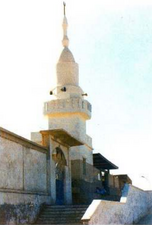
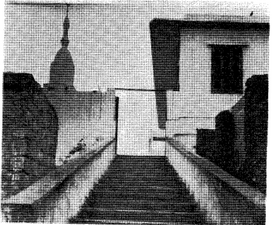
Early sources mention Masjid al-Qiblatayn as one of the mosques in which the Prophet (s) prayed,[6] and based on this, the construction of the mosque is believed to date back to the Prophetic era.[7] By the 7th/13th century, the mosque had fallen into ruins, and its stones were removed.[8] However, it was reconstructed in 893/1488 and 950/1543-44.[9] The traveler Abu Salim al-'Ayyashi, in his travelogue dated 1073/1662, described the mosque building as solid and well-built.[10]
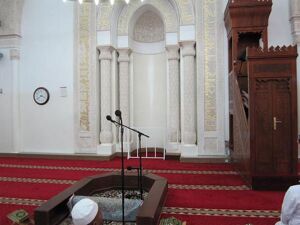
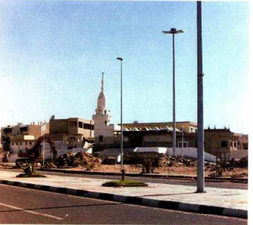
According to some reports, the mosque was in a state of disrepair by the late 14th/20th century but was subsequently renovated. At that time, mihrabs (prayer niches) were installed in two directions: toward Jerusalem and toward Mecca.[11] However, the mihrab facing Jerusalem was later removed.[12] The mosque was completely rebuilt in 1408/1987-88, which gave it its current form.[13]
Current Status
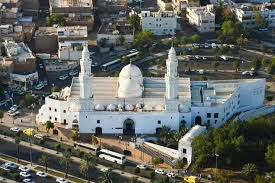
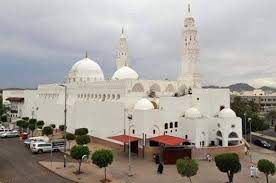
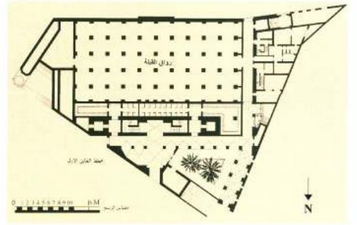
The overall layout of the mosque is triangular, but the main building consists of two rectangular floors and overlooks the main road through a balcony. Opposite the mosque lies an old cemetery known as Maqbarat al-Qiblatayn.[14] The mosque has two minarets and two domes, and its total area is 3,920 square meters, accommodating about 2,000 worshippers.[15]
Gallery
-
-
-
 Minbar and mihrab
 -
 Northern entrance
 -
 Map
Map -
 Before the latest reconstruction
 -
 The old minaret and entrance
 -


Notes
- ↑ 1.0 1.1 Man lā yahḍuruh al-faqīh, vol. 1, p. 426; Akhbar Madinat al-Rasul, p. 144.
- ↑ 2.0 2.1 Al-Masājid al-atharīyya fī Madīnat al-Nabawīyya, p. 183.
- ↑ ʿUmdat al-akhbār fī Madīnat al-mukhtār, p. 159.
- ↑ Wafāʾ al-wafā bi-akhbār dār al-Muṣṭafā, p. 195.
- ↑ Waṣf al-Madīna al-munawwara, p. 17; Āthār al-Madīna al-munawwara, p. 133.
- ↑ Tārīkh al-Madīna al-munawwara, p. 68.
- ↑ Al-Masājid al-atharīyya fī Madīnat al-Nabawīyya, p. 192.
- ↑ Al-Durra al-thamīna fī akhbār al-Madīna, p. 127.
- ↑ Wafāʾ al-wafā bi-akhbār dār al-Muṣṭafā, p. 197.
- ↑ Al-Riḥla al-ʿAyyāshīyya (1661–1663), vol. 1, p. 394.
- ↑ Al-Madīna bayn al-māḍī wa l-ḥāḍir, p. 74.
- ↑ Al-Durr al-thamīn fī maʿālim dār al-Rasūl al-amīn, p. 236.
- ↑ Masājid sallā fī-hā Rasūl Allāh, p. 233.
- ↑ Tārīkh maʿālim al-Madīna al-munawwara qadīman wa hadīthan, p. 408.
- ↑ Al-Masājid al-atharīyya fī Madīnat al-Nabawīyya, pp. 194–196.
References
- Akhbār Madīnat al-Rasūl, Muḥammad b. Ḥasan b. Zabala, Medina, 1424AH.
- Al-Durr al-thamīn fī maʿālim dār al-Rasūl al-amīn, Muḥammad Amīn al-Shanqīṭī, Jeddah, Dār al-Qibla, 1992.
- Al-Durra al-thamīna fī akhbār al-Madīna, Muḥammad b. Maḥmūd al-Najjār, Beirut, Dār al-Arqam.
- Al-Madīna bayn al-māḍī wa l-ḥāḍir, Ibrāhīm b. ʿAlī al-ʿAyyāshī, 1972.
- Al-Masājid al-atharīyya fī Madīnat al-Nabawīyya, Muḥammad Ilyās ʿAbd al-Ghanī, Medina, Maṭābiʿ al-Rashīd, 1419/1999.
- Al-Riḥla al-ʿAyyāshīyya (1661–1663).
- Āthār al-Madīna al-munawwara, ʿAbd al-Quddūs al-Anṣārī, Medina, al-Maktaba al-Salafīyya, 1393AH.
- Man lā yahḍuruh al-faqīh, al-Shaykh al-Ṣadūq, translation to Farsi Ghaffārī, Qom, Dār al-Kutub al-Īslāmī, 1385Sh.
- Masājid sallā fī-hā Rasūl Allāh, al-Sayyid Ḍīyāʾ al-Dīn b. Muḥammad ʿAṭṭār, Jeddah, Kunūz al-Maʿrifa, 1434AH.
- Tarikh al-Madina al-munawwara.
- Tārīkh maʿālim al-Madīna al-munawwara qadīman wa hadīthan, Aḥmad Yasīn Khīyārī, Riyadh, 1419AH.
- ʿUmdat al-akhbār fī Madīnat al-mukhtār, Aḥmad al-ʿAbbāsī, Cairo.
- Wafāʾ al-wafā bi-akhbār dār al-Muṣṭafā, ʿAlī b. ʿAbd Allāh al-Samhūdī, London, Muʾassasat al-Turāth, 2001.
- Waṣf al-Madīna al-munawwara, ʿAlī b. Mūsā al-Afandī, Maṭbaʿat Nihḍat Miṣr.