
Zamzam: Difference between revisions
No edit summary |
|||
| (12 intermediate revisions by the same user not shown) | |||
| Line 1: | Line 1: | ||
Zamzam (Arabic زَمزَم) | {{Building | ||
For centuries, the inhabitants of Mecca depended on the Zamzam well for their water supply. However, over time, the well's presence diminished, and it eventually became obscured. | | title = Zamzam Well | ||
Zamzam water holds profound religious significance for the people of [[Mecca]] and the broader Muslim community. The [[Prophet Muhammad (s) | | image = زمزم 1.jpg | ||
Throughout history, various efforts have been made to preserve and maintain the Zamzam well. The well has a diameter of 1.5 meters and a depth of 30 meters, and it is located 21 meters from the | | image size = | ||
Numerous travelogues across centuries have referenced the unique aspects of Zamzam, including its proximity to the | | image link = | ||
== | | image description = | ||
The term "Zamzam" is derived from the repeated root "zam," which signifies the act of restraining or gathering. Linguistically, it denotes water that is either slow-moving or abundant in flow. <ref>Mu'jam al-Buldan, vol. 3, p. 166.</ref> In religious and historical terminology, "Zamzam" refers to the revered well situated near the | | other names = | ||
According to Mas'udi, a historian of the 4th century | | place = [[Al-Masjid al-Haram]], 21 meters from [[al-Hajar al-Aswad]] | ||
== Names | | usage = Supplying part of the water used by Hajj pilgrims. | ||
Due to its significance and status, Zamzam has various names. Some of these names are mentioned in a narration from | | religious affiliation = | ||
* | | beliefs = | ||
* Saqiya Isma'il ( | | rituals = | ||
* Hafirat | | rulings = | ||
| pilgrims = | |||
| visitors = | |||
| time of construction = | |||
| founder = | |||
| events = | |||
| reconstructions = 822 AH and 1383 AH | |||
| time of reconstruction = | |||
| reconstructors = | |||
| missing parts = | |||
| historical features = | |||
| trustee = | |||
| Area = | |||
| space = | |||
| length = | |||
| width = | |||
| height = | |||
| status = Active | |||
| capacity = | |||
| facilities = | |||
| parts = | |||
| architect = | |||
| style = | |||
| properties = | |||
| domes = | |||
| minarets = | |||
| doors = | |||
| porticos = | |||
| courts = | |||
| verandas = | |||
| affiliated entity = | |||
| maintaining entity = | |||
| administrator = | |||
| imam of prayer = | |||
| subsidiary entities = | |||
| registered in = | |||
| registration no. = | |||
| registration date = | |||
| website = | |||
| latitude = | |||
| longitude = | |||
| map description = | |||
}} | |||
'''Zamzam''' (Arabic {{ia|زَمزَم}}) refers to the most renowned water well located within the [[al-Masjid al-Haram]] in [[Mecca]], situated approximately 21 meters from the sacred Black Stone ([[al-Hajar al-Aswad]]). According to historical accounts, the Zamzam spring emerged miraculously by divine will to provide water for [[Isma'il]] (a) and his mother, [[Hajar]]. The origin of the city of [[Mecca]] and the reconstruction of the [[Ka'ba]] are believed to be closely linked to the miraculous emergence of the Zamzam spring. | |||
For centuries, the inhabitants of Mecca depended on the Zamzam well for their water supply. However, over time, the well's presence diminished, and it eventually became obscured. After a long time, the responsibility of [[siqaya]] (water provision) for the Ka'ba reached [['Abd al-Muttalib]], the grandfather of the [[Prophet Muhammad (s)]], and the Zamzam well was dug by him, and its water gushed forth once again. | |||
Zamzam water holds profound religious significance for the people of [[Mecca]] and the broader Muslim community. The [[Prophet Muhammad (s)]] often drank from the well, regarding it as the finest water on earth. | |||
Throughout history, various efforts have been made to preserve and maintain the Zamzam well. The well has a diameter of 1.5 meters and a depth of 30 meters, and it is located 21 meters from the Ka'ba. In response to the growing number of pilgrims, the water from Zamzam has been channeled to taps around the courtyard of the [[al-Masjid al-Haram]], allowing for easier access to this sacred resource. | |||
Numerous travelogues across centuries have referenced the unique aspects of Zamzam, including its proximity to the Ka'ba, the dimensions of the well's mouth, its nearness to the [[Black Stone]], and the installation of a canopy for the muezzins near the well. | |||
== Terminology == | |||
The term "Zamzam" is derived from the repeated root "zam," which signifies the act of restraining or gathering. Linguistically, it denotes water that is either slow-moving or abundant in flow.<ref>Mu'jam al-Buldan, vol. 3, p. 166.</ref> In religious and historical terminology, "Zamzam" refers to the revered well situated near the Ka'ba in Mecca, whose origins are traditionally linked to the era of Prophet Ibrahim (a).<ref>''Akhbār Makka'', vol. 2, p. 39.</ref> | |||
According to al-Mas'udi, a historian of the 4th/10th century, the Iranians, considering themselves descendants of Prophet Ibrahim (a), would travel to Mecca during the Sassanid era.<ref>''Muruj al-dhahab'', vol. 1, p. 265.</ref> It is said that after performing the circumambulation of the Ka'ba, they would murmur (zamzama) over the well, and for this reason, it became known as Zamzam.<ref>''Lisān al-ʿArab'', vol. 6, p. 85; Mu'jam al-Buldan, vol. 3, p. 166.</ref> | |||
=== Names === | |||
Due to its significance and status, Zamzam has various names. Some of these names are mentioned in a narration from Imam [[Ja'far al-Sadiq]] (a) as follows: | |||
* Rakdat Jibra'il (footsteps of Gabriel) | |||
* Saqiya Isma'il (watering of Isma'il) | |||
* Hafirat 'Abd al-Muttalib (well dug by 'Abd al-Muttalib) | |||
* Al-Masunah (Precious) | * Al-Masunah (Precious) | ||
* Saqiya (Watering) | * Saqiya (Watering) | ||
* Shifa' Suqm ( | * Shifa' Suqm (healing of illness).<ref>''Wasāʾil al-Shīʿa'', vol. 13, p. 474, H18242.</ref> | ||
== The Rediscovery of the Zamzam Well by | == Origin == | ||
According to historical records, [[ | According to verse 37 of Surah Ibrahim, after Prophet [[Abraham (a)]] brought his wife Hajar and his son [[Isma'il]] to the arid land of [[Mecca]], where there was no water or vegetation,<ref>Sūra Ibrāhīm, verse 37.</ref> and left them there as commanded by God, they soon faced severe thirst. In search of water, [[Hajar]] made seven trips between the hills of [[Safa and Marwa]].<ref>''Al-Tafsīr al-ṣāfī'', vol. 3, p. 93.</ref> On the seventh time, while she was on Marwa, she saw water gushing from beneath Isma'il's feet.<ref>''Al-Tafsīr al-ṣāfī'', vol. 3, p. 93.</ref> | ||
Upon completing the excavation and revealing the water, | |||
After the conquest of Mecca, the destruction of idols, and the removal of images from the walls of the | There are variations in the details of this incident. Some sources attribute the emergence of water from the Zamzam well to the striking of Ishmael's heel on the ground. Others suggest that it was the action of Gabriel, who appeared in human form, either by rubbing his foot or hand on the ground that caused the water to spring forth.<ref>''Akhbār Makka'', vol. 2, S40</ref> | ||
== Rulings | |||
Abd al-Muttalib deemed the consumption of Zamzam water and its use for ablution as permissible (halal), but he did not allow its use for bathing. Similarly, Abbas | == Well of Zamzam == | ||
According to al-Azraqi, a Shafi'i historian of the 3rd/9th century, the emergence of a water spring in that desolate and barren region drew the attention of animals and birds. The activity of birds near the Zamzam well caught the eye of a passing caravan from the [[Jurhum tribe]]. They approached the well, drank from its water, and filled their containers. Consequently, this tribe settled around Zamzam, leading to the establishment and growth of the city of Mecca.<ref>''Akhbār Makka'', vol. 2, p. 40-41.</ref> | |||
</ref> | |||
== Characteristics | === Drying of Zamzam === | ||
Azraqi reported that the Zamzam well has a depth of sixty | During the leadership of Amr b. al-Harith over the Jurhum tribe, there was a significant lapse in their reverence for the sanctity of the al-Masjid al-Haram and the Ka'ba. Acting on Amr's order, sacred objects such as the Black Stone ([[al-Hajar al-Aswad]]), offerings, and various items stored in the Ka'ba—including weapons and swords—were thrown into the Zamzam well, which was then filled with soil. Over time, the well's location was flattened, and its existence was gradually forgotten.<ref>''Al-Sīra al-Nabawīyya'', vol. 1, part 2, p. 111.</ref> Even when the Khuza'a tribe succeeded the [[Jurhum]] in power, the Zamzam well remained hidden and undiscovered.<ref>''Al-Sīra al-Nabawīyya'', vol. 1, part 2, p. 117.</ref> | ||
During the reign of certain [[Abbasid caliphs]], the depth of the Zamzam well was increased. Notably, during the rule of Caliph al- | |||
== Rediscovery of the Zamzam Well by 'Abd al-Muttalib == | |||
Currently, the Zamzam well has a diameter of 1.5 meters and a depth of 30 meters. It is situated 21 meters from the [[ | According to historical records, [['Abd al-Muttalib]] b. Hashim, the grandfather of Prophet Muhammad (s) and the leader of the [[Quraysh]] tribe, received divine inspiration in a dream instructing him to dig the Zamzam well. Guided by the vision, [['Abd al-Muttalib]] went to the Ka'ba, seeking the signs that would lead him to the exact location of the well. He discovered the signs between the two idols, "Isaf" and "Na'ila," and, with the assistance of his son al-Harith, began digging the ground at that location. Despite facing mockery and resistance from members of the Quraysh tribe, 'Abd al-Muttalib remained steadfast. When the stone lining of the well finally surfaced, he offered thanks to God, confirming the truth of his divine inspiration. | ||
Upon completing the excavation and revealing the water, 'Abd al-Muttalib built a basin beside the Zamzam well. Together with his son al-Harith, they drew water from the well and poured it into the basin, facilitating the distribution of water to the pilgrims.<ref>''Al-Sīra al-Nabawīyya'', vol. 1, part 2, p. 142; Azraqī, ''Akhbār Makka'', p. 336.</ref> After digging the Zamzam and finding water, 'Abd al-Muttalib revived the work of supplying water to the pilgrims and had it under his control.<ref>''Al-Sīra al-Nabawīyya'', vol. 1, part 2, p. 143.</ref> | |||
After the conquest of Mecca, the destruction of idols, and the removal of images from the walls of the Ka'ba, the Prophet Muhammad (a) was the first to wash the interior of the Ka'ba with Zamzam water. This practice has been maintained up to the present day.<ref>''Kanz al-ʿummāl'', vol. 5, p. 299.</ref> | |||
== Rulings == | |||
'Abd al-Muttalib deemed the consumption of Zamzam water and its use for ablution as permissible (halal), but he did not allow its use for bathing. Similarly, al-'Abbas b. 'Abd al-Muttalib adhered to this view, maintaining that while Zamzam water was lawful for drinking and performing ablution, he did not consider it permissible for bathing.<ref>Fākihī, ''Akhbār Makka'', vol. 2, p. 63.</ref> | |||
It has been said that it is recommended for pilgrims to visit the Zamzam well after performing [[tawaf]] and before undertaking sa'y (jogging seven times between the hills Safa and Marwa). They are encouraged to drink from its water and perform [[ghusl]] (ritual purification). If a pilgrim is unable to perform ghusl, it is advised that they pour a small amount of Zamzam water over themselves.<ref>''Jawāhir al-kalām'', vol. 19, p. 411; ''Silsilat yanābīʿ al-fiqhīyya'', vol. 8, p. 461.</ref> According to ''al-'Urwa al-wuthqa'', it is recommended to wash the shroud with Zamzam water.<ref>''Al-ʿUrwa al-wuthqā'', vol. 2, S75.</ref> It is also recommended for an individual to recite the following supplication when drinking Zamzam water: {{ia|اللّهُمّ اجْعَلْه لی عِلْماً نافِعاً و رِزْقاً واسِعاً و شِفٰاءً مِنْ کُلِّ دٰاءٍ و سَقَمٍ انَّکَ قٰادِر یا رَبَّ العالمین؛}}, O Allah, make it a beneficial knowledge, abundant provision, and a cure for every illness and disease. Indeed, You are the All-Powerful, O Lord of the worlds."<ref>''Mustadrak al-wasāʾil'', vol. 9, p. 439.</ref> | |||
== Characteristics == | |||
Al-Azraqi reported that the Zamzam well has a depth of sixty cubits from top to bottom (approx. 30m). The well features water flow from three distinct points: one directly opposite the Black Stone, another aligned with Safa and [[Abu Qubais]], and a third directly opposite Marwa. In the years 223 and 224 AH, to address concerns about the well potentially drying up, an additional nine cubits were added to its depth. Subsequently, in the year 225 AH, increased rainfall and flooding led to an increase in the flow of Zamzam water.<ref>Azraqī, ''Akhbār Makka'', vol. 2, p. 61.</ref> | |||
During the reign of certain [[Abbasid caliphs]], the depth of the Zamzam well was increased. Notably, during the rule of Caliph al-Amin (reigned 193-198 AH), the well was subjected to reinforcement and restoration efforts.<ref>Azraqī, ''Akhbār Makka'', vol. 2, p. 61.</ref> | |||
=== Current State === | |||
Currently, the Zamzam well has a diameter of 1.5 meters and a depth of 30 meters. It is situated 21 meters from the [[Ka'ba]]. The well is lined with masonry for approximately 13 meters of its depth.<ref>"Zamzam", ''Dānishnāma-yi ḥajj wa Ḥaramayn sharīfayn''</ref> | |||
== Zamzam in Narrations == | == Zamzam in Narrations == | ||
In the teachings of Ahl al-Bayt (a | In the teachings of Ahl al-Bayt (a), drinking Zamzam water is highly recommended. The Prophet Muhammad (s) frequently drank Zamzam water<ref>''Sunan al-Nasāʾī'', vol. 5, p. 237.</ref> and regarded it as the finest water sourced from the earth.<ref>''Mustadrak al-wasāʾil'', vol. 9, p. 439</ref> | ||
[[Imam Sajjad | |||
[[Imam al-Sajjad (a)]] instructed a person to make a covenant with God at the Zamzam well to seek guidance away from sins and disobedience.<ref>''Al-Durr al-manthūr'', vol. 3, p. 223; Fākihī, ''Akhbār Makka'', vol. 2, p. 46.</ref> According to Aisha, the Prophet Muhammad (s) would carry Zamzam water to the sick for drinking or to pour over them for healing.<ref>''Shifā' al-gharām'', vol. 1, p. 415; ''Sunan al-Tirmidhī'', vol. 3, p. 295.</ref> | |||
==Throughout History== | |||
Historical records detail the evolution, restorations, and repairs of the Zamzam well across different eras. Accounts from travelers and historians provide insights into the well's features and the modifications it has undergone over time. | Historical records detail the evolution, restorations, and repairs of the Zamzam well across different eras. Accounts from travelers and historians provide insights into the well's features and the modifications it has undergone over time. | ||
== | |||
The initial construction of marble linings for the Zamzam well's walls and floor was initiated by Abbasid Caliph [[ | === Constructions and Renovations === | ||
In 1020 AH, [[Sultan | The initial construction of marble linings for the Zamzam well's walls and floor was initiated by Abbasid Caliph [[al-Mansur]] (reigned 136-158 AH) and completed by his successor, al-Mahdi (reigned 158-169 AH). Following this, the well remained exposed until the reign of [[al-Mu'tasim]] (reigned 218-227 AH), with only a small dome covering its opening. In 220 AH, Umar b. Faraj al-Rukhji, a writer and secretary under al-Mu'tasim, installed a teak wood roof over the Zamzam well, suspended chains, and affixed lamps to them, which were lit during the pilgrimage season at night.<ref>Azraqī, ''Akhbār Makka'', vol. 2, S61.</ref> | ||
<ref>Hajj dar | |||
In 1383 AH, during the Saudi era, the structure covering the Zamzam well was dismantled, and a new underground facility was constructed. This included creating an entrance to the basement, allowing pilgrims direct access to the well water. However, in 1424 AH, this entrance was sealed, and the water was redirected through a network of pipes around the courtyard of the [[Masjid al-Haram]]. This modification provided faucets for pilgrims to drink from and expanded the circumambulating area. <ref> | In 1020 AH, [[Sultan Ahmad Khan]] ordered the installation of an iron grille situated one meter above the water level in the Zamzam well. This precaution was introduced due to incidents where individuals, driven by misguided acts of self-sacrifice, had thrown themselves into the well and perished. The grille remained in place until 1318 AH. Additionally, in 1201 AH, under the orders of Sultan [[Abd al-Hamid Khan]], an inscription was placed on the northern side of the building, which read: "Zamzam water is a cure for every illness" and "The sign between us and the hypocrites is that they do not quench their thirst with Zamzam water." | ||
According to Saudi sources, Zamzam water is transported through a four-kilometer pipeline and stored in a 5,000-cubic-meter reservoir. The water undergoes purification and sterilization processes before being bottled in five-liter containers. Additionally, Zamzam water is dispensed through drinking fountains within the Masjid al-Haram and is also transported to the Prophet's Mosque in Medina for the benefit of pilgrims. <ref>Riḥlat | <ref>''Hajj dar andīsha-yi Islāmī'', p. 184-185.</ref> | ||
== | |||
Travelogues from different centuries provide detailed descriptions of Zamzam, noting its distance from the | [[File:چاه زمزم (تاریخی)۲.jpeg|thumb|The Zamzam Well entrance, built in 1383 AH, remained until the next expansion of the al-Masjid al-Haram in 1424 AH]] | ||
In 1383 AH, during the Saudi era, the structure covering the Zamzam well was dismantled, and a new underground facility was constructed. This included creating an entrance to the basement, allowing pilgrims direct access to the well water. However, in 1424 AH, this entrance was sealed, and the water was redirected through a network of pipes around the courtyard of the [[al-Masjid al-Haram]]. This modification provided faucets for pilgrims to drink from and expanded the circumambulating area.<ref>''Biʾr Zamzam'', "Journey of the Blessed Water", Taṭwīr wa Tashghīl al-Idārah al-ʿĀmmā li-Taqnīyat al-Maʿlumāt bi-l-Riʾāsa al-ʿĀmmā li-Shuʾūn al-Masjid al-Ḥarām wa al-Masjid al-Nabawī, accessed on 9th Tir 1401 Sh.</ref> | |||
According to Saudi sources, Zamzam water is transported through a four-kilometer pipeline and stored in a 5,000-cubic-meter reservoir. The water undergoes purification and sterilization processes before being bottled in five-liter containers. Additionally, Zamzam water is dispensed through drinking fountains within the al-Masjid al-Haram and is also transported to the Prophet's Mosque in Medina for the benefit of pilgrims.<ref>''Riḥlat māʾ Zamzam min al-bīʾr ilā an yarwī zamaʾ al-muʾminīn'', "The Journey of Zamzam Water from the Well to Quenching the Thirst of Pilgrims", Akhbaruna News Agency, April 13, 2022, accessed on June 27, 2024.</ref> | |||
== In Travelogues == | |||
Travelogues from different centuries provide detailed descriptions of Zamzam, noting its distance from the Ka'ba, the dimensions of its mouth, and its proximity to the al-Hajar al-Aswad.<ref>''Rahāward-i safar'', p. 122; Muḥammad ibn Aḥmad ibn Jubayr, ''Safarnāma-yi Ibn Jubayr'', p. 126; ''Safarnāma-yi Ibn Baṭṭūṭa'', vol. 1, p. 189.</ref> These accounts often highlight its function as a site where pilgrims perform ablution,<ref>''Safarnāma-yi Ibn Baṭṭūṭa'', vol. 1, p. 189.</ref> the presence of surrounding pools, and the construction of a canopy near the well for the convenience of muezzins.<ref>See: ''Hajj dar andīsha-yi Islāmī'', p. 180-185.</ref> | |||
==Gallery== | |||
<gallery mode="packed" heights="150px"> | |||
file:خروجی چاه زمزم.jpeg|The Zamzam Well outlet underground (2022 CE) | |||
file:مخازن آب زمزم.jpg|Zamzam water tanks in [[the Prophet's Mosque]] for pilgrims' consumption. | |||
file:چاه-زمزم- قدیمی .jpg|An old photograph of the Zamzam Well's location relative to the Ka'ba. | |||
</gallery> | |||
==Notes== | ==Notes== | ||
{{Notes}} | {{Notes}} | ||
==References== | ==References== | ||
{{References}} | {{References}} | ||
* ''Akhbār Makka fī qadīm al-dahri wa ḥadīthihī'', Muḥammad b. Isḥāq al-Fākihī (died: 275 AH), Beirut, Dār Khiḍr, 1414 AH. | |||
* ''Akhbār Makka wa mā jāʾa fī-hā min al-āthār'', Muḥammad b. ʿAbd Allāh al-Azraqī, Beirut, Dār al-Andalus, 1416 AH. | |||
* ''Al-Durr al-manthūr fī l-tafsīr bi-l-maʾthūr'', Jalāl al-Dīn al-Suyūtī, Qom, Āyatollāh Marashī Najafī Library, 1404 AH. | |||
* ''Al-Sīra al-Nabawīyya'', ʿAbd al-Malik b. Hishām, Beirut, Dār al-Maʿrifa, n.d. | |||
* ''Al-Tafsīr al-ṣāfī'', Mullā Muḥsin Fayḍ Kāshānī, Qum, Mūʾassisat al-Hādī, 1416 AH / 1374 SH. | |||
* ''Al-ʿUrwa al-wuthqā'', al-Sayyid Muḥammad Kāẓim al-Ṭabāṭabā'ī al-Yazdī, Qum, Mūʾassisat al-Nashr al-Islāmī, 1419 AH. | |||
* ''Biʾr Zamzam'', "Journey of the Blessed Water", Taṭwīr wa Tashghīl al-Idārah al-ʿĀmmā li-Taqnīyat al-Maʿlumāt bi-l-Riʾāsa al-ʿĀmmā li-Shuʾūn al-Masjid al-Ḥarām wa al-Masjid al-Nabawī, accessed on 9th Tir 1401 Sh. | |||
* ''Kanz al-ʿummāl fī sunan al-aqwāl wa al-afʿāl, al-Muttaqī al-Hindī, Beirut, al-Risāla, 1413 AH. | |||
* ''Lisān al-ʿArab'', Muḥammad b. Mukarram b. Manẓūr, Beirut, Dār Ṣādir, 1414 AH. | |||
* ''Muʿjam al-Buldān'', Yāqūt al-Ḥamawī, Beirut, Dār Iḥyāʾ al-Turāth al-ʿArabī. | |||
* ''Muruj al-dhahab'', ʿAlī b. Ḥusayn al-Masʿūdī, Qum, Mū'assisa Dār al-Hijra, 1409 AH. | |||
* ''Mustadrak al-wasāʾil'', Ḥusayn Nūrī Ṭabrisī, Beirut, Mūʾassisat Āl al-Bayt li-Iḥyāʾ al-Turāth, 1408-1429 AH / 1987-2008. | |||
* ''Rahāward-i safar'', (Selections from the Travelogue of Naṣir Khusruw) by Nasir Khusruw Qubādīyānī, Tehran, Sukhan, 1995 CE (1374 SH). | |||
* ''Riḥlat al-māʾ al-mubārak'', "Journey of the Blessed Water", developed and managed by the General Administration for Information Technology at the Presidency of the Two Holy Mosques, April 12, 2022, accessed on June 30, 2022. | |||
* ''Riḥlat al-māʾ al-mubārak'', Al-Fawz Kuwaiti Newspaper website, April 4, 2022, accessed July 1, 2022. | |||
* ''Riḥlat māʾ Zamzam min al-bīʾr ilā an yarwī zamaʾ al-muʾminīn'', "The Journey of Zamzam Water from the Well to Quenching the Thirst of Pilgrims", Akhbaruna News Agency, April 13, 2022, accessed on June 27, 2024. | |||
* ''Safarnāma-yi Ibn Baṭṭūṭa'', Ibn Baṭṭūṭah, trans. Muḥammad ʿAlī Muwaḥḥid, Mashhad, Mūʾassisa-yi Intishārāt-i Āgāh, 1370 SH. | |||
* ''Safarnāma-yi Ibn Jubayr'', Muḥammad b. Aḥmad b. Jubayr, trans. Parvīz Atābakī, Mashhad, Mū'assasa-yi Chāp wa Intishārāt-i Āstān-i Quds-i Raḍawī, 1370 SH. | |||
* ''Shifāʾ al-gharām bi-akhbār al-Balad al-Ḥarām'', al-Taqī al-Fāsī. | |||
* ''Silsilat yanābīʿ al-fiqhīyya'', ʿAlī Aṣghar Murwārīd, Beirut, Dār al-Turāth, 1990 - 1993. | |||
* ''Sunan al-Nasāʾī'', Aḥmad b. Shuʿayb al-Nasāʾī, Beirut, Dār al-Kutub al-ʿIlmīyya, 1411 AH. | |||
* ''Sunan al-Tirmidhī'', Muḥammad b. ʿĪsā al-Tirmidhī, Beirut, Dār al-Fikr, 1402 AH. | |||
* ''Wasāʾil al-Shīʿa'', Muhammad b. Hasan al-Hurr al-ʿĀmilī, Qom, Mūʾassisat Āl al-Bayt li-Iḥyāʾ al-Turāth, 1416 AH. | |||
* "Zamzam", Sayyid Alī Khayrkhāh ʿAlawī, ''Dānishnāma-yi ḥajj wa Ḥaramayn sharīfayn'', vol. 8. | |||
{{end}} | {{end}} | ||
[[Category:Wells of Mecca]] | |||
[[Category:Islamic Holy Places]] | |||
[[Category:Historical sites of Hijaz]] | |||
[[fa:زمزم]] | |||
Latest revision as of 13:07, 26 February 2025
 | |
| General Information | |
|---|---|
| Place | Al-Masjid al-Haram, 21 meters from al-Hajar al-Aswad |
| Usage | Supplying part of the water used by Hajj pilgrims. |
| History | |
| Reconstructions | 822 AH and 1383 AH |
| Current State | |
| Status | Active |
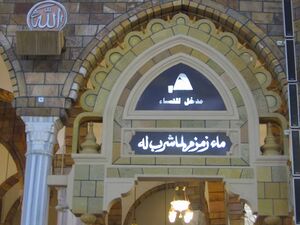
Zamzam (Arabic زَمزَم) refers to the most renowned water well located within the al-Masjid al-Haram in Mecca, situated approximately 21 meters from the sacred Black Stone (al-Hajar al-Aswad). According to historical accounts, the Zamzam spring emerged miraculously by divine will to provide water for Isma'il (a) and his mother, Hajar. The origin of the city of Mecca and the reconstruction of the Ka'ba are believed to be closely linked to the miraculous emergence of the Zamzam spring.
For centuries, the inhabitants of Mecca depended on the Zamzam well for their water supply. However, over time, the well's presence diminished, and it eventually became obscured. After a long time, the responsibility of siqaya (water provision) for the Ka'ba reached 'Abd al-Muttalib, the grandfather of the Prophet Muhammad (s), and the Zamzam well was dug by him, and its water gushed forth once again.
Zamzam water holds profound religious significance for the people of Mecca and the broader Muslim community. The Prophet Muhammad (s) often drank from the well, regarding it as the finest water on earth.
Throughout history, various efforts have been made to preserve and maintain the Zamzam well. The well has a diameter of 1.5 meters and a depth of 30 meters, and it is located 21 meters from the Ka'ba. In response to the growing number of pilgrims, the water from Zamzam has been channeled to taps around the courtyard of the al-Masjid al-Haram, allowing for easier access to this sacred resource.
Numerous travelogues across centuries have referenced the unique aspects of Zamzam, including its proximity to the Ka'ba, the dimensions of the well's mouth, its nearness to the Black Stone, and the installation of a canopy for the muezzins near the well.
Terminology
The term "Zamzam" is derived from the repeated root "zam," which signifies the act of restraining or gathering. Linguistically, it denotes water that is either slow-moving or abundant in flow.[1] In religious and historical terminology, "Zamzam" refers to the revered well situated near the Ka'ba in Mecca, whose origins are traditionally linked to the era of Prophet Ibrahim (a).[2]
According to al-Mas'udi, a historian of the 4th/10th century, the Iranians, considering themselves descendants of Prophet Ibrahim (a), would travel to Mecca during the Sassanid era.[3] It is said that after performing the circumambulation of the Ka'ba, they would murmur (zamzama) over the well, and for this reason, it became known as Zamzam.[4]
Names
Due to its significance and status, Zamzam has various names. Some of these names are mentioned in a narration from Imam Ja'far al-Sadiq (a) as follows:
- Rakdat Jibra'il (footsteps of Gabriel)
- Saqiya Isma'il (watering of Isma'il)
- Hafirat 'Abd al-Muttalib (well dug by 'Abd al-Muttalib)
- Al-Masunah (Precious)
- Saqiya (Watering)
- Shifa' Suqm (healing of illness).[5]
Origin
According to verse 37 of Surah Ibrahim, after Prophet Abraham (a) brought his wife Hajar and his son Isma'il to the arid land of Mecca, where there was no water or vegetation,[6] and left them there as commanded by God, they soon faced severe thirst. In search of water, Hajar made seven trips between the hills of Safa and Marwa.[7] On the seventh time, while she was on Marwa, she saw water gushing from beneath Isma'il's feet.[8]
There are variations in the details of this incident. Some sources attribute the emergence of water from the Zamzam well to the striking of Ishmael's heel on the ground. Others suggest that it was the action of Gabriel, who appeared in human form, either by rubbing his foot or hand on the ground that caused the water to spring forth.[9]
Well of Zamzam
According to al-Azraqi, a Shafi'i historian of the 3rd/9th century, the emergence of a water spring in that desolate and barren region drew the attention of animals and birds. The activity of birds near the Zamzam well caught the eye of a passing caravan from the Jurhum tribe. They approached the well, drank from its water, and filled their containers. Consequently, this tribe settled around Zamzam, leading to the establishment and growth of the city of Mecca.[10]
Drying of Zamzam
During the leadership of Amr b. al-Harith over the Jurhum tribe, there was a significant lapse in their reverence for the sanctity of the al-Masjid al-Haram and the Ka'ba. Acting on Amr's order, sacred objects such as the Black Stone (al-Hajar al-Aswad), offerings, and various items stored in the Ka'ba—including weapons and swords—were thrown into the Zamzam well, which was then filled with soil. Over time, the well's location was flattened, and its existence was gradually forgotten.[11] Even when the Khuza'a tribe succeeded the Jurhum in power, the Zamzam well remained hidden and undiscovered.[12]
Rediscovery of the Zamzam Well by 'Abd al-Muttalib
According to historical records, 'Abd al-Muttalib b. Hashim, the grandfather of Prophet Muhammad (s) and the leader of the Quraysh tribe, received divine inspiration in a dream instructing him to dig the Zamzam well. Guided by the vision, 'Abd al-Muttalib went to the Ka'ba, seeking the signs that would lead him to the exact location of the well. He discovered the signs between the two idols, "Isaf" and "Na'ila," and, with the assistance of his son al-Harith, began digging the ground at that location. Despite facing mockery and resistance from members of the Quraysh tribe, 'Abd al-Muttalib remained steadfast. When the stone lining of the well finally surfaced, he offered thanks to God, confirming the truth of his divine inspiration.
Upon completing the excavation and revealing the water, 'Abd al-Muttalib built a basin beside the Zamzam well. Together with his son al-Harith, they drew water from the well and poured it into the basin, facilitating the distribution of water to the pilgrims.[13] After digging the Zamzam and finding water, 'Abd al-Muttalib revived the work of supplying water to the pilgrims and had it under his control.[14]
After the conquest of Mecca, the destruction of idols, and the removal of images from the walls of the Ka'ba, the Prophet Muhammad (a) was the first to wash the interior of the Ka'ba with Zamzam water. This practice has been maintained up to the present day.[15]
Rulings
'Abd al-Muttalib deemed the consumption of Zamzam water and its use for ablution as permissible (halal), but he did not allow its use for bathing. Similarly, al-'Abbas b. 'Abd al-Muttalib adhered to this view, maintaining that while Zamzam water was lawful for drinking and performing ablution, he did not consider it permissible for bathing.[16]
It has been said that it is recommended for pilgrims to visit the Zamzam well after performing tawaf and before undertaking sa'y (jogging seven times between the hills Safa and Marwa). They are encouraged to drink from its water and perform ghusl (ritual purification). If a pilgrim is unable to perform ghusl, it is advised that they pour a small amount of Zamzam water over themselves.[17] According to al-'Urwa al-wuthqa, it is recommended to wash the shroud with Zamzam water.[18] It is also recommended for an individual to recite the following supplication when drinking Zamzam water: اللّهُمّ اجْعَلْه لی عِلْماً نافِعاً و رِزْقاً واسِعاً و شِفٰاءً مِنْ کُلِّ دٰاءٍ و سَقَمٍ انَّکَ قٰادِر یا رَبَّ العالمین؛, O Allah, make it a beneficial knowledge, abundant provision, and a cure for every illness and disease. Indeed, You are the All-Powerful, O Lord of the worlds."[19]
Characteristics
Al-Azraqi reported that the Zamzam well has a depth of sixty cubits from top to bottom (approx. 30m). The well features water flow from three distinct points: one directly opposite the Black Stone, another aligned with Safa and Abu Qubais, and a third directly opposite Marwa. In the years 223 and 224 AH, to address concerns about the well potentially drying up, an additional nine cubits were added to its depth. Subsequently, in the year 225 AH, increased rainfall and flooding led to an increase in the flow of Zamzam water.[20]
During the reign of certain Abbasid caliphs, the depth of the Zamzam well was increased. Notably, during the rule of Caliph al-Amin (reigned 193-198 AH), the well was subjected to reinforcement and restoration efforts.[21]
Current State
Currently, the Zamzam well has a diameter of 1.5 meters and a depth of 30 meters. It is situated 21 meters from the Ka'ba. The well is lined with masonry for approximately 13 meters of its depth.[22]
Zamzam in Narrations
In the teachings of Ahl al-Bayt (a), drinking Zamzam water is highly recommended. The Prophet Muhammad (s) frequently drank Zamzam water[23] and regarded it as the finest water sourced from the earth.[24]
Imam al-Sajjad (a) instructed a person to make a covenant with God at the Zamzam well to seek guidance away from sins and disobedience.[25] According to Aisha, the Prophet Muhammad (s) would carry Zamzam water to the sick for drinking or to pour over them for healing.[26]
Throughout History
Historical records detail the evolution, restorations, and repairs of the Zamzam well across different eras. Accounts from travelers and historians provide insights into the well's features and the modifications it has undergone over time.
Constructions and Renovations
The initial construction of marble linings for the Zamzam well's walls and floor was initiated by Abbasid Caliph al-Mansur (reigned 136-158 AH) and completed by his successor, al-Mahdi (reigned 158-169 AH). Following this, the well remained exposed until the reign of al-Mu'tasim (reigned 218-227 AH), with only a small dome covering its opening. In 220 AH, Umar b. Faraj al-Rukhji, a writer and secretary under al-Mu'tasim, installed a teak wood roof over the Zamzam well, suspended chains, and affixed lamps to them, which were lit during the pilgrimage season at night.[27]
In 1020 AH, Sultan Ahmad Khan ordered the installation of an iron grille situated one meter above the water level in the Zamzam well. This precaution was introduced due to incidents where individuals, driven by misguided acts of self-sacrifice, had thrown themselves into the well and perished. The grille remained in place until 1318 AH. Additionally, in 1201 AH, under the orders of Sultan Abd al-Hamid Khan, an inscription was placed on the northern side of the building, which read: "Zamzam water is a cure for every illness" and "The sign between us and the hypocrites is that they do not quench their thirst with Zamzam water." [28]
%DB%B2.jpeg)
In 1383 AH, during the Saudi era, the structure covering the Zamzam well was dismantled, and a new underground facility was constructed. This included creating an entrance to the basement, allowing pilgrims direct access to the well water. However, in 1424 AH, this entrance was sealed, and the water was redirected through a network of pipes around the courtyard of the al-Masjid al-Haram. This modification provided faucets for pilgrims to drink from and expanded the circumambulating area.[29]
According to Saudi sources, Zamzam water is transported through a four-kilometer pipeline and stored in a 5,000-cubic-meter reservoir. The water undergoes purification and sterilization processes before being bottled in five-liter containers. Additionally, Zamzam water is dispensed through drinking fountains within the al-Masjid al-Haram and is also transported to the Prophet's Mosque in Medina for the benefit of pilgrims.[30]
In Travelogues
Travelogues from different centuries provide detailed descriptions of Zamzam, noting its distance from the Ka'ba, the dimensions of its mouth, and its proximity to the al-Hajar al-Aswad.[31] These accounts often highlight its function as a site where pilgrims perform ablution,[32] the presence of surrounding pools, and the construction of a canopy near the well for the convenience of muezzins.[33]
Gallery
-
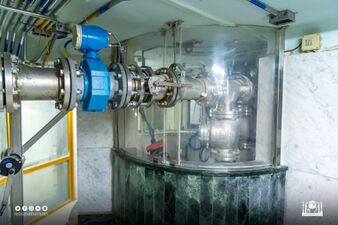 The Zamzam Well outlet underground (2022 CE)
 -
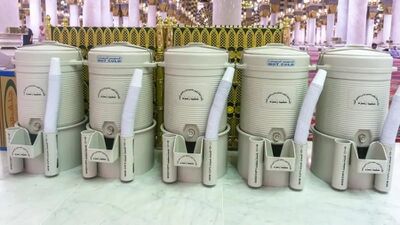 Zamzam water tanks in the Prophet's Mosque for pilgrims' consumption.
 -
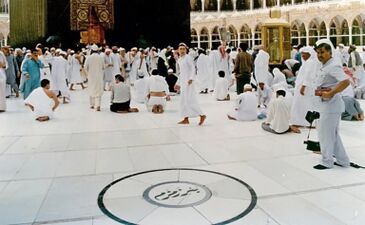 An old photograph of the Zamzam Well's location relative to the Ka'ba.


Notes
- ↑ Mu'jam al-Buldan, vol. 3, p. 166.
- ↑ Akhbār Makka, vol. 2, p. 39.
- ↑ Muruj al-dhahab, vol. 1, p. 265.
- ↑ Lisān al-ʿArab, vol. 6, p. 85; Mu'jam al-Buldan, vol. 3, p. 166.
- ↑ Wasāʾil al-Shīʿa, vol. 13, p. 474, H18242.
- ↑ Sūra Ibrāhīm, verse 37.
- ↑ Al-Tafsīr al-ṣāfī, vol. 3, p. 93.
- ↑ Al-Tafsīr al-ṣāfī, vol. 3, p. 93.
- ↑ Akhbār Makka, vol. 2, S40
- ↑ Akhbār Makka, vol. 2, p. 40-41.
- ↑ Al-Sīra al-Nabawīyya, vol. 1, part 2, p. 111.
- ↑ Al-Sīra al-Nabawīyya, vol. 1, part 2, p. 117.
- ↑ Al-Sīra al-Nabawīyya, vol. 1, part 2, p. 142; Azraqī, Akhbār Makka, p. 336.
- ↑ Al-Sīra al-Nabawīyya, vol. 1, part 2, p. 143.
- ↑ Kanz al-ʿummāl, vol. 5, p. 299.
- ↑ Fākihī, Akhbār Makka, vol. 2, p. 63.
- ↑ Jawāhir al-kalām, vol. 19, p. 411; Silsilat yanābīʿ al-fiqhīyya, vol. 8, p. 461.
- ↑ Al-ʿUrwa al-wuthqā, vol. 2, S75.
- ↑ Mustadrak al-wasāʾil, vol. 9, p. 439.
- ↑ Azraqī, Akhbār Makka, vol. 2, p. 61.
- ↑ Azraqī, Akhbār Makka, vol. 2, p. 61.
- ↑ "Zamzam", Dānishnāma-yi ḥajj wa Ḥaramayn sharīfayn
- ↑ Sunan al-Nasāʾī, vol. 5, p. 237.
- ↑ Mustadrak al-wasāʾil, vol. 9, p. 439
- ↑ Al-Durr al-manthūr, vol. 3, p. 223; Fākihī, Akhbār Makka, vol. 2, p. 46.
- ↑ Shifā' al-gharām, vol. 1, p. 415; Sunan al-Tirmidhī, vol. 3, p. 295.
- ↑ Azraqī, Akhbār Makka, vol. 2, S61.
- ↑ Hajj dar andīsha-yi Islāmī, p. 184-185.
- ↑ Biʾr Zamzam, "Journey of the Blessed Water", Taṭwīr wa Tashghīl al-Idārah al-ʿĀmmā li-Taqnīyat al-Maʿlumāt bi-l-Riʾāsa al-ʿĀmmā li-Shuʾūn al-Masjid al-Ḥarām wa al-Masjid al-Nabawī, accessed on 9th Tir 1401 Sh.
- ↑ Riḥlat māʾ Zamzam min al-bīʾr ilā an yarwī zamaʾ al-muʾminīn, "The Journey of Zamzam Water from the Well to Quenching the Thirst of Pilgrims", Akhbaruna News Agency, April 13, 2022, accessed on June 27, 2024.
- ↑ Rahāward-i safar, p. 122; Muḥammad ibn Aḥmad ibn Jubayr, Safarnāma-yi Ibn Jubayr, p. 126; Safarnāma-yi Ibn Baṭṭūṭa, vol. 1, p. 189.
- ↑ Safarnāma-yi Ibn Baṭṭūṭa, vol. 1, p. 189.
- ↑ See: Hajj dar andīsha-yi Islāmī, p. 180-185.
References
- Akhbār Makka fī qadīm al-dahri wa ḥadīthihī, Muḥammad b. Isḥāq al-Fākihī (died: 275 AH), Beirut, Dār Khiḍr, 1414 AH.
- Akhbār Makka wa mā jāʾa fī-hā min al-āthār, Muḥammad b. ʿAbd Allāh al-Azraqī, Beirut, Dār al-Andalus, 1416 AH.
- Al-Durr al-manthūr fī l-tafsīr bi-l-maʾthūr, Jalāl al-Dīn al-Suyūtī, Qom, Āyatollāh Marashī Najafī Library, 1404 AH.
- Al-Sīra al-Nabawīyya, ʿAbd al-Malik b. Hishām, Beirut, Dār al-Maʿrifa, n.d.
- Al-Tafsīr al-ṣāfī, Mullā Muḥsin Fayḍ Kāshānī, Qum, Mūʾassisat al-Hādī, 1416 AH / 1374 SH.
- Al-ʿUrwa al-wuthqā, al-Sayyid Muḥammad Kāẓim al-Ṭabāṭabā'ī al-Yazdī, Qum, Mūʾassisat al-Nashr al-Islāmī, 1419 AH.
- Biʾr Zamzam, "Journey of the Blessed Water", Taṭwīr wa Tashghīl al-Idārah al-ʿĀmmā li-Taqnīyat al-Maʿlumāt bi-l-Riʾāsa al-ʿĀmmā li-Shuʾūn al-Masjid al-Ḥarām wa al-Masjid al-Nabawī, accessed on 9th Tir 1401 Sh.
- Kanz al-ʿummāl fī sunan al-aqwāl wa al-afʿāl, al-Muttaqī al-Hindī, Beirut, al-Risāla, 1413 AH.
- Lisān al-ʿArab, Muḥammad b. Mukarram b. Manẓūr, Beirut, Dār Ṣādir, 1414 AH.
- Muʿjam al-Buldān, Yāqūt al-Ḥamawī, Beirut, Dār Iḥyāʾ al-Turāth al-ʿArabī.
- Muruj al-dhahab, ʿAlī b. Ḥusayn al-Masʿūdī, Qum, Mū'assisa Dār al-Hijra, 1409 AH.
- Mustadrak al-wasāʾil, Ḥusayn Nūrī Ṭabrisī, Beirut, Mūʾassisat Āl al-Bayt li-Iḥyāʾ al-Turāth, 1408-1429 AH / 1987-2008.
- Rahāward-i safar, (Selections from the Travelogue of Naṣir Khusruw) by Nasir Khusruw Qubādīyānī, Tehran, Sukhan, 1995 CE (1374 SH).
- Riḥlat al-māʾ al-mubārak, "Journey of the Blessed Water", developed and managed by the General Administration for Information Technology at the Presidency of the Two Holy Mosques, April 12, 2022, accessed on June 30, 2022.
- Riḥlat al-māʾ al-mubārak, Al-Fawz Kuwaiti Newspaper website, April 4, 2022, accessed July 1, 2022.
- Riḥlat māʾ Zamzam min al-bīʾr ilā an yarwī zamaʾ al-muʾminīn, "The Journey of Zamzam Water from the Well to Quenching the Thirst of Pilgrims", Akhbaruna News Agency, April 13, 2022, accessed on June 27, 2024.
- Safarnāma-yi Ibn Baṭṭūṭa, Ibn Baṭṭūṭah, trans. Muḥammad ʿAlī Muwaḥḥid, Mashhad, Mūʾassisa-yi Intishārāt-i Āgāh, 1370 SH.
- Safarnāma-yi Ibn Jubayr, Muḥammad b. Aḥmad b. Jubayr, trans. Parvīz Atābakī, Mashhad, Mū'assasa-yi Chāp wa Intishārāt-i Āstān-i Quds-i Raḍawī, 1370 SH.
- Shifāʾ al-gharām bi-akhbār al-Balad al-Ḥarām, al-Taqī al-Fāsī.
- Silsilat yanābīʿ al-fiqhīyya, ʿAlī Aṣghar Murwārīd, Beirut, Dār al-Turāth, 1990 - 1993.
- Sunan al-Nasāʾī, Aḥmad b. Shuʿayb al-Nasāʾī, Beirut, Dār al-Kutub al-ʿIlmīyya, 1411 AH.
- Sunan al-Tirmidhī, Muḥammad b. ʿĪsā al-Tirmidhī, Beirut, Dār al-Fikr, 1402 AH.
- Wasāʾil al-Shīʿa, Muhammad b. Hasan al-Hurr al-ʿĀmilī, Qom, Mūʾassisat Āl al-Bayt li-Iḥyāʾ al-Turāth, 1416 AH.
- "Zamzam", Sayyid Alī Khayrkhāh ʿAlawī, Dānishnāma-yi ḥajj wa Ḥaramayn sharīfayn, vol. 8.