
Tomb of Khadija(a): Difference between revisions
No edit summary |
m Text replacement - " <ref>" to "<ref>" Tags: Mobile edit Mobile web edit |
||
| (4 intermediate revisions by one other user not shown) | |||
| Line 82: | Line 82: | ||
Subsequently, a wooden enclosure was constructed around the grave. This early attempt to mark and protect the site reflects the reverence accorded to Lady Khadijah and the desire to preserve her resting place with due honor.<ref>Ṣabbāgh, ''Taḥṣīl al-marām'', vol. 2, p. 647.</ref> | Subsequently, a wooden enclosure was constructed around the grave. This early attempt to mark and protect the site reflects the reverence accorded to Lady Khadijah and the desire to preserve her resting place with due honor.<ref>Ṣabbāgh, ''Taḥṣīl al-marām'', vol. 2, p. 647.</ref> | ||
In 950 AH, [[Muhammad ibn Sulayman]], a distinguished and prominent official from [[Egypt]], undertook the task of constructing a stone dome and shrine for the grave of Lady Khadijah. <ref>Ṣabbāgh, ''Taḥṣīl al-marām'', vol. 2, p. 647.</ref> | In 950 AH, [[Muhammad ibn Sulayman]], a distinguished and prominent official from [[Egypt]], undertook the task of constructing a stone dome and shrine for the grave of Lady Khadijah.<ref>Ṣabbāgh, ''Taḥṣīl al-marām'', vol. 2, p. 647.</ref> | ||
Alongside the newly erected stone structure, a wooden enclosure was placed over the grave, and it was adorned with a luxurious textile. To ensure proper maintenance and respect for the site, a dedicated caretaker was appointed. This initiative highlighted the continued reverence for Lady [[Khadijah]] and demonstrated a commitment to preserving her sacred resting place.<ref>Ṣabbāgh, ''Taḥṣīl al-marām'', vol. 2, p. 647; Gāzī, ''Ifādat al-anām'', vol. 2, p. 150.</ref> | Alongside the newly erected stone structure, a wooden enclosure was placed over the grave, and it was adorned with a luxurious textile. To ensure proper maintenance and respect for the site, a dedicated caretaker was appointed. This initiative highlighted the continued reverence for Lady [[Khadijah]] and demonstrated a commitment to preserving her sacred resting place.<ref>Ṣabbāgh, ''Taḥṣīl al-marām'', vol. 2, p. 647; Gāzī, ''Ifādat al-anām'', vol. 2, p. 150.</ref> | ||
Following its destruction by the forces of the Saudi dynasty, the shrine of Lady Khadijah was reconstructed in 1242 AH.<ref>Gāzī, ''Ifādat al-anām'', vol. 2, p. 151.</ref> This restored structure remained intact through the 14th century AH. Historical accounts indicate that textiles were sent by the Ottoman rulers of Egypt to be used for covering the wooden enclosure of the shrine. This gesture underscores the enduring commitment of successive rulers to honor and preserve the sacred site of Lady Khadijah's resting place.<ref>Gāzī, ''Ifādat al-anām'', vol. 2, p. 170.</ref> | Following its destruction by the forces of the Saudi dynasty, the shrine of Lady Khadijah was reconstructed in 1242 AH.<ref>Gāzī, ''Ifādat al-anām'', vol. 2, p. 151.</ref> This restored structure remained intact through the 14th century AH. Historical accounts indicate that textiles were sent by the Ottoman rulers of Egypt to be used for covering the wooden enclosure of the shrine. This gesture underscores the enduring commitment of successive rulers to honor and preserve the sacred site of Lady Khadijah's resting place.<ref>Gāzī, ''Ifādat al-anām'', vol. 2, p. 170.</ref> | ||
| Line 89: | Line 89: | ||
==Destruction of the Mausoleum== | ==Destruction of the Mausoleum== | ||
With the rise of [[ | With the rise of the [[Wahhabi's]] movement and the establishment of the first Saudi state, a significant transformation occurred in the historical landscape of Mecca. On Wednesday, 29 Rabi' al-Thani 1218 AH, the Wahhabi forces undertook the demolition of all existing structures, including domes and buildings, within [[Jannat al-Mu'alla]]. This action resulted in the complete leveling of the graves in the cemetery, erasing the previous architectural and commemorative landmarks.<ref>Sanjārī, ''Manāʾiḥ al-karam''.vol. 4, p. 422; Amīn, ''Kashf al-irtīyāb'', p. 27.</ref> | ||
The destruction was part of a broader effort by the Wahhabis to reform and purify Islamic practices according to their interpretation, which included the removal of structures deemed as innovations or deviations from their understanding of Islam. | |||
Following the fall of the first Saudi state to Ottoman forces, there was a brief period during which the grave of [[Lady Khadijah]] was honored with the reconstruction of a new dome and shrine. This effort aimed to restore the reverence and historical significance of the site. | |||
However, this restoration was short-lived. The renewed shrine was demolished in 1343 AH, coinciding with the establishment of the third Saudi state. This final destruction marked a significant shift in the treatment of historical and religious sites in Mecca, reflecting the ongoing changes in political and religious policies over time.<ref>Gāzī, ''Ifādat al-anām'',vol. 2, p. 151.</ref> | |||
''' Related Topics''': | |||
* [[Lady Khadijah (S)]] | |||
* [[Jannat al-Mu'alla]] | |||
==Notes== | ==Notes== | ||
Latest revision as of 12:38, 5 March 2025
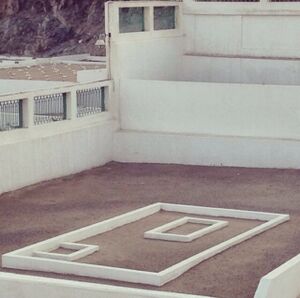 The tomb of Khadija (right square) and her son Qasim (left square) | |
| General Information | |
|---|---|
| Place | cemetery of Abu Talib, Jannat al-Mu'lla |
| History | |
| Events | Destruction of Jannah al-Mu'alla cemetery in the years 1218 AH/1803 and 1343 AH/1924-5 |
The Grave of Lady Khadijah (AS), daughter of Khuwaylid and wife of Prophet Muhammad (S), is situated in the Abu Talib cemetery, also known as Jannat al-Mu'alla or Hujun, in Mecca. Historical accounts reveal that Khadijah's (S) body was interred in the Hujun area of this cemetery. However, the exact location of her grave remained unidentified until the 8th century AH (14th century CE).
In the early 8th century AH, a specific site within the Ma'ala cemetery in Mecca was designated as the resting place of Lady Khadijah (S). At this location, a gravestone was erected to honor her memory. Over time, a mausoleum was constructed at the site. This mausoleum, which included a prominent dome, was subject to several modifications and reconstructions.
The original mausoleum was demolished in 1218 AH by the Wahhabis. It was subsequently rebuilt but faced destruction once more in 1343 AH with the establishment of the Saudi state. Despite these events, the grave of Lady Khadijah (S) remains a site of historical and religious significance, reflecting the challenges faced in preserving sacred sites in Islamic history.
Lady Khadija (S)
Lady Khadijah bint Khuwaylid (S) holds a distinguished place in Islamic history as the first wife of Prophet Muhammad (S).[1] ) Her marriage to the Prophet (S) occurred when he was 25 years old, marking the beginning of a significant partnership that would greatly influence the early years of Islam.[2] Khadijah (AS) and Muhammad (S) were united in marriage at a time when the Prophet was embarking on his career as a respected merchant in Mecca. This union was both a personal and strategic alliance, as Khadijah (AS) was a wealthy and esteemed businesswoman of the Quraysh tribe. Their marriage lasted for approximately 25 years, during which they had six children. The couple had two sons, Qasim and Abdullah, and four daughters: Zainab, Ruqayyah, Umm Kulthum, and Fatimah (AS).[3] According to a well-known narration by Prophet Muhammad (S), Khadijah (AS) is listed among the four most revered women in history, alongside Fatimah (S), Maryam (Mary), and Asiya. This recognition underscores her exceptional status and the profound impact she had on both the Prophet's personal life and the broader Islamic tradition.[4] Her contributions and virtues are reflected in numerous Islamic texts and traditions, which highlight her pivotal role in supporting the Prophet (S) and fostering the early Muslim community. Khadijah (S) passed away on the 10th of Ramadan in the 10th year of the Prophetic mission in Mecca, leaving behind a lasting legacy that continues to inspire and inform the Islamic faith.[5]
Historical Reports on the Location of the Grave
Sources indicate that Lady Khadijah (S) was buried in the cemetery of Hujun, which is also known as the Jannat al-Mu'alla cemetery. This cemetery is located in the area of Bab al-Mu'alla, and it is often referred to by this name in historical and religious texts.[6] The earliest documented references to the precise location of Lady Khadijah's (S) grave appear in sources from the eighth century. Before this period, the exact location of her burial site was not well established. Ibn Jubayr (d. 614 AH), writing in the sixth century, reported that the graves in the Hujun cemetery, located at Bab al-Mu'alla, had fallen into disrepair and were largely forgotten.[7] In 696 AH, the esteemed traveler Tajibi documented his observations of Mecca, providing insights into the local beliefs regarding the resting place of Lady Khadijah (S). According to the accounts from the residents of Mecca at that time, it was commonly believed that Lady Khadijah's grave was situated in a specific niche located in the Ma'ala area of the cemetery. Despite these assertions, Tajibi noted that no visible grave was discernible at that particular location. This discrepancy highlights the historical challenges in pinpointing exact burial sites and reflects the evolving understanding and reverence of sacred sites in the Islamic heritage.[8] It was not until the eighth century AH that the grave of Lady Khadijah (S) became widely recognized and referenced in historical sources as being located in Jannat al-Mu'ala. During his stay in Mecca between 729 and 730 AH, the renowned traveler Ibn Battuta reported that only a few graves, including that of Lady Khadijah, were identifiable within the Ma'ala cemetery. This period marks a significant moment in the documentation and acknowledgment of Lady Khadijah’s resting place, reflecting the evolving historical and religious landscape of Mecca.[9] In the eighth century AH, the geographer Murjani (d. 770 AH) reported that the exact location of Lady Khadijah's grave in Mecca was not definitively known. However, according to his account, it was revealed to a pious individual through a dream or vision that Lady Khadijah's grave was situated next to the tomb of Fudayl ibn 'Iyad. Following this revelation, a stone was placed at the site in the year 749 AH to mark her resting place. This development highlights the ongoing efforts during this period to identify and honor the graves of significant historical and religious figures.[10] The renowned historian of Mecca, Fasi (d. 832 AH), expressed skepticism about the authenticity of attributing a specific grave to Lady Khadijah (peace be upon her) within Jannat al-Mu'alla. Fasi questioned whether the grave attributed to her was genuinely hers, and he even suggested that no companions of the Prophet (peace be upon him) were buried in the Ma'ala cemetery.[11] Some contemporary researchers also share this skepticism, raising doubts about the accuracy of the grave’s attribution to Lady Khadijah. This ongoing uncertainty reflects the complexities and challenges involved in historically verifying sacred sites associated with prominent figures of Islamic history.[12]
Construction of the Dome and Shrine

In the year 749 AH, a stone bearing the inscription "This is the grave of Lady Khadijah" was placed over her grave.[13]
Subsequently, a wooden enclosure was constructed around the grave. This early attempt to mark and protect the site reflects the reverence accorded to Lady Khadijah and the desire to preserve her resting place with due honor.[14]
In 950 AH, Muhammad ibn Sulayman, a distinguished and prominent official from Egypt, undertook the task of constructing a stone dome and shrine for the grave of Lady Khadijah.[15] Alongside the newly erected stone structure, a wooden enclosure was placed over the grave, and it was adorned with a luxurious textile. To ensure proper maintenance and respect for the site, a dedicated caretaker was appointed. This initiative highlighted the continued reverence for Lady Khadijah and demonstrated a commitment to preserving her sacred resting place.[16] Following its destruction by the forces of the Saudi dynasty, the shrine of Lady Khadijah was reconstructed in 1242 AH.[17] This restored structure remained intact through the 14th century AH. Historical accounts indicate that textiles were sent by the Ottoman rulers of Egypt to be used for covering the wooden enclosure of the shrine. This gesture underscores the enduring commitment of successive rulers to honor and preserve the sacred site of Lady Khadijah's resting place.[18] For instance, Farahani, in 1302 AH, referred to the wooden enclosure of the grave.[19] Additionally, Refaat Pasha, writing in 1318 AH, reported on the prominent dome of Lady Khadijah's tomb. These accounts reflect the continued significance and recognition of the shrine during these periods.[20]
Destruction of the Mausoleum
With the rise of the Wahhabi's movement and the establishment of the first Saudi state, a significant transformation occurred in the historical landscape of Mecca. On Wednesday, 29 Rabi' al-Thani 1218 AH, the Wahhabi forces undertook the demolition of all existing structures, including domes and buildings, within Jannat al-Mu'alla. This action resulted in the complete leveling of the graves in the cemetery, erasing the previous architectural and commemorative landmarks.[21] The destruction was part of a broader effort by the Wahhabis to reform and purify Islamic practices according to their interpretation, which included the removal of structures deemed as innovations or deviations from their understanding of Islam.
Following the fall of the first Saudi state to Ottoman forces, there was a brief period during which the grave of Lady Khadijah was honored with the reconstruction of a new dome and shrine. This effort aimed to restore the reverence and historical significance of the site.
However, this restoration was short-lived. The renewed shrine was demolished in 1343 AH, coinciding with the establishment of the third Saudi state. This final destruction marked a significant shift in the treatment of historical and religious sites in Mecca, reflecting the ongoing changes in political and religious policies over time.[22]
Related Topics:
Notes
- ↑ Ibn Isḥāq, Sīra Ibn Isḥāq: al-Sīra al-Nabawiyya li Ibn Isḥāq, p. 245; Ibn Maghāzīlī, Manāqib ʿAlī b. Abī Ṭālib, vol 1, p. 149; Shahīdī, Tārīkh-i taḥlīlī-yi Islām, p. 39-40.
- ↑ Shahīdī, Tārīkh-i taḥlīlī-yi Islām, p. 39-40.
- ↑ Ziriklī, Al-Aʿlām, vol. 2, p. 302.
- ↑ Ibn Kathīr, Al-Bidāya wa l-nihāya, vol. 2, p. 129.
- ↑ Ibn Saʿd, Al-Ṭabaqāt al-kubrā, vol. 8, p. 14; Ibn Hishām, Al-Sīra al-nabawīyya, vol. 1, p. 416.
- ↑ Maqrizī, Imtāʿ al-asmāʾ, vol. 6, p. 30.
- ↑ Ibn Jubayr, Riḥla Ibn Jubayr, p. 78.
- ↑ Tajībī, Mustafād al-riḥla wa al-ightirāb, p. 340-341.
- ↑ Ibn Baṭūṭa, Al-Raḥla Ibn Baṭūṭa,vol. 1, p. 381; Shahīd al-Awwal, Al-Durūs al-sharʿīyya fī fiqh al-imāmiyya, vol. 1, p. 468.
- ↑ Marjānī,Bahjat al-nufūs wa al-asrār, vol. 2, p. 1016.
- ↑ Fāsī al-Makkī, Shifāʾ al-gharām bi akhbār al-balad al-ḥarām, vol. 1, p. 376.
- ↑ Jāsir, Al-ʿArab al-sunna al- ʿĀshira, vol. 3 and 4, p. 278-279.
- ↑ Ṣabbāgh, Taḥṣīl al-marām, vol. 2, p. 646.
- ↑ Ṣabbāgh, Taḥṣīl al-marām, vol. 2, p. 647.
- ↑ Ṣabbāgh, Taḥṣīl al-marām, vol. 2, p. 647.
- ↑ Ṣabbāgh, Taḥṣīl al-marām, vol. 2, p. 647; Gāzī, Ifādat al-anām, vol. 2, p. 150.
- ↑ Gāzī, Ifādat al-anām, vol. 2, p. 151.
- ↑ Gāzī, Ifādat al-anām, vol. 2, p. 170.
- ↑ Farāhānī, Safarnāma-yi Mīrzā Muḥammad Ḥusayn Farāhānī, p. 202.
- ↑ Rafʿat Pāshā, Mirʾāt al-ḥaramayn ,vol. 1, p. 30.
- ↑ Sanjārī, Manāʾiḥ al-karam.vol. 4, p. 422; Amīn, Kashf al-irtīyāb, p. 27.
- ↑ Gāzī, Ifādat al-anām,vol. 2, p. 151.
References
- Amīn, Sayyid Muḥsin al-. Kashf al-irtīyāb. Edited by Ḥasan al-Amīn. Qom: Maktabat al-Ḥarīs, 1382 AH.
- Farāhānī, Muḥammad Ḥusayn. Safarnāma-yi Mīrzā Muḥammad Ḥusayn Farāhānī. Tehran: Firdaws, 1362 Sh.
- Fāsī al-Makkī, Muḥammad b. Aḥmad. Shifāʾ al-gharām bi akhbār al-balad al-ḥarām.
- Ibn al-Athīr al-Jazarī, ʿAlī b. Muḥammad. Usd al-ghāba fī maʿrifat al-ṣaḥāba. Beirut: Dār al-Fikr, 1409 AH.
- Gāzī, ʿAbdullāh b. Muḥammad al-. Ifādat al-anām. Mecca: Maktabat al-Asadī, 1430 AH.
- Ibn Baṭūṭa, Muḥammad b. ʿAbd Allāh. Al-Raḥla Ibn Baṭūṭa. Edited by ʿAbd al-Hādī Tāzī. Rabat: Ākādimīyya al-Mamlikat al-Maghribīyya, 1417 AH.
- Ibn Hishām, ʿAbd al-Malik. Al-Sīra al-nabawīyya. Edited by Muṣṭafā al-Saqā. Beirut: Dār al-Maʿrifa, [n.d].
- Ibn Isḥāq, Muḥammad. Sīra Ibn Isḥāq: al-Sīra al-Nabawiyya li Ibn Isḥāq. Edited by Aḥmad Farīd al-Mazīdī. Beirut: Dār al-Kutub al-ʿIlmiyya, 1424 AH.
- Ibn Jubayr, Muḥammad b. Aḥmad. Riḥla Ibn Jubayr. Beirut: Dār al-Maktaba al-Hilāl, 1986.
- Ibn Kathīr, Ismāʿīl b. ʿUmar. Al-Bidāya wa l-nihāya. Beirut: Dār al-Fikr, 1407 AH.
- Ibn Maghāzīlī, ʿAlī b. Muḥammad. Manāqib ʿAlī b. Abī Ṭālib. Beirut: Dār al-Aḍwaʾ, 1424 AH.
- Ibn Saʿd, Muḥammad b. Manīʿ al-Ḥāshimī al-Baṣrī. Al-Ṭabaqāt al-kubrā. Edited by Muḥammad ʿAbd al-Qādir ʿAṭā. Beirut: Dar al-Kutub al-ʿIlmiyya,1410AH-1990.
- Jāsir, Ḥamad al-. Al-ʿArab al-sunna al- ʿĀshira. Riyadh: n.p, n.d.
- Maqrizī, Aḥmad b. ʿAlī. Imtāʿ al-asmāʾ. Edited by Muḥammad ʿAbd al-Ḥamīd al-Namīsī. Beirut: Dār al-Kutub al-ʿIlmiyya, 1420 AH.
- Marjānī, ʿAbdullāh al-. Bahjat al-nufūs wa al-asrār. Beirut: Dār al-Gharb al-Islāmī, 2002.
- Rafʿat Pāshā, Ibrāhīm. Mirʾāt al-ḥaramayn, aw, al-raḥlāt al-ḥijāziyya wa al-ḥaj wa mashāʿirihi al-dīniyya. Beirut: Dār al-Maʿrifa, [n.d].
- Ṣabbāgh, Muḥammad. Aḥmad. Taḥṣīl al-marām. Mecca, Maktabat al-Asadī, 1424 AH.
- Sanjārī,ʿAlī b. Tāj al-ddīn al-.Manāʾiḥ al-karam. Mecca: umm al-qurā university, 1998.
- Shahīd al-Awwal, Muḥammad b. Makkī. Al-Durūs al-sharʿīyya fī fiqh al-imāmiyya. Qom: Intishārāt-i Islāmī (Jāmiʿat al-Mudarrisīn,1417 AH.
- Shahīdī, Sayyid Jaʿfar. Tārīkh-i taḥlīlī-yi Islām. Tehran: Markaz-i Nashr-i Dānishgāhī, 1390 Sh.
- Tajībī, Qāsim b. Yūsuf.Mustafād al-riḥla wa al-ightirāb. Edited by ʿAbd al-Ḥafiẓ Mansūr. Tunisia, Dār al- ʿarabīyya li-l kitāb, 1975.
- Ziriklī, Khayr al-Dīn al-. Al-Aʿlām qāmus tarājum li ashhur al-rijāl wa al-nisāʾ min al-ʿarab wa al-mustaʿribīn wa al-mustashriqīn. Eighth edition. Beirut: Dār al-ʿIlm li-l-Malāyyīn, 1989.