
Birthplace of the Holy Prophet (s): Difference between revisions
Pourghorbani (talk | contribs) No edit summary |
Pourghorbani (talk | contribs) No edit summary |
||
| (5 intermediate revisions by the same user not shown) | |||
| Line 52: | Line 52: | ||
| map description = | | map description = | ||
}} | }} | ||
'''Birthplace of the Holy Prophet (s)'''(Arabic: مولد النبی) is the house of [[Abdullah b. Abdul-Muttalib]], where the prophet was born; this place is located in the city of [[Mecca]], in the neighborhood of [[Sha'ab Abi Talib]]. In the second century of hijra, [[Khayzaran]], the mother of [[Harun al-Rashid]], bought that place and converted it into a mosque. | '''Birthplace of the Holy Prophet (s)''' (Arabic: مولد النبی) is the house of [[Abdullah b. Abdul-Muttalib]], where the prophet was born; this place is located in the city of [[Mecca]], in the neighborhood of [[Sha'ab Abi Talib]]. In the second century of hijra, [[Khayzaran]], the mother of [[Harun al-Rashid]], bought that place and converted it into a mosque. | ||
Reports from the sixth century onwards indicate that a decorated marble stone was erected as a commemoration of the Prophet's birthplace in a section of the mosque. In the reconstruction of 1009 AH/ 1600-1, a grand dome and minaret were built for this mosque. | Reports from the sixth century onwards indicate that a decorated marble stone was erected as a commemoration of the Prophet's birthplace in a section of the mosque. In the reconstruction of 1009 AH/ 1600-1, a grand dome and minaret were built for this mosque. | ||
The Mosque of the Birthplace of the Prophet was considered one of the sacred places in Mecca, and every year on the night of the Prophet's birth, the people of Mecca would gather there. | The Mosque of the Birthplace of the Prophet was considered one of the sacred places in Mecca, and every year on the night of the Prophet's birth, the people of Mecca would gather there. | ||
| Line 87: | Line 87: | ||
Mullah Ibrahim Kaziruni, who was fortunate enough to visit this house in the year 1315 AH/1897-8, writes: "On Friday, the fourteenth, we went to visit the site known as the birthplace of the Proph(s), which is located in [[Suq al-Layl]]. We entered through the door and descended approximately fourteen steps. We entered a room designated as a mosque. After that, we went into another room where there is a shrine. The caretaker opened the door of the shrine. Inside the shrine, there is a cavity. In the middle of it was a green stone which was the place of birth of the Seal of the Prophets.<ref>Kāzirūnī, ''Safarnāma- yi Mulla Ibrāhīm Kāzirūnī, Mīrāth Islāmī Iran'', p. 366.</ref> | Mullah Ibrahim Kaziruni, who was fortunate enough to visit this house in the year 1315 AH/1897-8, writes: "On Friday, the fourteenth, we went to visit the site known as the birthplace of the Proph(s), which is located in [[Suq al-Layl]]. We entered through the door and descended approximately fourteen steps. We entered a room designated as a mosque. After that, we went into another room where there is a shrine. The caretaker opened the door of the shrine. Inside the shrine, there is a cavity. In the middle of it was a green stone which was the place of birth of the Seal of the Prophets.<ref>Kāzirūnī, ''Safarnāma- yi Mulla Ibrāhīm Kāzirūnī, Mīrāth Islāmī Iran'', p. 366.</ref> | ||
Mohammad Labib Bitouni, who traveled to Mecca in the year 1327 AH/1909/10, depicted the above plan of the structure of the Prophet's birthplace in his travelogue and described it as follows: "Upon entering it, you first enter an open space measuring 12 meters in length and 6 meters in width, with a door on the right wall. After passing through it, you enter a space where a dome is placed. In the middle of this space, and under the dome, there is a niche made of wood leaning towards the west wall, within which a concave marble stone can be seen, slightly recessed in the middle. This location indicates the birthplace of the Prophet."<ref>Batanūnī, ''Safarnāma- yi Ḥijāz'', p. 146.</ref> | Mohammad Labib Bitouni, who traveled to Mecca in the year 1327 AH/1909/10, depicted the above plan of the structure of the Prophet's birthplace in his travelogue and described it as follows: "Upon entering it, you first enter an open space measuring 12 meters in length and 6 meters in width, with a door on the right wall. After passing through it, you enter a space where a dome is placed. In the middle of this space, and under the dome, there is a niche made of wood leaning towards the west wall, within which a concave marble stone can be seen, slightly recessed in the middle. This location indicates the birthplace of the Prophet."<ref>Batanūnī, ''Safarnāma- yi Ḥijāz'', p. 146.</ref> | ||
==Reconstructions== | ==Reconstructions== | ||
[[file:مولد النبی پیش از تخریب.jpg|thumbnail|Left| A photo of Birthplace of the Holy Prophet building before its destruction, where the dome and minaret can be seen.]] | |||
The building of the Prophet's birthplace received attention from emirs and sultans and underwent several reconstructions. The list of these reconstructions is as follows: | The building of the Prophet's birthplace received attention from emirs and sultans and underwent several reconstructions. The list of these reconstructions is as follows: | ||
| Line 114: | Line 117: | ||
==Destruction of buildings and the construction of a library== | ==Destruction of buildings and the construction of a library== | ||
[[file:تصویر قدیمی مکتبه مکه مکرمه.jpg|thumbnail|An old picture of the library building.]] | |||
In the Al Saud government, the structure of the Prophet's birthplace, like many other ancient buildings in [[Mecca]], was demolished on the pretext that people excessively sought blessings from it.<ref>Bilādī, ''Maʿālim makka al-tārīkhīyya wa al-atharīyya'', p. 294.</ref> It was demolished in the year 1343/1924-5. | In the Al Saud government, the structure of the Prophet's birthplace, like many other ancient buildings in [[Mecca]], was demolished on the pretext that people excessively sought blessings from it.<ref>Bilādī, ''Maʿālim makka al-tārīkhīyya wa al-atharīyya'', p. 294.</ref> It was demolished in the year 1343/1924-5. | ||
| Line 119: | Line 123: | ||
Later, considering that there was no tomb to be visited at this location, some tried to obtain permission for its reconstruction. In 1370 AH/1950-1, a permit was issued for the construction of a library in this place. | Later, considering that there was no tomb to be visited at this location, some tried to obtain permission for its reconstruction. In 1370 AH/1950-1, a permit was issued for the construction of a library in this place. | ||
The construction capital was provided by Fatimah, the daughter of Yusuf Qatan, and her brother Sheikh Abbas Qatan (d. 1370 AH/1950-1) supervised the construction. After his death, his sons completed the construction work. Thus, the "Maktabat Makkah al-Mukarramah" was built at this location.<ref>Kurdī, ''Al-Tārīkh al-qawīm li Makka wa bayt Allāh al-karīm'', p. 171-173; ʿAbd al-Wahhāb Ibrāhīm Abū Solaymān, ''Maktabat makka al-mukarrama qadīman wa ḥadīthan'', p. 80.</ref> | The construction capital was provided by Fatimah, the daughter of Yusuf Qatan, and her brother Sheikh Abbas Qatan (d. 1370 AH/1950-1) supervised the construction. After his death, his sons completed the construction work. Thus, the "Maktabat Makkah al-Mukarramah" was built at this location.<ref>Kurdī, ''Al-Tārīkh al-qawīm li Makka wa bayt Allāh al-karīm'', p. 171-173; ʿAbd al-Wahhāb Ibrāhīm Abū Solaymān, ''Maktabat makka al-mukarrama qadīman wa ḥadīthan'', p. 80.</ref> | ||
==Notes== | ==Notes== | ||
{{Notes}} | {{Notes}} | ||
| Line 142: | Line 147: | ||
*Ṭabarī, Muḥammad b. ʿAlī al-. Tārīkh-i Makka, Ittiḥāf fudhal al-zaman bi tārīkh wālīh banī al-ḥasan. Edited by Muḥsin Muḥammad Ḥasan Salīm. Cairo: Dār al-Kitāb al-Jāmiʿī, 1413 AH. | *Ṭabarī, Muḥammad b. ʿAlī al-. Tārīkh-i Makka, Ittiḥāf fudhal al-zaman bi tārīkh wālīh banī al-ḥasan. Edited by Muḥsin Muḥammad Ḥasan Salīm. Cairo: Dār al-Kitāb al-Jāmiʿī, 1413 AH. | ||
{{end}} | {{end}} | ||
[[fa:مولد النبی(ص)]] | |||
Latest revision as of 15:00, 7 April 2024
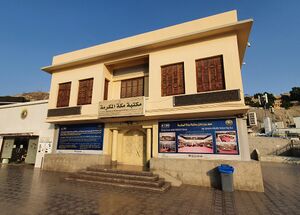 The library of Mecca was built in the place of Mawlid al-Nabi | |
| General Information | |
|---|---|
| Place | Mecca, Masjid al-haram |
| Usage | library |
Birthplace of the Holy Prophet (s) (Arabic: مولد النبی) is the house of Abdullah b. Abdul-Muttalib, where the prophet was born; this place is located in the city of Mecca, in the neighborhood of Sha'ab Abi Talib. In the second century of hijra, Khayzaran, the mother of Harun al-Rashid, bought that place and converted it into a mosque. Reports from the sixth century onwards indicate that a decorated marble stone was erected as a commemoration of the Prophet's birthplace in a section of the mosque. In the reconstruction of 1009 AH/ 1600-1, a grand dome and minaret were built for this mosque. The Mosque of the Birthplace of the Prophet was considered one of the sacred places in Mecca, and every year on the night of the Prophet's birth, the people of Mecca would gather there. Reports from the tenth century have mentioned the existence of a special official ceremony, which was held in the presence of an Ottoman representative in Mecca (the overseer of the Masjid al-Haram) on the night of the twelfth of Rabi' al-Awwal.
Due to the importance and fame of the Mosque of the Birthplace of the Prophet, this building has been reconstructed numerous times by the orders of sultans and rulers. However, during the rule of the Al Saud dynasty, like many other sacred places and buildings in Mecca, it was demolished (in the year 1343 AH / 1924-5 ) In the year 1370 AH / 1950-1, with the aim of preserving the memory of this place, a library was built there, which still exists and is named "Maktabat Makkah al-Mukarramah" (The Library of the Honored Mecca).
History
They consider a house in which the prophet(s) was born, located in the area of Sha'ab Abi Talib in a neighborhood called Suq al-Layl, as the "Birthplace of the Prophet" or the place of the Prophet's birth. In some historical sources, other places have also been mentioned as possible locations of the Prophet's birth, but these are not confirmed by most historians of Mecca.[1]
Until the third century
According to Azraqi's report in the book of Akhbar Makkah, who lived in the third century, the house where the Prophet was born, after his emigration, came into the possession of Aqil, the son of Abu Talib, and was transferred to Aqil's children until it was sold to Muhammad b. Yusuf Thaqafi, who annexed it to his own house known as the White House. When Khayzaran, the mother of Harun al-Rashid, performed Hajj in 171 AH/ 788, she bought it and built a mosque in which prayers are offered. Azraqi states that the people of Mecca have no disagreement about the location of the Prophet's birthplace.[2] The same report is also mentioned by Fakihi (d. 245 AH/859-60), another ancient historian of Mecca.[3]
Report of Ibn Jubayr (7th Century)
Ibn Jubayr (d. 614 AH/ ) visited this mosque in 579 AH and described it in his travelogue.[4] He considered the building to be a magnificent mosque, stating, "On Tuesdays of the month of Rabi' al-Awwal, which is the birth and celebration day of the Prophet(s), it is opened, and all people come there to gain blessings and grace. Other sacred places are also opened on the same day, and it is always a day of resurrection in Mecca.[5] According to Ibn Jubayr, the birthplace of the Prophet in this mosque is constructed in the form of a small pool, three cubits wide. In the middle of it lies a green marble stone, two-thirds the width of the pool, which has been encased in silver. The mihrab of the mosque is located opposite this site.[6]
Report of Fasi (9th Century)
More than two centuries later, Taqi al-Din al-Fasi (d.832 AH/1428-9), a historian of Mecca, provided a description of this revered and esteemed place in his book "Shifa al-Gharam." He depicted the structure of the mosque as square-shaped with two arched domes, with a large corner placed in the southwest corner.[7]
Report of Uliya Chalabi (11th Century)
Two and a half centuries later, in the year 1081/1670-1, Uliya Chalabi, a Turkish travelogue writer, witnessed the birthplace of the Prophet and described it in his book. He described this building as a large and beautiful mosque, with a square structure, a tall dome covered in lead. Chalabi mentioned the interior decorations of the mosque, including valuable carpets and a pulpit covered in silk fabrics and gold plating. According to him, the birthplace of the Prophet was marked by a yellow-colored stone in a cavity, bearing the impression of the Prophet's body.[8]
Before Destruction
Mullah Ibrahim Kaziruni, who was fortunate enough to visit this house in the year 1315 AH/1897-8, writes: "On Friday, the fourteenth, we went to visit the site known as the birthplace of the Proph(s), which is located in Suq al-Layl. We entered through the door and descended approximately fourteen steps. We entered a room designated as a mosque. After that, we went into another room where there is a shrine. The caretaker opened the door of the shrine. Inside the shrine, there is a cavity. In the middle of it was a green stone which was the place of birth of the Seal of the Prophets.[9]
Mohammad Labib Bitouni, who traveled to Mecca in the year 1327 AH/1909/10, depicted the above plan of the structure of the Prophet's birthplace in his travelogue and described it as follows: "Upon entering it, you first enter an open space measuring 12 meters in length and 6 meters in width, with a door on the right wall. After passing through it, you enter a space where a dome is placed. In the middle of this space, and under the dome, there is a niche made of wood leaning towards the west wall, within which a concave marble stone can be seen, slightly recessed in the middle. This location indicates the birthplace of the Prophet."[10]
Reconstructions

The building of the Prophet's birthplace received attention from emirs and sultans and underwent several reconstructions. The list of these reconstructions is as follows:
- In the year 576/1180-1: Nasser, the Abbasid Caliph.
- In the year 666/1267-8: Malik Mazaffar, the ruler of Yemen.
- In the year 740/1339-40: Malik Mujahid, the ruler of Yemen.
- In the year 758/1356-7: Amir Sheikhoun, one of the dignitaries of Egypt.
- In the year 766/1364-5: Malik Shaaban, the Sultan of Egypt.
- In the year 801/1398-9: Malik Zaher Barquq, the Sultan of Egypt.[11]
During the Ottoman era
- In the year 935/1528-9: Sultan Suleiman, the Ottoman Sultan.
- In the year 1009/1600-1: By the order of Sultan Muhammad, the Ottoman Sultan, under the supervision of Ghazanfar Agha.[12] In this reconstruction, a large dome and minaret were built for this structure, and endowments were allocated by the Ottoman government for it, and a muezzin, servant, and imam were appointed for the mosque.[13]
- The year 1230/1814-5 according to the command of Sultan Mahmud Khan.
- The last apparent repair was during the time of Abdul-Majid Khan.[14]
The celebration of the Prophet's(s) birthday at the Mosque of the Prophet's Birthplace
Ibn Jubayr in the sixth century reported the presence of the people of Mecca at the Mosque of the Prophet's Birthplace on Tuesday of the month of Rabi' al-Awwal to commemorate the anniversary of his birth.[15] Reports of the celebration of the Prophet's birthday at this location exist in the subsequent centuries.
Muhammad b. Ahmad Nahrawali (d. 990 AH/1582-3) in the tenth century of Hijra provided a detailed report about the celebration of the Prophet's birthday night. According to him, every year on the night of the twelfth of Rabi' al-Awwal, after the Maghrib prayer, jurists, dignitaries, scholars, and people gather while carrying numerous candles and torches before the overseer of the Masjid al-Haram and the judges of the four schools of thought. They assemble at the Masjid al-Haram and proceed towards Suq al-Layl and the location of the Prophet's birthplace. Upon reaching there, a sermon is delivered, and then people return to the Masjid al-Haram where some dignitaries are honored, and the Isha prayer is performed, concluding the ceremony.[16] More than a century later, the travelogue written in the years 1105-1106/1693-4 about the pilgrimage journey quotes Nahrawali's report and describes this ceremony as a great gathering, in which many Bedouins and residents of other cities (besides Mecca) participated.[17]
Destruction of buildings and the construction of a library

In the Al Saud government, the structure of the Prophet's birthplace, like many other ancient buildings in Mecca, was demolished on the pretext that people excessively sought blessings from it.[18] It was demolished in the year 1343/1924-5.
Later, considering that there was no tomb to be visited at this location, some tried to obtain permission for its reconstruction. In 1370 AH/1950-1, a permit was issued for the construction of a library in this place.
The construction capital was provided by Fatimah, the daughter of Yusuf Qatan, and her brother Sheikh Abbas Qatan (d. 1370 AH/1950-1) supervised the construction. After his death, his sons completed the construction work. Thus, the "Maktabat Makkah al-Mukarramah" was built at this location.[19]
Notes
- ↑ Fāsī al-Makkī, Shifāʾ al-gharām bi akhbār al-balad al-ḥarām, vol. 1, p. 270.
- ↑ Azraqī, Akhbār Makka, vol. 2, p. 198.
- ↑ Fākihī, Akhbār Makka fī qadīm al-dahr wa ḥaīthih, vol. 4, p. 5.
- ↑ Ibn Jubayr, Safarnāma Ibn Jubayr, p. 82/p. 125.
- ↑ Ibn Jubayr, Safarnāma Ibn Jubayr, p. 154.
- ↑ Ibn Jubayr, Safarnāma Ibn Jubayr, p. 126-127.
- ↑ Fāsī al-Makkī, Shifāʾ al-gharām bi akhbār al-balad al-ḥarām, vol. 1, p. 268.
- ↑ Chilibī, Al-Raḥla al-ḥijazīyya, p. 255-256.
- ↑ Kāzirūnī, Safarnāma- yi Mulla Ibrāhīm Kāzirūnī, Mīrāth Islāmī Iran, p. 366.
- ↑ Batanūnī, Safarnāma- yi Ḥijāz, p. 146.
- ↑ Fāsī al-Makkī, Shifāʾ al-gharām bi akhbār al-balad al-ḥarām, vol. 1, p. 270.
- ↑ ʿAlī b. Tāj al-ddīn al-sanjārī, Manāʾiḥ al-karam, vol. 3, p. 506.
- ↑ Ṭabarī, Tārīkh-i Makka, vol. 2, p. 15.
- ↑ Gāzī, Ifādat al-anām, vol. 2, p. 71; Jaʿfariyān, Āthār-i islāmi-yi Makka wa Madīna, p. 185.
- ↑ Ibn Jubayr, Safarnāma Ibn Jubayr, p. 154.
- ↑ Nahrawālī al-Makkī, Al-Aʿlām bi aʿlām bayt Allāh al-harām, p. 422.
- ↑ Nāblusī, Al-Ḥaqīqa wa al-majāz fī riḥlat al-bilād al-shām wa miṣr wa al-ḥijāz, vol. 3, p. 354-355.
- ↑ Bilādī, Maʿālim makka al-tārīkhīyya wa al-atharīyya, p. 294.
- ↑ Kurdī, Al-Tārīkh al-qawīm li Makka wa bayt Allāh al-karīm, p. 171-173; ʿAbd al-Wahhāb Ibrāhīm Abū Solaymān, Maktabat makka al-mukarrama qadīman wa ḥadīthan, p. 80.
References
- ʿAbd al-Wahhāb Ibrāhīm Abū Solaymān . Maktabat makka al-mukarrama qadīman wa ḥadīthan. Riyadh: Maktaba al-Malik Fahad al-Waṭanīyya, 1433 AH.
- ʿAlī b. Tāj al-ddīn al-sanjārī.Manāʾiḥ al-karam. Mecca: umm al-qurā university, 1998.
- Azraqī, Muḥammad b. ʿAbd Allāh al-. Akhbār Makka. Qom: Maktaba al-Sharīf al-Raḍī, [n.d]
- Batanūnī, Muḥammad Labīb. Safarnāma- yi Ḥijāz. Translated by Hādī Anṣārī. Tehran: Intishārāt-i Mashʿar, 1381 sh.
- Bilādī, ʿĀtiq b. Ghayth al-. Maʿālim makka al-tārīkhīyya wa al-atharīyya. Mecca: Dār al-Makka, 1403 AH.
- Chilibī, ʾUlīyā. Al-Raḥla al-ḥijazīyya. Translated by Aḥmad al-Mursī. Cairo: Dār al-Āfāq al-ʿArabīyya, 1420 AH.
- Fāsī al-Makkī, Muḥammad b. Aḥmad. Shifāʾ al-gharām bi akhbār al-balad al-ḥarām. Translated by Muḥammad Muqaddas. Tehran: Mashʿar, 1386 sh.
- Fākihī, Muḥammad b. Isḥāq. Akhbār Makka fī qadīm al-dahr wa ḥaīthih. Edited by ʿAbd al-Malik b. ʿAbd Allāh. Makka: Maktabat al-Nahḍa al-Ḥadītha, 1407 AH.
- Gāzī, ʿAbdullāh b. Muḥammad al-. Ifādat al-anām. Mecca: Maktabat al-Asadī, 1430 AH.
- Ibn Jubayr, Muḥammad b. Aḥmad. Safarnāma Ibn Jubayr. Translated by Parwīz Atābakī. Mashhad: Intishārāt-i Āstān-i Quds-i Raḍawī, 1370 Sh.
- Jaʿfariyān, Rasūl. Āthār-i islāmi-yi Makka wa Madīna. Tehran: Mashʿar, 1382 Sh.
- Kāzirūnī, Ibrāhīm. Safarnāma- yi Mulla Ibrāhīm Kāzirūnī, Mīrāth Islāmī Iran. Qom: Kitābkhāna-yi Marʿashī Najafī, Fifth edition, 1376 sh.
- Kurdī, Muḥammad Ṭāhir. Al-Tārīkh al-qawīm li Makka wa bayt Allāh al-karīm
- Nāblusī, ʿAbdu-l Ghanī al-. Al-Ḥaqīqa wa al-majāz fī riḥlat al-bilād al-shām wa miṣr wa al-ḥijāz. Edited by Riyādh ʿAbdu-l Ḥamīd Murād. Damascus: Dār al-Maʿrifa, 1419 AH.
- Nahrawālī al-Makkī, Quṭb al-Dīn. Al-Aʿlām bi aʿlām bayt Allāh al-harām. Edited by ʿAlī Muḥammad ʿUmar. Cairo: Maktabat al-Thaqāfa al-Dīnīyya, 1425 AH.
- Ṭabarī, ʿAlī b. ʿAbdu-l Qādir. Al-ʾArj al-miskī. [n.p], Dār al-Makka, 1400 AH.
- Ṭabarī, Muḥammad b. ʿAlī al-. Tārīkh-i Makka, Ittiḥāf fudhal al-zaman bi tārīkh wālīh banī al-ḥasan. Edited by Muḥsin Muḥammad Ḥasan Salīm. Cairo: Dār al-Kitāb al-Jāmiʿī, 1413 AH.