
Al-Rayah Mosque (Medina): Difference between revisions
No edit summary |
m Text replacement - "<gallery>" to "<gallery mode="packed" heights="150px">" |
||
| (2 intermediate revisions by 2 users not shown) | |||
| Line 58: | Line 58: | ||
Dhubab Mosque is located to the northwest of the [[Masjid al-nabi]]<ref>ʿAbd al-Ghanī, '' Masājid al-Ātharīyah'', p. 80.</ref> | Dhubab Mosque is located to the northwest of the [[Masjid al-nabi]]<ref>ʿAbd al-Ghanī, '' Masājid al-Ātharīyah'', p. 80.</ref> | ||
And it is situated on top of the small Mount Dhubab, on the right side of Uthman b. Affan Street.<ref>Kaʿakī, ''Maʿālim al-Madīnah al-Munawwarah Bayna al-ʿAmārah wa al-Tārīkh'', vol. 2, p. 160,164.</ref> | |||
This mountain is | This mountain is to the east of [[Mount Sala']] and near [[Thaniyat al-Wada']].<ref>ʿIyāshī, '' Al-Riḥlah al-ʿIyāshīyah'', vol. 1, p. 396.</ref> | ||
===Current Status=== | ===Current Status=== | ||
The entrance | The entrance of Al-Rayah Mosque is located on the (south), the side which faces the Qibla.<ref>Kaʿakī, ''Maʿālim al-Madīnah al-Munawwarah Bayna al-ʿAmārah wa al-Tārīkh'', vol. 2, p. 168.</ref> The mosque has a simple appearance and does not have a minaret or prominent verses or inscriptions inside or outside of it.<ref>Kaʿakī, ''Maʿālim al-Madīnah al-Munawwarah Bayna al-ʿAmārah wa al-Tārīkh'', vol. 2, p. 172.</ref> | ||
By the end of 2022, the mosque underwent reconstruction, transforming its look from white to a light stone color, and by the end of 2023, the neighboring houses were demolished.<ref>[https://www.spa.gov.sa/N2064796 Website of Saudi Press Agency (SPA)]</ref> | |||
== | ==History== | ||
During the [[Battle of Ahzab]] ( | During the [[Battle of the Ahzab]](5 AH/627) and while digging the trench around Medina, a tent was erected for [[Prophet Muhammad (s)|the Prophet (s)]] at this location to rest and oversee the trench digging activities. The Prophet (s) also prayed there.<ref>Samhūdī, '' Wafāʾ al-Wafā bi Akhbār Dār al-Muṣṭafá '', vol. 3, p. 201.</ref> | ||
==Names== | ==Names== | ||
The reason for naming this mosque Al-Rayah Mosque is that the flag of the Prophet's companion, [[Muslim b. Uqbah]], was raised at this location during the [[Battle of Harrah]] (63 AH/683).<ref>Samhūdī, '' Wafāʾ al-Wafā bi Akhbār Dār al-Muṣṭafá '', vol. 3, p. 204.</ref> | |||
It is also possible that this name is due to the placement of the flag | It is also possible that this name is due to the placement of the Islamic flag on this mountain during the Battle of the Ahzab.<ref>Shanqīṭī, '' Al-Durr al-Thamīn fī Maʿālim Dār al-Rasūl al-Amīn '' , p. 71. </ref> | ||
It has also been said that Dhu'bab was the name of a man whom [[Marwan b. Hakam]] hanged on top of this mosque.<ref>Namīrī, "Tārīkh al-Madīnah Munawwarah", p. 262.</ref> | |||
Another name for | Another name for it is "Qarin Mosque".<ref>ʿAbd al-Ghanī, '' Masājid al-Ātharīyah'', p. 80.</ref> | ||
==History== | ==Building History== | ||
According to | According to evidence, the Al-Rayah Mosque was first built during the time of Umar ibn Abdul Aziz's governance over Medina.(12) al-Samhūdī, '' Wafāʾ al-Wafā bi Akhbār Dār al-Muṣṭafá '', vol. 3, p. 202. | ||
The mosque building had been destroyed during a period before the 9th century AH, and around 845 AH/1441-2, it was reconstructed by Amir Janbak al-Nayruzi.<ref>Anṣārī, ''Āthār al-Madīnah al-Munawwarah'', p. 129.</ref> | The mosque building had been destroyed during a period before the 9th century AH, and around 845 AH/1441-2, it was reconstructed by Amir Janbak al-Nayruzi.<ref>Anṣārī, ''Āthār al-Madīnah al-Munawwarah'', p. 129.</ref> | ||
Additionally, some Arab historians have seen and described this mosque at various times. Abdul Qadous Ansari (d: 1403 AH/1982-3) observed this mosque at the end of the fourteenth century AH and noted its dimensions, stating that the length and width of the building were 4 meters and its height was 6 meters. He believed that the stone structure of the mosque resembled its construction in the ninth century.<ref>Anṣārī, ''Āthār al-Madīnah al-Munawwarah'', p. 129.</ref> | |||
Shanqiti ( | Shanqiti (d: 1393 AH/1973-4) also described this mosque as being built in 1405 with old-style light stones. According to him, the mosque only had a main chamber and a courtyard without a door.<ref>Shanqīṭī, '' Al-Durr al-Thamīn fī Maʿālim Dār al-Rasūl al-Amīn '' , p. 172.</ref> | ||
Elias Abdul Ghani | Elias Abdul Ghani, in his work "Masajid al-Athariyyah," described the interior and exterior of the building as having been plastered in 1418 AH. He mentioned the presence of a covered prayer hall (musalla) which enlarged the mosque space, accommodating the five daily prayers.<ref>ʿAbd al-Ghanī, '' Masājid al-Ātharīyah'', p. 80.</ref> | ||
Contemporary researcher Ka'aki, in his book published in 2011, states that the mosque remains in the same condition as described by Ansari. However, Ka'aki also mentions the renovation of the mosque during the era of the Al Saud dynasty.<ref>Kaʿakī, ''Maʿālim al-Madīnah al-Munawwarah Bayna al-ʿAmārah wa al-Tārīkh'', vol. 2, p. 166.</ref> | |||
==Gallery== | ==Gallery== | ||
====Images of the mosque, in 2021 (the time when this white appearance of the mosque came into existence is not specified)==== | ====Images of the mosque, in 2021 (the time when this white appearance of the mosque came into existence is not specified)==== | ||
<gallery> | <gallery mode="packed" heights="150px"> | ||
file:مسجد ذباب پیش از بازسازی1.jpeg|The exterior environment of the mosque with white walls and white color scheme | file:مسجد ذباب پیش از بازسازی1.jpeg|The exterior environment of the mosque with white walls and white color scheme | ||
| Line 93: | Line 93: | ||
==== Images of the mosque after the 2022 renovation ==== | ==== Images of the mosque after the 2022 renovation ==== | ||
<gallery> | <gallery mode="packed" heights="150px"> | ||
file:ذباب بعد بازسازی1.png|Entrance of the mosque | file:ذباب بعد بازسازی1.png|Entrance of the mosque | ||
file:ذباب بعد بازسازی2.png|The return of the appearance of the mosque's walls and arches to their former and ancient look | file:ذباب بعد بازسازی2.png|The return of the appearance of the mosque's walls and arches to their former and ancient look | ||
| Line 102: | Line 102: | ||
==== Images from 2024, after the demolition of the houses around the mosque ==== | ==== Images from 2024, after the demolition of the houses around the mosque ==== | ||
<gallery> | <gallery mode="packed" heights="150px"> | ||
file:2024.png|alt=|Images from a distance of the mosque area during the municipality operations in Medina | file:2024.png|alt=|Images from a distance of the mosque area during the municipality operations in Medina | ||
file:2024-1.png|alt=|The back wall of the mosque in the midst of the municipality operations | file:2024-1.png|alt=|The back wall of the mosque in the midst of the municipality operations | ||
| Line 111: | Line 111: | ||
==== Old pictures of the mosque building ==== | ==== Old pictures of the mosque building ==== | ||
<gallery> | <gallery mode="packed" heights="150px"> | ||
file:1403-02-20 17 30 11-المعالم المدینه المنوره بین العمارة و التاریخ الجزء الرابع المجلد الثانی.pdf - P.png|alt= | file:1403-02-20 17 30 11-المعالم المدینه المنوره بین العمارة و التاریخ الجزء الرابع المجلد الثانی.pdf - P.png|alt= | ||
file:1403-02-20 18 33 04-المعالم المدینه المنوره بین العمارة و التاریخ الجزء الرابع المجلد الثانی.pdf - P.png|alt= | file:1403-02-20 18 33 04-المعالم المدینه المنوره بین العمارة و التاریخ الجزء الرابع المجلد الثانی.pdf - P.png|alt= | ||
Latest revision as of 06:59, 22 August 2025
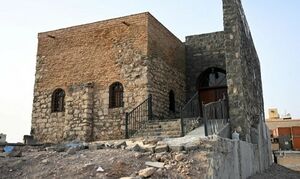 | |
| General Information | |
|---|---|
| Other Names | Dhubab Mosque, Qarin Mosque |
| Place | in the north of Medina on top of Mount Dhubab |
| Usage | Mosque |
| Religious Aspect | |
| Religious Affiliation | Islam |
| Beliefs | Prayer of the Prophet (s) in the area of this mosque |
| Rituals | performing congregational prayers |
| History | |
| Time of Construction | during the time of the prophet |
| Events | Demolition of houses around the mosque at the end of 2023 AD |
| Reconstructions | The last renovation in 2022 |
| Historical Features | The place of the Prophet (s) tent and praying while digging a trench during the Battle of Ahzab |
| Current State | |
| Status | Available |
| Capacity | 100 people |
| Parts | Mihrab and Musalla |
Al-Rāyah Mosque (Arabic: مسجد الرایه) (Means: Flag Mosque), also known as Al-Dhubāb Mosque and Qarin Mosque, is a mosque located in the north of Medina on top of Mount Dhubab.
During the Battle of Ahzab, a tent was erected for the Prophet (s) on top of Mount Dhubab where he prayed. Later, Muslims built the Al-Rayah Mosque to commemorate this place.
Location
Dhubab Mosque is located to the northwest of the Masjid al-nabi[1] And it is situated on top of the small Mount Dhubab, on the right side of Uthman b. Affan Street.[2] This mountain is to the east of Mount Sala' and near Thaniyat al-Wada'.[3]
Current Status
The entrance of Al-Rayah Mosque is located on the (south), the side which faces the Qibla.[4] The mosque has a simple appearance and does not have a minaret or prominent verses or inscriptions inside or outside of it.[5] By the end of 2022, the mosque underwent reconstruction, transforming its look from white to a light stone color, and by the end of 2023, the neighboring houses were demolished.[6]
History
During the Battle of the Ahzab(5 AH/627) and while digging the trench around Medina, a tent was erected for the Prophet (s) at this location to rest and oversee the trench digging activities. The Prophet (s) also prayed there.[7]
Names
The reason for naming this mosque Al-Rayah Mosque is that the flag of the Prophet's companion, Muslim b. Uqbah, was raised at this location during the Battle of Harrah (63 AH/683).[8] It is also possible that this name is due to the placement of the Islamic flag on this mountain during the Battle of the Ahzab.[9] It has also been said that Dhu'bab was the name of a man whom Marwan b. Hakam hanged on top of this mosque.[10] Another name for it is "Qarin Mosque".[11]
Building History
According to evidence, the Al-Rayah Mosque was first built during the time of Umar ibn Abdul Aziz's governance over Medina.(12) al-Samhūdī, Wafāʾ al-Wafā bi Akhbār Dār al-Muṣṭafá , vol. 3, p. 202. The mosque building had been destroyed during a period before the 9th century AH, and around 845 AH/1441-2, it was reconstructed by Amir Janbak al-Nayruzi.[12] Additionally, some Arab historians have seen and described this mosque at various times. Abdul Qadous Ansari (d: 1403 AH/1982-3) observed this mosque at the end of the fourteenth century AH and noted its dimensions, stating that the length and width of the building were 4 meters and its height was 6 meters. He believed that the stone structure of the mosque resembled its construction in the ninth century.[13] Shanqiti (d: 1393 AH/1973-4) also described this mosque as being built in 1405 with old-style light stones. According to him, the mosque only had a main chamber and a courtyard without a door.[14] Elias Abdul Ghani, in his work "Masajid al-Athariyyah," described the interior and exterior of the building as having been plastered in 1418 AH. He mentioned the presence of a covered prayer hall (musalla) which enlarged the mosque space, accommodating the five daily prayers.[15] Contemporary researcher Ka'aki, in his book published in 2011, states that the mosque remains in the same condition as described by Ansari. However, Ka'aki also mentions the renovation of the mosque during the era of the Al Saud dynasty.[16]
Gallery
Images of the mosque, in 2021 (the time when this white appearance of the mosque came into existence is not specified)
-
 The exterior environment of the mosque with white walls and white color scheme
 -
 Image of the interior environment of the mosque + the mihrab area
 -
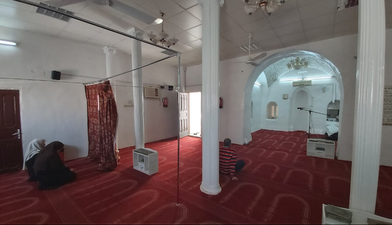 The public section of the mosque's prayer hall that has been attached to the main section
 -
 The exterior view of the mosque along with the surrounding houses and the public passage
 -
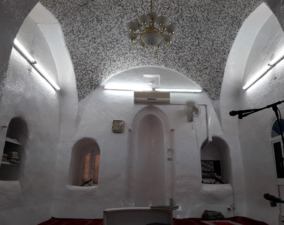 The main and old section of the mosque with dimensions approximately 4 meters in length and width + a view of the ceiling


Images of the mosque after the 2022 renovation
-
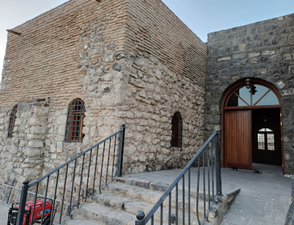 Entrance of the mosque
 -
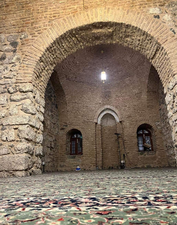 The return of the appearance of the mosque's walls and arches to their former and ancient look
 -
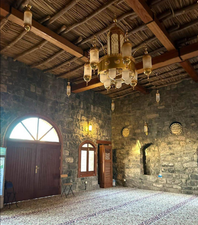 Public space of the mosque
 -
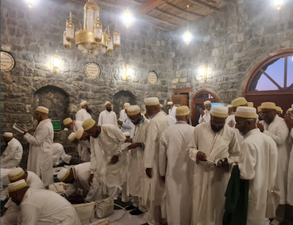 Presence of worshipers in the mosque
 -
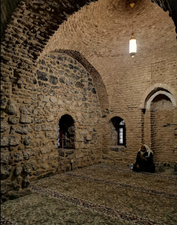 A view of the mihrab and the main old section of the mosque


Images from 2024, after the demolition of the houses around the mosque
-
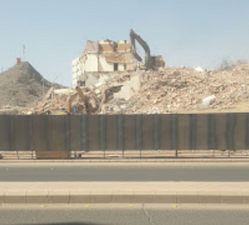 Images from a distance of the mosque area during the municipality operations in Medina
 -
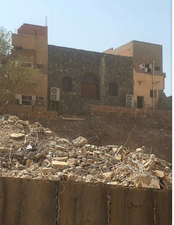 The back wall of the mosque in the midst of the municipality operations
 -
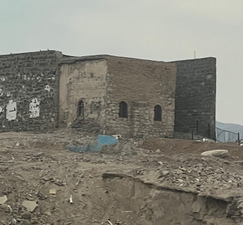 View of the mosque after the demolition of the surrounding houses
 -
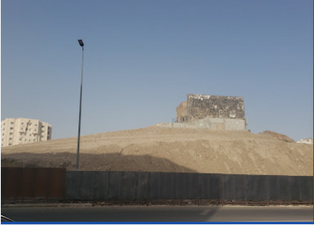 A distant view of the mosque after the renovation operations where only the mosque building remains
 -
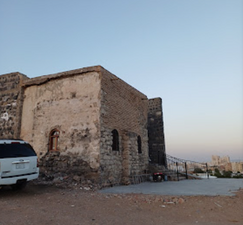 The current image of the mosque after leveling the surrounding lands


Old pictures of the mosque building


Notes
- ↑ ʿAbd al-Ghanī, Masājid al-Ātharīyah, p. 80.
- ↑ Kaʿakī, Maʿālim al-Madīnah al-Munawwarah Bayna al-ʿAmārah wa al-Tārīkh, vol. 2, p. 160,164.
- ↑ ʿIyāshī, Al-Riḥlah al-ʿIyāshīyah, vol. 1, p. 396.
- ↑ Kaʿakī, Maʿālim al-Madīnah al-Munawwarah Bayna al-ʿAmārah wa al-Tārīkh, vol. 2, p. 168.
- ↑ Kaʿakī, Maʿālim al-Madīnah al-Munawwarah Bayna al-ʿAmārah wa al-Tārīkh, vol. 2, p. 172.
- ↑ Website of Saudi Press Agency (SPA)
- ↑ Samhūdī, Wafāʾ al-Wafā bi Akhbār Dār al-Muṣṭafá , vol. 3, p. 201.
- ↑ Samhūdī, Wafāʾ al-Wafā bi Akhbār Dār al-Muṣṭafá , vol. 3, p. 204.
- ↑ Shanqīṭī, Al-Durr al-Thamīn fī Maʿālim Dār al-Rasūl al-Amīn , p. 71.
- ↑ Namīrī, "Tārīkh al-Madīnah Munawwarah", p. 262.
- ↑ ʿAbd al-Ghanī, Masājid al-Ātharīyah, p. 80.
- ↑ Anṣārī, Āthār al-Madīnah al-Munawwarah, p. 129.
- ↑ Anṣārī, Āthār al-Madīnah al-Munawwarah, p. 129.
- ↑ Shanqīṭī, Al-Durr al-Thamīn fī Maʿālim Dār al-Rasūl al-Amīn , p. 172.
- ↑ ʿAbd al-Ghanī, Masājid al-Ātharīyah, p. 80.
- ↑ Kaʿakī, Maʿālim al-Madīnah al-Munawwarah Bayna al-ʿAmārah wa al-Tārīkh, vol. 2, p. 166.
References
- ʿAbdu-l Ghanī, Muḥammad ʾIlyās. Al-Masājid al-Atharīyya fī al- madīna al-munawwara. Medina: [n.p], 2000.
- Anṣārī, ʿAbdu-l quddūs al-. Āthār al-madīna al-munawwara. Medina: Maktabat al-Salafīyya, 1973.
- ʿAyyāshī, ʿAbd Allāh b. Muḥammad. Al-Riḥla al-ʿAyyāshiyya. Abu Dhabi: Dār al-Suwaydī, 2006.
- Kaʿakī, ʿAbd al-ʿAzīz al-. Al-Majmūʿah al-Muṣawwarah li-Āshar al-Maʿālim al-Madīnah al-Munawwarah. Medina: 1999
- Kaʿakī, ʿAbd al-ʿAzīz b. ʿAbd al-Raḥmān. Ma ʿālim al-madina al-munawwara bayn al-ʿMārat wa al-Tārīkh. Beirut: Dār wa maktabat al-hilāl, 2011.
- Khiyārī, Sayyraid Aḥmad Yāsīn. Tārīkh maʿālimal-madīna al-munawwara qadīman wa ḥadīthan. Riyadh: al-Amāna alʿāmma li-liḥtifāl miʾat ʿām ʿalā tʾsīs al-mamlika al- ʿarabiyya al-suʿūdiyya, 1419 AH/1999.
- Numīrī, Ibn Shabbah. Tārīkh al-madīna al-munawwara. Edited by Fahīm Muḥammad Shaltūt. Tehran: Mashʿar, 1380 sh.
- Samhūdī, ʿAlī b. ʿAbd Allāh. Wafāʾ al-wafā bi akhbār dar al-Muṣṭafā. Edited by Muḥammad Muḥyi al-Dīn ʿAbd al-Ḥamīd. Beirut: 1984.
- Shanqīṭī, Ghālī Muḥammad Amīn al-. Al-Durr al-Thamīn fī Maʿālim Dār al-Rasūl al-Amīn. Jeddah: Dār al-Qiblah, 1992.