
User:Pourghorbani: Difference between revisions
Pourghorbani (talk | contribs) No edit summary |
Pourghorbani (talk | contribs) |
||
| (330 intermediate revisions by the same user not shown) | |||
| Line 1: | Line 1: | ||
{{Building | |||
== | | title = Salman al-Farsi Mosque | ||
| image =سلمان.jpg | |||
== | | image size = | ||
| image link = | |||
| image description = | |||
| other names = | |||
| place = [[Saudi Arabia]] * [[Medina]] * Near the [[Fath Mosque]] and at the edge of Mount Sela' | |||
| usage = Mosque | |||
| religious affiliation = Islam | |||
| beliefs = | |||
| rituals = | |||
| rulings = | |||
| pilgrims = | |||
| visitors = | |||
| time of construction = 1st century AH | |||
| founder = | |||
| events = | |||
| reconstructions = | |||
| reconstructors = | |||
| missing parts = | |||
| historical features = The place where the Prophet(s) prayed | |||
| trustee = | |||
| space = | |||
| length = | |||
| width = | |||
| height = | |||
| status = Existing | |||
| capacity = | |||
| facilities = | |||
| parts = | |||
| architect = | |||
| style = | |||
| properties = | |||
| domes = | |||
| minarets = | |||
| doors = | |||
| porticos = | |||
| courts = | |||
| verandas = | |||
| affiliated entity = | |||
| maintaining entity = | |||
| administrator = | |||
| imam of prayer = | |||
| subsidiary entities = | |||
| registered in = | |||
| registration no. = | |||
| registration date = | |||
| website = | |||
| latitude = 24.477443 | |||
| longitude = 39.595562 | |||
| map description = | |||
}} | |||
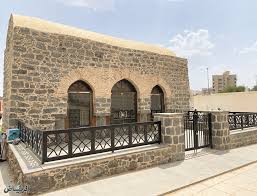
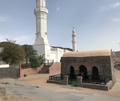
'''Salman al-Farsi Mosque''' is one of the historical mosques in Medina, located south of the [[Fath Mosque (Medina)|Fath Mosque]] and northwest of [[Mount Sela']]. The Prophet (PBUH) prayed at this site during the [[Battle of the Trench]]. The mosque is named after [[Salman al-Farsi]], one of the companions of [[Prophet Muhammad(s)], who suggested digging the trench to defend against the Quraysh army. The mosque features a courtyard and a rectangular prayer hall. | |||
==Name and Location== | |||
Salman al-Farsi Mosque is located south of the [[Fath Mosque]] and northwest of the slopes of [[Mount Sela']].<ref name=":0">[https://wikihaj.com/index.php?title=File:Masajid_al-Athariya.pdf&page=143 Masājid al-Athariya, ʿAbd al-Ghanī, p. 143.]</ref> It is said that the mosque was named after [[Salman al-Farsi]], a companion of the Prophet (PBUH), who played a key role in the [[Battle of the Trench]] by proposing the idea of digging the trench.<ref name=":0" /> | |||
== | ==The Prophet's Prayer== | ||
Salman al-Farsi Mosque is one of the [[Fath Mosques]]. According to narrations, the Prophet (PBUH) prayed at the Fath Mosque and its surrounding mosques.<ref name=":4">Al-Durra al-Thamina fi Tarikh al-Madina, Ibn Najjar, p. 189.</ref> Ibn Shabba reports that during the [[Battle of the Trench]], the Prophet prayed at the base of Mount Sela' and then ascended the mountain to supplicate.<ref name=":2">[https://wikihaj.com/index.php?title=File:Tarikh_al-Madina_al-Munawwara_Ibn_Shabba.pdf&page=59 Tarikh al-Madina al-Munawwara, Ibn Shabba, pp. 58–59.]</ref> Researchers believe this site to be the same as Salman al-Farsi Mosque.<ref name=":1">[https://wikihaj.com/index.php?title=File:Masajid_al-Athariya.pdf&page=144 Masājid al-Athariya, ʿAbd al-Ghanī, p. 144.]</ref> | |||
== | ==History== | ||
Salman al-Farsi Mosque is one of the oldest mosques in [[Medina]]. Some scholars suggest that it was likely built during the governorship of [[Umar ibn Abd al-Aziz]] over Medina (87–101 AH).<ref name=":6">[https://wikihaj.com/index.php?title=File:Al-Madina_al-Munawwara_Tatawwuruhā_al-ʿUmrānī.pdf&page=188 Al-Madīna al-Munawwara: Tatawwuruhā al-ʿUmrānī, p. 188.]</ref> The mention of the mosque in the works of Ibn Shabba<ref name=":2" /> (who lived between 173–262 AH) indicates that the mosque existed in the 2nd century AH. | |||
Ibn al-Barraj (d. 481 AH) also mentioned this mosque.<ref>Al-Muhadhdhab, Ibn al-Barraj, vol. 1, p. 283.</ref> The mosque was reconstructed in 577 AH.<ref name=":5">Bahjat al-Nufus wa al-Asrar fi Tarikh Dar Hijrat al-Nabi al-Mukhtar, Marjani, vol. 1, p. 570.</ref><ref>[https://wikihaj.com/index.php?title=File:Al-Madina_al-Munawwara_Tatawwuruhā_al-ʿUmrānī.pdf&page=189 Al-Madīna al-Munawwara: Tatawwuruhā al-ʿUmrānī, p. 189.]</ref> After this reconstruction, [[Ibn Najjar]] described the mosque as being surrounded by numerous palm trees and constructed with stone and plaster.<ref name=":4" /> Some Shia sources from the 7th century AH mention prayers and visits to this mosque.<ref>Al-Mazar, Muhammad ibn Jaʿfar al-Mashhadi, p. 102.</ref><ref>Misbah al-Zaʾir, Sayyid Ibn Tawus, p. 64.</ref> | |||
[[Ibn Jubayr]] (d. 614 AH) described the mosque in his travelogue as being on the way to [[Mount Uhud]].<ref>Rihlat Ibn Jubayr, p. 156.</ref> The mosque is also mentioned in works from the 8th century,<ref>Rihlat Ibn Battuta, vol. 1, p. 363 / Bahjat al-Nufus wa al-Asrar fi Tarikh Dar Hijrat al-Nabi al-Mukhtar, Marjani, vol. 1, p. 570.</ref> 9th century,<ref>Al-Tuhfa al-Latifa fi Tarikh al-Madina al-Sharifa, Sakhavi, vol. 1, p. 40. / Itharat al-Targhib wa al-Tashwiq (with Ziyarat Bayt al-Maqdis by Ibn Taymiyya), Khwarizmi, vol. 2, p. 74.</ref> 10th century,<ref>[https://wikihaj.com/index.php?title=File:Wafa_al-Wafa_Samhudi_Vol3.pdf&page=189 Wafāʾ al-Wafāʾ, Samhudi, vol. 3, p. 189.]</ref> and 11th century.<ref>Al-Jawahir al-Thamina fi Mahasin al-Madina, p. 135 / Al-Rihla al-ʿAyyashiyya, vol. 1, p. 392.</ref> | |||
* | ==Current Status== | ||
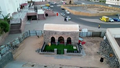
*Ibn | Today, Salman al-Farsi Mosque remains a site of visitation and prayer for pilgrims.<ref name=":3">Athar Islami Makka wa Madina, Jaʿfariyan, p. 300.</ref> The mosque features a covered prayer hall in the southern part (qibla side) and a courtyard in the northern section. The prayer hall is rectangular with an arched roof.<ref name=":1" /> The mosque is 8.5 meters long and 7 meters wide.<ref name=":6" /> | ||
* | |||
* | ==Historical Images== | ||
* | <gallery> | ||
* | File:غغب.jpg|alt= | ||
* | File:1776097.jpg|alt= | ||
* | File:سلمان2.jpg|alt= | ||
File:Cdn4.premiumread.jpg|alt= | |||
File:2024-09-03 06 39 50-الفتح، 7149 - حي - 3378، المدينة المنورة 42312، عربستان سعودی - Google Maps.png|alt=|According to the image, the mosque's entrance was blocked for some time. | |||
</gallery> | |||
==Recent Images== | |||
<gallery> | |||
File:2024-09-03 07 11 04-Google Maps.png|alt= | |||
File:2024-09-03 07 06 12-Google Maps.png|Mihrab | |||
File:2024-09-03 06 59 44-Google Maps.png|alt=|Southern side of the mosque from the outside, showing the mihrab. | |||
File:2024-09-03 07 04 33-Google Maps.png|alt=|Images of the mosque before the installation of glass doors. | |||
File:2024-09-03 07 05 48-Google Maps.png|alt= | |||
File:2024-09-03 07 00 12-Google Maps.png|alt= | |||
File:Thumbnail sm MfPou8NzLmWlkOg.webp|alt= | |||
</gallery> | |||
==Notes== | |||
{{Notes}} | |||
==References== | |||
{{References}} | |||
*Ibn al-Barraj, Al-Qāḍī.** *Al-Muhadhdhab*. Qom: Muʾassasat al-Nashr al-Islāmī, 1406 AH. | |||
*Ibn Ṭāwūs, Sayyid.** *Miṣbāḥ al-Zāʾir*. Qom: Muʾassasat Āl al-Bayt, 1417 AH. | |||
*Khwārizmī, Muḥammad ibn Isḥāq.** *Ithārat al-Targhīb wa al-Tashwīq (with Ziyārat Bayt al-Maqdis by Ibn Taymiyya)*. Mecca: Maktabat Nizār Muṣṭafā al-Bāz, 1418 AH. | |||
*Mashhadī, Muḥammad ibn Jaʿfar.** *Al-Mazār*. Qom: Nashr al-Qayyūm, 1419 AH. | |||
*Ibn Jubayr.** *Riḥlat Ibn Jubayr (Tadhkira bi al-Akhbār ʿan Ittifāqāt al-Asfār)*. Beirut: Al-Muʾassasa al-ʿArabiyya li al-Dirāsāt wa al-Nashr, 2008 CE. | |||
*Ibn Baṭṭūṭa.** *Riḥlat Ibn Baṭṭūṭa (Tuḥfat al-Nuẓẓār fī Gharāʾib al-Amṣār wa ʿAjāʾib al-Asfār)*. Rabat: Akādīmiyyat al-Mamlaka al-Maghribiyya, 1417 AH. | |||
*Sakhāwī, Shams al-Dīn.** *Al-Tuḥfa al-Laṭīfa fī Tārīkh al-Madīna al-Sharīfa*. Beirut: Dār al-Kutub al-ʿIlmiyya, 1414 AH/1993 CE. | |||
*Ḥusaynī, Muḥammad Kabrīt al-Madanī.** *Al-Jawāhir al-Thamīna fī Maḥāsin al-Madīna*. Beirut: Dār al-Kutub al-ʿIlmiyya, 1417 AH. | |||
*ʿAyyāshī, ʿAbd Allāh ibn Muḥammad.** *Al-Riḥla al-ʿAyyāshiyya (1661–1663 CE)*. Abu Dhabi: Dār al-Suwaydī, 2006 CE. | |||
*ʿAbd al-Ghanī, Muḥammad Ilyās.** *Masājid al-Āthārīya fī al-Madīna al-Munawwara*. Medina: Maṭābiʿ al-Rashīd, 1419 AH. | |||
*Samhūdī, ʿAlī ibn ʿAbd Allāh.** *Wafāʾ al-Wafā bi-Akhbār Dār al-Muṣṭafā*. Edited by Qāsim al-Sāmarrāʾī. London: Muʾassasat al-Furqān, 2001 CE. | |||
*Jaʿfariyān, Rasūl.** *Āthār Islāmī Makka wa Madīna*. Tehran: Nashr Mashʿar, 1390 SH. | |||
*Ibn Najjār, Muḥammad ibn Maḥmūd.** *Al-Durra al-Thamīna fī Tārīkh al-Madīna*. Cairo: Maktabat al-Thaqāfa al-Dīniyya, n.d. | |||
*Muṣṭafā, Ṣāliḥ Lamʿī.** *Al-Madīna al-Munawwara: Taṭawwuruhā al-ʿUmrānī*. Beirut: Dār al-Nahḍa al-ʿArabiyya, 1981 CE. | |||
{{end}} | |||
{{Places in Medina}} | |||
[[Category:Mosques in Medina]] | |||
[[Category:Completed articles]] | |||
Revision as of 15:09, 18 March 2025
 | |
| General Information | |
|---|---|
| Place | Saudi Arabia * Medina * Near the Fath Mosque and at the edge of Mount Sela' |
| Usage | Mosque |
| Religious Aspect | |
| Religious Affiliation | Islam |
| History | |
| Time of Construction | 1st century AH |
| Historical Features | The place where the Prophet(s) prayed |
| Current State | |
| Status | Existing |
Salman al-Farsi Mosque is one of the historical mosques in Medina, located south of the Fath Mosque and northwest of Mount Sela'. The Prophet (PBUH) prayed at this site during the Battle of the Trench. The mosque is named after Salman al-Farsi, one of the companions of [[Prophet Muhammad(s)], who suggested digging the trench to defend against the Quraysh army. The mosque features a courtyard and a rectangular prayer hall.
Name and Location
Salman al-Farsi Mosque is located south of the Fath Mosque and northwest of the slopes of Mount Sela'.[1] It is said that the mosque was named after Salman al-Farsi, a companion of the Prophet (PBUH), who played a key role in the Battle of the Trench by proposing the idea of digging the trench.[1]
The Prophet's Prayer
Salman al-Farsi Mosque is one of the Fath Mosques. According to narrations, the Prophet (PBUH) prayed at the Fath Mosque and its surrounding mosques.[2] Ibn Shabba reports that during the Battle of the Trench, the Prophet prayed at the base of Mount Sela' and then ascended the mountain to supplicate.[3] Researchers believe this site to be the same as Salman al-Farsi Mosque.[4]
History
Salman al-Farsi Mosque is one of the oldest mosques in Medina. Some scholars suggest that it was likely built during the governorship of Umar ibn Abd al-Aziz over Medina (87–101 AH).[5] The mention of the mosque in the works of Ibn Shabba[3] (who lived between 173–262 AH) indicates that the mosque existed in the 2nd century AH.
Ibn al-Barraj (d. 481 AH) also mentioned this mosque.[6] The mosque was reconstructed in 577 AH.[7][8] After this reconstruction, Ibn Najjar described the mosque as being surrounded by numerous palm trees and constructed with stone and plaster.[2] Some Shia sources from the 7th century AH mention prayers and visits to this mosque.[9][10]
Ibn Jubayr (d. 614 AH) described the mosque in his travelogue as being on the way to Mount Uhud.[11] The mosque is also mentioned in works from the 8th century,[12] 9th century,[13] 10th century,[14] and 11th century.[15]
Current Status
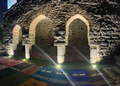
Today, Salman al-Farsi Mosque remains a site of visitation and prayer for pilgrims.[16] The mosque features a covered prayer hall in the southern part (qibla side) and a courtyard in the northern section. The prayer hall is rectangular with an arched roof.[4] The mosque is 8.5 meters long and 7 meters wide.[5]
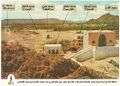
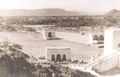
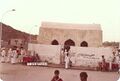
Historical Images
-
-
-
-
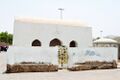
-
 According to the image, the mosque's entrance was blocked for some time.


Recent Images
-
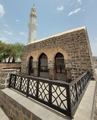
-
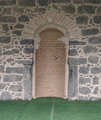 Mihrab
 -
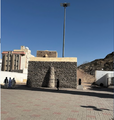 Southern side of the mosque from the outside, showing the mihrab.
 -
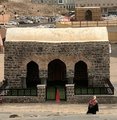 Images of the mosque before the installation of glass doors.
 -
-
-


Notes
- ↑ 1.0 1.1 Masājid al-Athariya, ʿAbd al-Ghanī, p. 143.
- ↑ 2.0 2.1 Al-Durra al-Thamina fi Tarikh al-Madina, Ibn Najjar, p. 189.
- ↑ 3.0 3.1 Tarikh al-Madina al-Munawwara, Ibn Shabba, pp. 58–59.
- ↑ 4.0 4.1 Masājid al-Athariya, ʿAbd al-Ghanī, p. 144.
- ↑ 5.0 5.1 Al-Madīna al-Munawwara: Tatawwuruhā al-ʿUmrānī, p. 188.
- ↑ Al-Muhadhdhab, Ibn al-Barraj, vol. 1, p. 283.
- ↑ Bahjat al-Nufus wa al-Asrar fi Tarikh Dar Hijrat al-Nabi al-Mukhtar, Marjani, vol. 1, p. 570.
- ↑ Al-Madīna al-Munawwara: Tatawwuruhā al-ʿUmrānī, p. 189.
- ↑ Al-Mazar, Muhammad ibn Jaʿfar al-Mashhadi, p. 102.
- ↑ Misbah al-Zaʾir, Sayyid Ibn Tawus, p. 64.
- ↑ Rihlat Ibn Jubayr, p. 156.
- ↑ Rihlat Ibn Battuta, vol. 1, p. 363 / Bahjat al-Nufus wa al-Asrar fi Tarikh Dar Hijrat al-Nabi al-Mukhtar, Marjani, vol. 1, p. 570.
- ↑ Al-Tuhfa al-Latifa fi Tarikh al-Madina al-Sharifa, Sakhavi, vol. 1, p. 40. / Itharat al-Targhib wa al-Tashwiq (with Ziyarat Bayt al-Maqdis by Ibn Taymiyya), Khwarizmi, vol. 2, p. 74.
- ↑ Wafāʾ al-Wafāʾ, Samhudi, vol. 3, p. 189.
- ↑ Al-Jawahir al-Thamina fi Mahasin al-Madina, p. 135 / Al-Rihla al-ʿAyyashiyya, vol. 1, p. 392.
- ↑ Athar Islami Makka wa Madina, Jaʿfariyan, p. 300.
References
- Ibn al-Barraj, Al-Qāḍī.** *Al-Muhadhdhab*. Qom: Muʾassasat al-Nashr al-Islāmī, 1406 AH.
- Ibn Ṭāwūs, Sayyid.** *Miṣbāḥ al-Zāʾir*. Qom: Muʾassasat Āl al-Bayt, 1417 AH.
- Khwārizmī, Muḥammad ibn Isḥāq.** *Ithārat al-Targhīb wa al-Tashwīq (with Ziyārat Bayt al-Maqdis by Ibn Taymiyya)*. Mecca: Maktabat Nizār Muṣṭafā al-Bāz, 1418 AH.
- Mashhadī, Muḥammad ibn Jaʿfar.** *Al-Mazār*. Qom: Nashr al-Qayyūm, 1419 AH.
- Ibn Jubayr.** *Riḥlat Ibn Jubayr (Tadhkira bi al-Akhbār ʿan Ittifāqāt al-Asfār)*. Beirut: Al-Muʾassasa al-ʿArabiyya li al-Dirāsāt wa al-Nashr, 2008 CE.
- Ibn Baṭṭūṭa.** *Riḥlat Ibn Baṭṭūṭa (Tuḥfat al-Nuẓẓār fī Gharāʾib al-Amṣār wa ʿAjāʾib al-Asfār)*. Rabat: Akādīmiyyat al-Mamlaka al-Maghribiyya, 1417 AH.
- Sakhāwī, Shams al-Dīn.** *Al-Tuḥfa al-Laṭīfa fī Tārīkh al-Madīna al-Sharīfa*. Beirut: Dār al-Kutub al-ʿIlmiyya, 1414 AH/1993 CE.
- Ḥusaynī, Muḥammad Kabrīt al-Madanī.** *Al-Jawāhir al-Thamīna fī Maḥāsin al-Madīna*. Beirut: Dār al-Kutub al-ʿIlmiyya, 1417 AH.
- ʿAyyāshī, ʿAbd Allāh ibn Muḥammad.** *Al-Riḥla al-ʿAyyāshiyya (1661–1663 CE)*. Abu Dhabi: Dār al-Suwaydī, 2006 CE.
- ʿAbd al-Ghanī, Muḥammad Ilyās.** *Masājid al-Āthārīya fī al-Madīna al-Munawwara*. Medina: Maṭābiʿ al-Rashīd, 1419 AH.
- Samhūdī, ʿAlī ibn ʿAbd Allāh.** *Wafāʾ al-Wafā bi-Akhbār Dār al-Muṣṭafā*. Edited by Qāsim al-Sāmarrāʾī. London: Muʾassasat al-Furqān, 2001 CE.
- Jaʿfariyān, Rasūl.** *Āthār Islāmī Makka wa Madīna*. Tehran: Nashr Mashʿar, 1390 SH.
- Ibn Najjār, Muḥammad ibn Maḥmūd.** *Al-Durra al-Thamīna fī Tārīkh al-Madīna*. Cairo: Maktabat al-Thaqāfa al-Dīniyya, n.d.
- Muṣṭafā, Ṣāliḥ Lamʿī.** *Al-Madīna al-Munawwara: Taṭawwuruhā al-ʿUmrānī*. Beirut: Dār al-Nahḍa al-ʿArabiyya, 1981 CE.