
Shadharwan: Difference between revisions
Pourghorbani (talk | contribs) |
Pourghorbani (talk | contribs) |
||
| (4 intermediate revisions by the same user not shown) | |||
| Line 1: | Line 1: | ||
{{Building | |||
| title = Shadharwan | |||
| image =شاذروان.jpeg | |||
| image size = | |||
| image link = | |||
| image description = | |||
| other names = Ta'zir | |||
| place = [[Mecca]], [[Masjid al-haram]] | |||
| usage = Determining the location of the foundations of the [[Ka'ba]] during the era of Abraham, protecting the Ka'ba from floods | |||
| religious affiliation = | |||
| beliefs = | |||
| rituals = | |||
| rulings = | |||
| pilgrims = | |||
| visitors = | |||
| time of construction = | |||
| founder = Abdullah b. Zubayr, | |||
| events = | |||
| reconstructions = The end of the third of hijra, the first decade of 670 AH/1271-2, 1098 AH/1686-7, 1417 AH/1996-7, 1394 sh/2015-6. | |||
| reconstructors = | |||
| missing parts = | |||
| historical features = | |||
| trustee = | |||
| space = | |||
| length = | |||
| width = | |||
| height = | |||
| status = | |||
| capacity = | |||
| facilities = | |||
| parts = | |||
| architect = | |||
| style = | |||
| properties = | |||
| domes = | |||
| minarets = | |||
| doors = | |||
| porticos = | |||
| courts = | |||
| verandas = | |||
| affiliated entity = | |||
| maintaining entity = | |||
| administrator = | |||
| imam of prayer = | |||
| subsidiary entities = | |||
| registered in = | |||
| registration no. = | |||
| registration date = | |||
| website = | |||
| latitude = | |||
| longitude = | |||
| map description = | |||
}} | |||
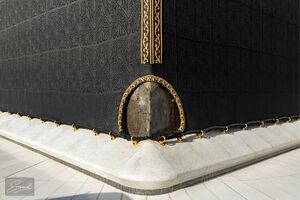
'''Shadharwan''' is a short, sloped protrusion located at the bottom of the Ka'ba's walls, except for the side of [[Hijr Isma'il|Hijr Ismail]] and below the door of the Ka'ba. It is believed to be a part of the Ka'ba constructed by [[Abraham (a)|Abraham]], which was reduced by the Quraysh during the renovation of the [[Ka'ba]]. Shi'a jurists and some Sunni jurists consider performing [[Tawaf]] over it as invalid; arguing that the Tawaf should be performed around the Ka'ba, not inside it. | '''Shadharwan''' is a short, sloped protrusion located at the bottom of the Ka'ba's walls, except for the side of [[Hijr Isma'il|Hijr Ismail]] and below the door of the Ka'ba. It is believed to be a part of the Ka'ba constructed by [[Abraham (a)|Abraham]], which was reduced by the Quraysh during the renovation of the [[Ka'ba]]. Shi'a jurists and some Sunni jurists consider performing [[Tawaf]] over it as invalid; arguing that the Tawaf should be performed around the Ka'ba, not inside it. | ||
Ali Akbar Dehkhoda considers the origin of the word "Shadharwan" to be Persian, meaning a large curtain that is drawn in front of the doorways and porches of kings and rulers. | Ali Akbar Dehkhoda considers the origin of the word "Shadharwan" to be Persian, meaning a large curtain that is drawn in front of the doorways and porches of kings and rulers. | ||
| Line 7: | Line 60: | ||
Dehkhoda considers the origin of the word "Shadharwan" to be Persian, meaning a large curtain that is hung in front of the entrances and porches of the homes and palaces of kings and rulers.<ref>Dihkhudā, ''Lughatnāma-yi Dihkhudā'', under the word شاذروان. </ref> | Dehkhoda considers the origin of the word "Shadharwan" to be Persian, meaning a large curtain that is hung in front of the entrances and porches of the homes and palaces of kings and rulers.<ref>Dihkhudā, ''Lughatnāma-yi Dihkhudā'', under the word شاذروان. </ref> | ||
Some believe that it is called "Shadharwan" because [[Curtain of Ka'ba|the curtain of the Ka'ba]] is connected to the rings that are located on it (akin to a "curtain holder").<ref> Ṣabrī Pāshā, ''Mawsūʿa mirʾāt al-ḥaramayn'', p. 67.</ref> | Some believe that it is called "Shadharwan" because [[Curtain of Ka'ba|the curtain of the Ka'ba]] is connected to the rings that are located on it (akin to a "curtain holder").<ref> Ṣabrī Pāshā, ''Mawsūʿa mirʾāt al-ḥaramayn'', p. 67.</ref> | ||
Shadharwan is also referred to as "Ta'zir | Shadharwan is also referred to as "Ta'zir" because it serves as a type of belt or covering for the Ka'ba.<ref>Kurdī, ''Al-Tārīkh al-qawīm li Makka wa bayt Allāh al-karīm'', vol. 3, p. 288.</ref> | ||
At the bottom of the side of Hijr Ismail, there is no Shadharwan, and likewise, there is no Shadharwan placed beneath the door of the Ka'ba. Instead, a flat step measuring 345 centimeters in length has been constructed there.<ref>Kurdī, ''Al-Tārīkh al-qawīm li Makka wa bayt Allāh al-karīm'',vol. 3, p. 289.</ref> | At the bottom of the side of Hijr Ismail, there is no Shadharwan, and likewise, there is no Shadharwan placed beneath the door of the Ka'ba. Instead, a flat step measuring 345 centimeters in length has been constructed there.<ref>Kurdī, ''Al-Tārīkh al-qawīm li Makka wa bayt Allāh al-karīm'',vol. 3, p. 289.</ref> | ||
==Background== | ==Background== | ||
| Line 24: | Line 77: | ||
Before that, the Shadhrwan was in the form of a step, and sometimes people would perform [[Tawaf]] over it.<ref>Kurdī, ''Al-Tārīkh al-qawīm li Makka wa bayt Allāh al-karīm'',vol. 3, p. 295.</ref> | Before that, the Shadhrwan was in the form of a step, and sometimes people would perform [[Tawaf]] over it.<ref>Kurdī, ''Al-Tārīkh al-qawīm li Makka wa bayt Allāh al-karīm'',vol. 3, p. 295.</ref> | ||
The stones of the Shadharwan were replaced with flint stones in the year 1098 Hijri, by the order of Ahmad Pasha.<ref>Kurdī, ''Al-Tārīkh al-qawīm li Makka wa bayt Allāh al-karīm'',vol. 3, p. 295.</ref> | The stones of the Shadharwan were replaced with flint stones in the year 1098 Hijri, by the order of Ahmad Pasha.<ref>Kurdī, ''Al-Tārīkh al-qawīm li Makka wa bayt Allāh al-karīm'',vol. 3, p. 295.</ref> | ||
In the year 1417 AH/ 1996-7, during the reign of King Fahd, the fifth king of Saudi Arabia, the marble stones of the Shadharwan were also replaced. | In the year 1417 AH/ 1996-7, during the reign of King Fahd, the fifth king of Saudi Arabia, the marble stones of the Shadharwan were also replaced.<ref>Kurdī, ''Al-Tārīkh al-qawīm li Makka wa bayt Allāh al-karīm'',vol. 3, p. 296.</ref> | ||
Reports in historical sources also mention repairs and other modifications to parts of the Shadharwan in the years 542, 636, 661, 670, 838, 846, and 1040 of Hijra.<ref>Kurdī, ''Al-Tārīkh al-qawīm li Makka wa bayt Allāh al-karīm'',vol. 3, p. 295.</ref> | Reports in historical sources also mention repairs and other modifications to parts of the Shadharwan in the years 542, 636, 661, 670, 838, 846, and 1040 of Hijra.<ref>Kurdī, ''Al-Tārīkh al-qawīm li Makka wa bayt Allāh al-karīm'',vol. 3, p. 295.</ref> | ||
==Eight pieces of marble== | |||
On the Shadharwan to the right of the Ka'ba's door, there are eight pieces of marble placed side by side. The color of these marbles is a matte yellow tending towards red.<ref>Kurdī, ''Al-Tārīkh al-qawīm li Makka wa bayt Allāh al-karīm'',vol. 3, p. 17.</ref> | On the Shadharwan to the right of the Ka'ba's door, there are eight pieces of marble placed side by side. The color of these marbles is a matte yellow tending towards red.<ref>Kurdī, ''Al-Tārīkh al-qawīm li Makka wa bayt Allāh al-karīm'',vol. 3, p. 17.</ref> | ||
Some have suggested, "It appears that these stones were placed here during the renovation of the Mataf area in the year 631 AH/ 1233-4.<ref>Kurdī, ''Al-Tārīkh al-qawīm li Makka wa bayt Allāh al-karīm'',vol. 3, p. 17.</ref> | Some have suggested, "It appears that these stones were placed here during the renovation of the Mataf area in the year 631 AH/ 1233-4.<ref>Kurdī, ''Al-Tārīkh al-qawīm li Makka wa bayt Allāh al-karīm'',vol. 3, p. 17.</ref> | ||
These pieces of stone are considered among the most valuable Islamic artifacts in the [[al-Masjid al-Haram|Masjid al-Haram]].<ref>Kurdī, ''Al-Tārīkh al-qawīm li Makka wa bayt Allāh al-karīm'',vol. 3, p. 17.</ref> | These pieces of stone are considered among the most valuable Islamic artifacts in the [[al-Masjid al-Haram|Masjid al-Haram]].<ref>Kurdī, ''Al-Tārīkh al-qawīm li Makka wa bayt Allāh al-karīm'',vol. 3, p. 17.</ref> | ||
Each of the eight pieces is rectangular, with the largest measuring 33 centimeters in length and 21 centimeters in width. All of them are arranged together in a square formation, each side measuring 74 centimeters.<ref> Kurdī, ''Al-Tārīkh al-qawīm li Makka wa bayt Allāh al-karīm'',vol. 3, p. 17.</ref> | Each of the eight pieces is rectangular, with the largest measuring 33 centimeters in length and 21 centimeters in width. All of them are arranged together in a square formation, each side measuring 74 centimeters.<ref> Kurdī, ''Al-Tārīkh al-qawīm li Makka wa bayt Allāh al-karīm'',vol. 3, p. 17.</ref> | ||
Rings have been installed on the Shadharwan which are used to secure the curtain of the | ==Shadharwan rings== | ||
Rings have been installed on the Shadharwan which are used to secure the curtain of the Ka'ba in place, preventing it from being displaced by the wind.<ref>Kurdī, ''Al-Tārīkh al-qawīm li Makka wa bayt Allāh al-karīm'',vol. 3, p. 297.</ref> | |||
These rings are made of yellow brass.<ref>Kurdī, ''Al-Tārīkh al-qawīm li Makka wa bayt Allāh al-karīm'',vol. 3, p. 297.</ref> | These rings are made of yellow brass.<ref>Kurdī, ''Al-Tārīkh al-qawīm li Makka wa bayt Allāh al-karīm'',vol. 3, p. 297.</ref> | ||
Initially, these rings were made of silver, and then in the year 1396 SH/2017-8, they were replaced with gold rings.<ref>«[https://www.yjc.news/fa/news/6100071 Installing gold rings on the Shadharwan of the Ka'ba]»</ref> | Initially, these rings were made of silver, and then in the year 1396 SH/2017-8, they were replaced with gold rings.<ref>«[https://www.yjc.news/fa/news/6100071 Installing gold rings on the Shadharwan of the Ka'ba]»</ref> | ||
In the past, there were 48 rings.<ref>Kurdī, ''Al-Tārīkh al-qawīm li Makka wa bayt Allāh al-karīm'',vol. 3, p. 297.</ref> The number was increased to 57 rings.<ref>[https://www.alwatan.com.sa/article/286823 «Shadherwan of the Ka'ba and the wall of Hatim in a new look»]</ref> | In the past, there were 48 rings.<ref>Kurdī, ''Al-Tārīkh al-qawīm li Makka wa bayt Allāh al-karīm'',vol. 3, p. 297.</ref> The number was increased to 57 rings.<ref>[https://www.alwatan.com.sa/article/286823 «Shadherwan of the Ka'ba and the wall of Hatim in a new look»]</ref> | ||
==Rulings== | ==Rulings== | ||
According to the fatwa of Shiite jurists, Tawaf on the Shadharwan is not valid.<ref>Mūsawī Shāhrūdī, ''Jāmiʿal-fatāwā'', p. 116.</ref> | According to the fatwa of Shiite jurists, Tawaf on the Shadharwan is not valid.<ref>Mūsawī Shāhrūdī, ''Jāmiʿal-fatāwā'', p. 116.</ref> | ||
| Line 44: | Line 100: | ||
اجزا و متعلقات کعبه.jpg|The position of Shadharwan among other parts and belongings of the Ka'ba. | اجزا و متعلقات کعبه.jpg|The position of Shadharwan among other parts and belongings of the Ka'ba. | ||
ضلع حجر اسماعیل از کعبه۲.jpg|The [[Hijr Isma'il]] side, which does not have a Shadharwan and a platform has been placed instead. | ضلع حجر اسماعیل از کعبه۲.jpg|The [[Hijr Isma'il]] side, which does not have a Shadharwan and a platform has been placed instead. | ||
ضلع حجر اسماعیل از کعبه.jpg|The side platform of | ضلع حجر اسماعیل از کعبه.jpg|The side platform of Hijr Ismail and the golden rings that replaced the silver rings in 2016. | ||
کعبه، شاذروان و در کعبه.jpeg|Under the door of the Ka'ba, there is no Shadharwan , and a staircase has been built instead. | کعبه، شاذروان و در کعبه.jpeg|Under the door of the Ka'ba, there is no Shadharwan , and a staircase has been built instead. | ||
هشت قطعه مرمر روی شاذروان.jpeg|Eight pieces of marble that are on the stone next to the door of the Ka'ba. | هشت قطعه مرمر روی شاذروان.jpeg|Eight pieces of marble that are on the stone next to the door of the Ka'ba. | ||
حلقههای شاذروان کعبه.jpg|Closing the Ka'ba curtain to the rings embedded in | حلقههای شاذروان کعبه.jpg|Closing the [[The Ka'ba's curtain|Ka'ba curtain]] to the rings embedded in Shadharwan . | ||
</gallery> | </gallery> | ||
Latest revision as of 14:18, 19 May 2024
 | |
| General Information | |
|---|---|
| Other Names | Ta'zir |
| Place | Mecca, Masjid al-haram |
| Usage | Determining the location of the foundations of the Ka'ba during the era of Abraham, protecting the Ka'ba from floods |
| History | |
| Founder | Abdullah b. Zubayr, |
| Reconstructions | The end of the third of hijra, the first decade of 670 AH/1271-2, 1098 AH/1686-7, 1417 AH/1996-7, 1394 sh/2015-6. |
Shadharwan is a short, sloped protrusion located at the bottom of the Ka'ba's walls, except for the side of Hijr Ismail and below the door of the Ka'ba. It is believed to be a part of the Ka'ba constructed by Abraham, which was reduced by the Quraysh during the renovation of the Ka'ba. Shi'a jurists and some Sunni jurists consider performing Tawaf over it as invalid; arguing that the Tawaf should be performed around the Ka'ba, not inside it. Ali Akbar Dehkhoda considers the origin of the word "Shadharwan" to be Persian, meaning a large curtain that is drawn in front of the doorways and porches of kings and rulers.
Throughout history, the Shadharwan has been reconstructed or replaced several times. Its covering with plaster and marble in the late third century of hijra and its transformation into a sloped surface in the first decade of 670 AH/ 1271-2 are among its significant changes. Today, the Shadharwan is covered with white marble stones and is fitted with 57 gold rings to hold the curtain of the Ka'ba. Additionally, eight pieces of precious marble are placed on the Shadharwan to the right of the Ka'ba’s door, which date back to the stones of the Mataf in the year 631 AH/ 1233-4.
Introduction
Shadharwan is a short, sloped protrusion located at the bottom of the Ka'ba's walls, except for the side of Hijr Ismail and below the Ka'ba’s door. Dehkhoda considers the origin of the word "Shadharwan" to be Persian, meaning a large curtain that is hung in front of the entrances and porches of the homes and palaces of kings and rulers.[1] Some believe that it is called "Shadharwan" because the curtain of the Ka'ba is connected to the rings that are located on it (akin to a "curtain holder").[2] Shadharwan is also referred to as "Ta'zir" because it serves as a type of belt or covering for the Ka'ba.[3] At the bottom of the side of Hijr Ismail, there is no Shadharwan, and likewise, there is no Shadharwan placed beneath the door of the Ka'ba. Instead, a flat step measuring 345 centimeters in length has been constructed there.[4]
Background
The Shadharwan is considered a part of the Ka'ba that was originally constructed by Abraham. It was reduced by the Quraysh when they rebuilt the Ka'ba.[5] The Quraysh reduced the dimensions of the Ka'ba from all four sides.[6] Indeed, they reduced the side of Hijr Ismail more than the other sides. Before this, that side of the Ka'ba extended up to halfway through Hijr Ismail.[7] For this reason, the side of Hijr Ismail does not have a Shadharwan.[8] The Shadharwan in its current form is believed to have been constructed by Abdullah b. Zubayr in the year 64 AH/683-4.[9] It has been said that Abdullah b. Zubayr created the Shadharwan to protect the walls of the Kaaba from water infiltration and to prevent the bodies of those performing Tawaf from touching the Ka'ba’s curtain. This was intended to prevent damage to both the individuals and the curtain during crowded times.[10] Other opinions exist regarding the timing of the construction of the first Shadharwan.[11]
Renovations
The Shadharwan has been reconstructed or replaced several times throughout history. Some of the most significant changes include:
- In the late third century of Hijra, the Shadharwan was covered with plaster and marble.[12] And in the first decade of the year 670 AH/1271-2, it was converted into a sloped form.[13] Before that, the Shadhrwan was in the form of a step, and sometimes people would perform Tawaf over it.[14] The stones of the Shadharwan were replaced with flint stones in the year 1098 Hijri, by the order of Ahmad Pasha.[15] In the year 1417 AH/ 1996-7, during the reign of King Fahd, the fifth king of Saudi Arabia, the marble stones of the Shadharwan were also replaced.[16] Reports in historical sources also mention repairs and other modifications to parts of the Shadharwan in the years 542, 636, 661, 670, 838, 846, and 1040 of Hijra.[17]
Eight pieces of marble
On the Shadharwan to the right of the Ka'ba's door, there are eight pieces of marble placed side by side. The color of these marbles is a matte yellow tending towards red.[18] Some have suggested, "It appears that these stones were placed here during the renovation of the Mataf area in the year 631 AH/ 1233-4.[19] These pieces of stone are considered among the most valuable Islamic artifacts in the Masjid al-Haram.[20] Each of the eight pieces is rectangular, with the largest measuring 33 centimeters in length and 21 centimeters in width. All of them are arranged together in a square formation, each side measuring 74 centimeters.[21]
Shadharwan rings
Rings have been installed on the Shadharwan which are used to secure the curtain of the Ka'ba in place, preventing it from being displaced by the wind.[22] These rings are made of yellow brass.[23] Initially, these rings were made of silver, and then in the year 1396 SH/2017-8, they were replaced with gold rings.[24] In the past, there were 48 rings.[25] The number was increased to 57 rings.[26]
Rulings
According to the fatwa of Shiite jurists, Tawaf on the Shadharwan is not valid.[27] And if someone performs Tawaf on the Shadharwan due to a large crowd or for other reasons, they must redo the portion of the Tawaf they performed there.[28] The reason why Tawaf on the Shadharwan is considered invalid is understood to be because the Shadharwan is part of the Ka'ba, and Tawaf must be performed around the Ka'ba, not inside it.[29] According to the opinions of Shiite religious authorities, it is permissible to touch the wall of the Ka'ba on the three sides where the Shadharwan is located, and it does not harm the Tawaf; although it is recommended as a precaution to avoid doing so.[30] Sunni jurisprudential schools have differing opinions about the ruling on Tawaf over the Shadharwan. The Shafi'i and Maliki schools consider Tawaf on the Shadharwan to be invalid. The Hanafi school, on the other hand, does not consider the Shadharwan to be part of the Ka'ba. In contrast, the Hanbali school does not regard Tawaf over it as invalidating the Tawaf.[31]
Gallery
-
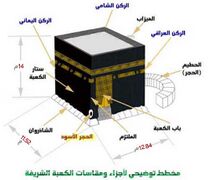 The position of Shadharwan among other parts and belongings of the Ka'ba.
 -
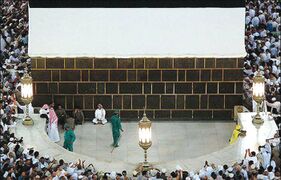 The Hijr Isma'il side, which does not have a Shadharwan and a platform has been placed instead.
 -
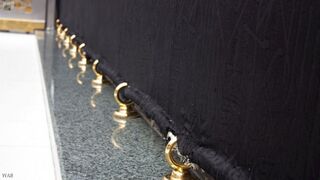 The side platform of Hijr Ismail and the golden rings that replaced the silver rings in 2016.
 -
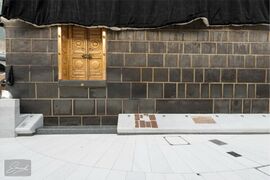 Under the door of the Ka'ba, there is no Shadharwan , and a staircase has been built instead.
 -
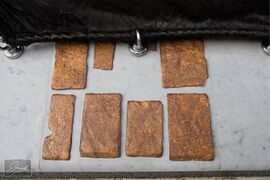 Eight pieces of marble that are on the stone next to the door of the Ka'ba.
 -
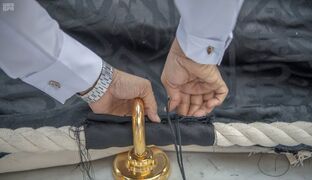 Closing the Ka'ba curtain to the rings embedded in Shadharwan .


Notes
- ↑ Dihkhudā, Lughatnāma-yi Dihkhudā, under the word شاذروان.
- ↑ Ṣabrī Pāshā, Mawsūʿa mirʾāt al-ḥaramayn, p. 67.
- ↑ Kurdī, Al-Tārīkh al-qawīm li Makka wa bayt Allāh al-karīm, vol. 3, p. 288.
- ↑ Kurdī, Al-Tārīkh al-qawīm li Makka wa bayt Allāh al-karīm,vol. 3, p. 289.
- ↑ Ṣabrī Pāshā, Mawsūʿa mirʾāt al-ḥaramayn, vol. 1, p. 263.
- ↑ Ḥusaynī kāshānī, Mufarraḥt al-anām fī taʾsīs bayt allah al-ḥrām, p. 24.
- ↑ Kurdī, Al-Tārīkh al-qawīm li Makka wa bayt Allāh al-karīm,vol. 3, p. 289.
- ↑ Kurdī, Al-Tārīkh al-qawīm li Makka wa bayt Allāh al-karīm,vol. 3, p. 289.
- ↑ Kurdī, Al-Tārīkh al-qawīm li Makka wa bayt Allāh al-karīm,vol. 3, p. 295.
- ↑ Ḥamū, Muʿarifī amākin makka mukarrama, p. 47.
- ↑ Kurdī, Al-Tārīkh al-qawīm li Makka wa bayt Allāh al-karīm,vol. 3, p. 295.
- ↑ Kurdī, Al-Tārīkh al-qawīm li Makka wa bayt Allāh al-karīm,vol. 3, p. 295.
- ↑ Kurdī, Al-Tārīkh al-qawīm li Makka wa bayt Allāh al-karīm,vol. 3, p. 295.
- ↑ Kurdī, Al-Tārīkh al-qawīm li Makka wa bayt Allāh al-karīm,vol. 3, p. 295.
- ↑ Kurdī, Al-Tārīkh al-qawīm li Makka wa bayt Allāh al-karīm,vol. 3, p. 295.
- ↑ Kurdī, Al-Tārīkh al-qawīm li Makka wa bayt Allāh al-karīm,vol. 3, p. 296.
- ↑ Kurdī, Al-Tārīkh al-qawīm li Makka wa bayt Allāh al-karīm,vol. 3, p. 295.
- ↑ Kurdī, Al-Tārīkh al-qawīm li Makka wa bayt Allāh al-karīm,vol. 3, p. 17.
- ↑ Kurdī, Al-Tārīkh al-qawīm li Makka wa bayt Allāh al-karīm,vol. 3, p. 17.
- ↑ Kurdī, Al-Tārīkh al-qawīm li Makka wa bayt Allāh al-karīm,vol. 3, p. 17.
- ↑ Kurdī, Al-Tārīkh al-qawīm li Makka wa bayt Allāh al-karīm,vol. 3, p. 17.
- ↑ Kurdī, Al-Tārīkh al-qawīm li Makka wa bayt Allāh al-karīm,vol. 3, p. 297.
- ↑ Kurdī, Al-Tārīkh al-qawīm li Makka wa bayt Allāh al-karīm,vol. 3, p. 297.
- ↑ «Installing gold rings on the Shadharwan of the Ka'ba»
- ↑ Kurdī, Al-Tārīkh al-qawīm li Makka wa bayt Allāh al-karīm,vol. 3, p. 297.
- ↑ «Shadherwan of the Ka'ba and the wall of Hatim in a new look»
- ↑ Mūsawī Shāhrūdī, Jāmiʿal-fatāwā, p. 116.
- ↑ Mūsawī Shāhrūdī, Jāmiʿal-fatāwā, p. 116.
- ↑ Ḥamū, Muʿarifī amākin makka mukarrama, p. 46.
- ↑ Mūsawī Shāhrūdī, Jāmiʿal-fatāwā, p. 116.
- ↑ Fāsī al-Makkī, Shifāʾ al-gharām bi akhbār al-balad al-ḥarām,vol. 2, p. 188.
References
- Dihkhudā, ʿAlī Akbar. Lughatnāma-yi Dihkhudā. Tehran: Intishārāt-i Dānishgāh-i Tehrān, 1377 Sh.
- Fāsī al-Makkī, Muḥammad b. Aḥmad. Shifāʾ al-gharām bi akhbār al-balad al-ḥarām. Cairo: Al-Thiqāfat al-Dīniyya, 2008.
- Ḥamū, Maḥmūd Muḥammad. Muʿarifī amākin makka mukarrama. Translated by Murtaḍā Ḥusaynī fāḍilī, Tehran: Nashr-i Mashʿar, 1391 sh.
- Ḥusaynī kāshānī, Zayn al-ʿĀbidīn. Mufarraḥt al-anām fī taʾsīs bayt allah al-ḥrām. Tehran: Mashʿar, 1386 sh.
- Kurdī, Muḥammad Ṭāhir. Al-Tārīkh al-qawīm li Makka wa bayt Allāh al-karīm. Beirut: : Dār al- Khiḍr, 1420 AH.
- Mūsawī Shāhrūdī, Sayyid Murtaḍā. Jāmiʿal-fatāwā; manāsik Ḥajj. Tehran: Nashr-i Mashʿar, 1428 AH.
- Qāʾidān, Aṣghar. Tārīkh wa āthār-i Islāmī-yi Makka wa Madīna. 4th edition. Qom: Nashr-i Mashʿar, 1381 Sh.
- Ṣabrī Pāshā, Ayyūb. Mawsūʿa mirʾāt al-ḥaramayn. Cairo: Shirkat al-Dawlīyya li-l-Ṭibāʿa, 2004.
- Shurrāb, Muḥammad b. Muḥammad Ḥasan. Al-Ma ʿālim al-athīra. Tehran: Mashʿar, 1383 sh.